Samsung Electronics released its Q3 financial report: profits hit a record high, and the good days for memory chips continue
 Core Viewpoint


 Samsung Electronics Q3 2026 financial report: Profits hit a record high driven by memory chips, but the terminal business is under pressure; total shareholder return for the year is expected to be between 67.08 billion and 82.00 billion USD.

Co-CEO of Samsung Electronics, Han Jong-hee and Lee Jae-young (left). Image generated by AI
Written by|Li Hailun
Edited by|Xu Qingyang
On October 29, local time in South Korea, Samsung Electronics officially released its financial report for the third quarter of 2026.
Driven by large-scale investments in artificial intelligence infrastructure and a continuous surge in demand for AI chips, the company's consolidated revenue for the quarter reached $145.52 billion (195.25 trillion Korean won), a quarter-on-quarter increase of 13.9% and a year-on-year increase of 126.9%.
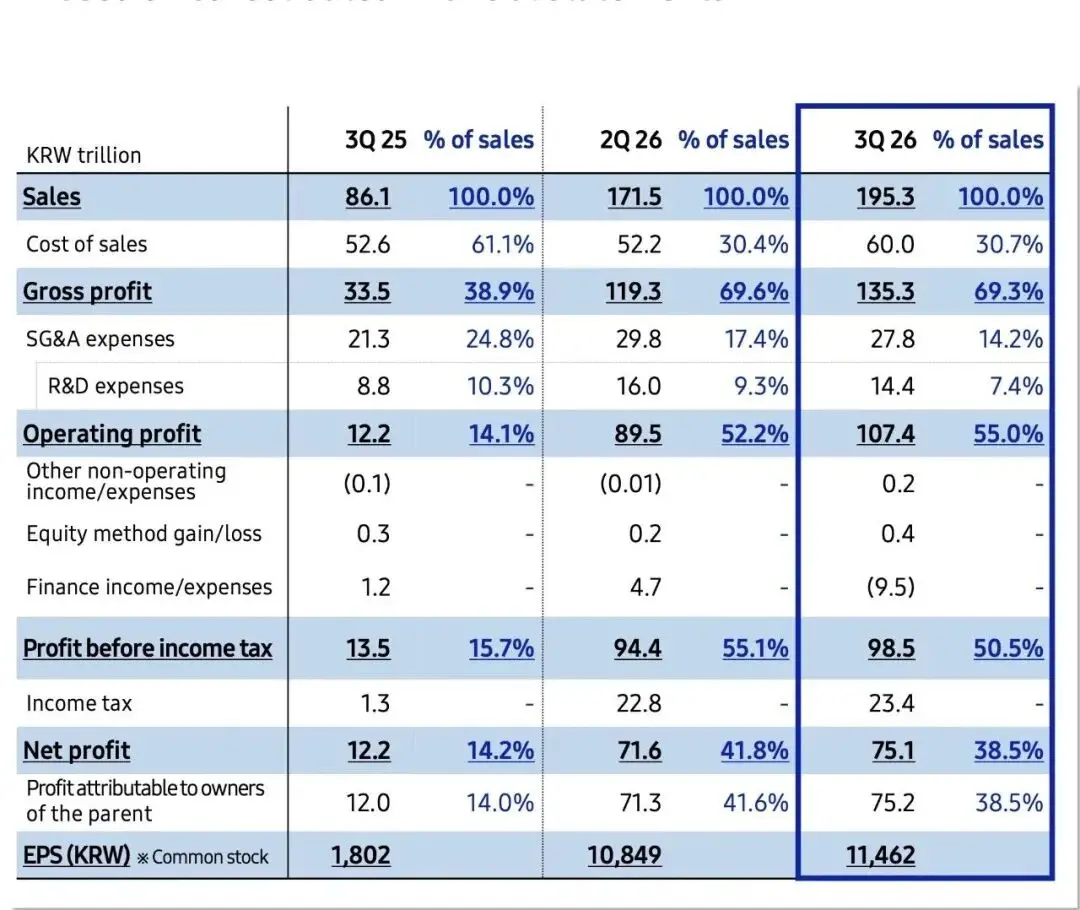
Operating profit reached $80.07 billion (107.44 trillion Korean won), a quarter-on-quarter increase of 20.1% and a year-on-year surge of 783.1%, achieving an operating profit margin of 55.0%, making it the first company in South Korea to surpass 100 trillion Korean won in operating profit in a single quarter.
Net profit reached $56.00 billion (75.14 trillion Korean won), a year-on-year increase of 514.6%.
At the same time, the company's board approved a cash dividend of $22.36 billion (30 trillion Korean won) as part of its annual shareholder return plan of $67.08 billion to $82.00 billion (90 trillion to 110 trillion Korean won).
01 Supply of Storage Chips May Continue to Fall Short Until 2027
Samsung Electronics' significant profit growth in the third quarter was mainly attributed to the demand for storage chips driven by AI.
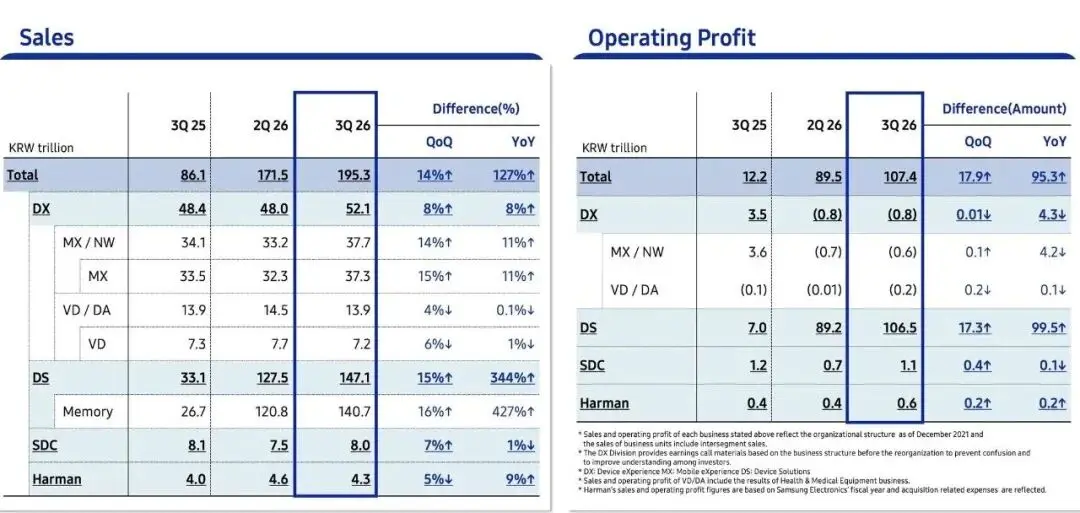
Revenue from the DS division reached $109.63 billion (147.1 trillion Korean won), a substantial increase compared to $24.67 billion (33.1 trillion Korean won) in the third quarter of 2025 and $95.03 billion (127.5 trillion Korean won) in the second quarter. Operating profit reached $79.37 billion (106.5 trillion Korean won), far exceeding $5.22 billion (7.0 trillion Korean won) in the third quarter of 2025 and $66.50 billion (89.2 trillion Korean won) in the second quarter.
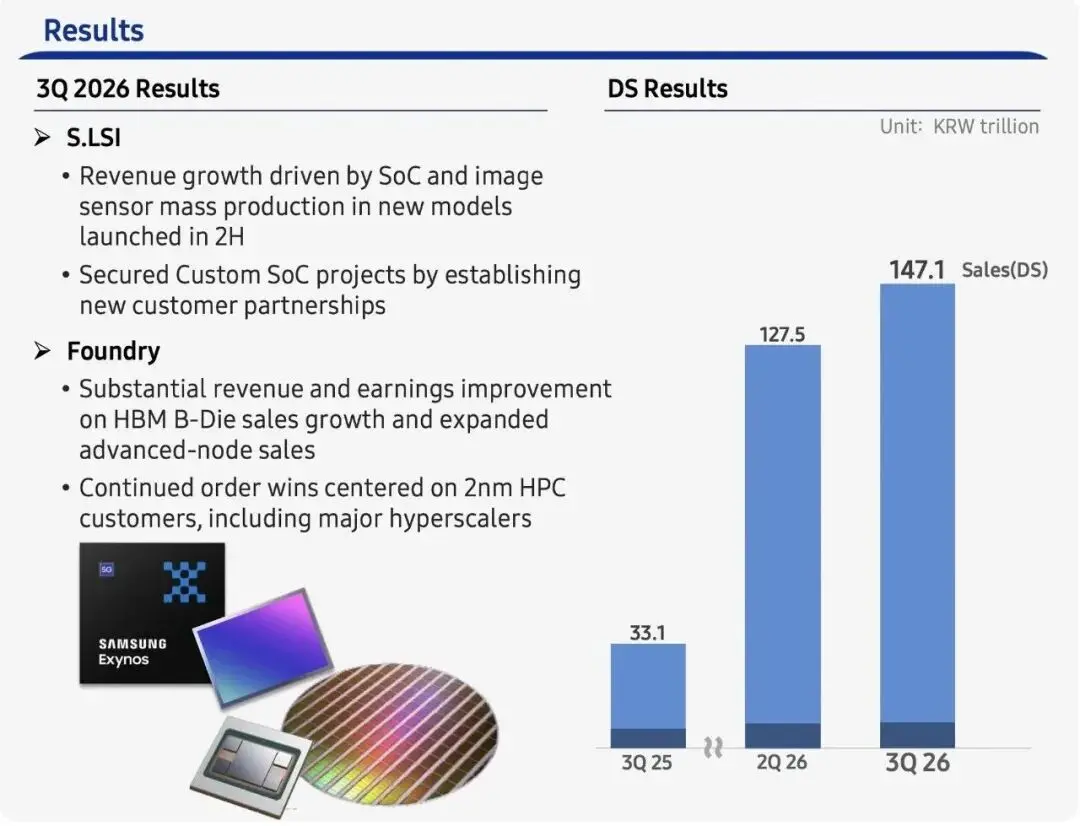
Among them, revenue from the storage business was $104.90 billion (140.7 trillion Korean won), significantly increasing from $19.90 billion (26.7 trillion Korean won) in the third quarter of 2025 and $90.03 billion (120.8 trillion Korean won) in the second quarter.
Faced with limited production capacity, the company prioritized the supply of AI-related products and improved profitability by adjusting its product structure. With the growth in server demand, storage chip prices generally increased. Samsung Electronics expanded sales of its high-bandwidth memory (HBM) products, and demand for server solid-state drives (SSD) continued to rise. Among them, HBM4 further expanded sales due to its product competitiveness, driving revenue growth in the storage business.
Samsung Electronics expects that AI infrastructure investment in the fourth quarter will continue to support memory demand, with new generation CPU and GPU platforms driving sales of related memory products. The development of personal AI agent services is also expected to boost demand for QLC SSDs. The company plans to continue expanding sales of HBM, server DRAM, and SSDs, and increase the supply of high-speed server DDR5 and QLC SSDs.
Regarding market trends in 2027, Samsung Electronics believes that as the AI ecosystem continues to expand, related infrastructure investments are expected to reach historical highs, and the chip demand brought by AI may continue to exceed the overall supply capacity of the industry, with supply-demand tensions potentially even higher than in 2026.
To address this trend, Samsung plans to leverage its technological advantages, further optimize its product portfolio, and stabilize sales through long-term contracts. At the same time, the company will accelerate new product development to ensure that products can meet the demands of AI applications in a timely manner.
02 Improvements in Advanced Process Business
In addition to the storage business, Samsung Electronics' system LSI and foundry businesses also showed improvement. The system LSI business saw revenue growth in the third quarter, mainly driven by the mass production of SoCs and image sensors due to new product launches in the second half of the year. The company also gained customized SoC projects through expanded customer collaborations.
In the fourth quarter, Samsung Electronics plans to maintain stable production and sales of flagship SoCs and 200-megapixel image sensors. In 2027, the company will continue to expand sales of flagship SoCs and promote high-resolution image sensors into non-mobile device fields. The foundry business benefited from increased sales of HBM bare chips and the expansion of advanced process businesses, with both revenue and profits improving.
Samsung Electronics stated that it has received multiple orders related to 2-nanometer high-performance computing (HPC), including orders from major cloud service providers. The company expects that revenue from the foundry business in the fourth quarter will achieve double-digit growth, and profitability will continue to improve, mainly driven by new mobile products, mass production of 4-nanometer NPUs, and increased sales of storage-related products.
Looking ahead to 2027, 4-nanometer and 2-nanometer advanced processes will become important drivers of growth for the foundry business. As demand for AI and HPC continues to grow, Samsung also plans to advance the production of its new factory in Taylor, Texas, to expand advanced process capacity.
03 Mobile Business Still Faces Pressure
While the semiconductor business performed strongly, Samsung Electronics' terminal business still faced cost pressures.
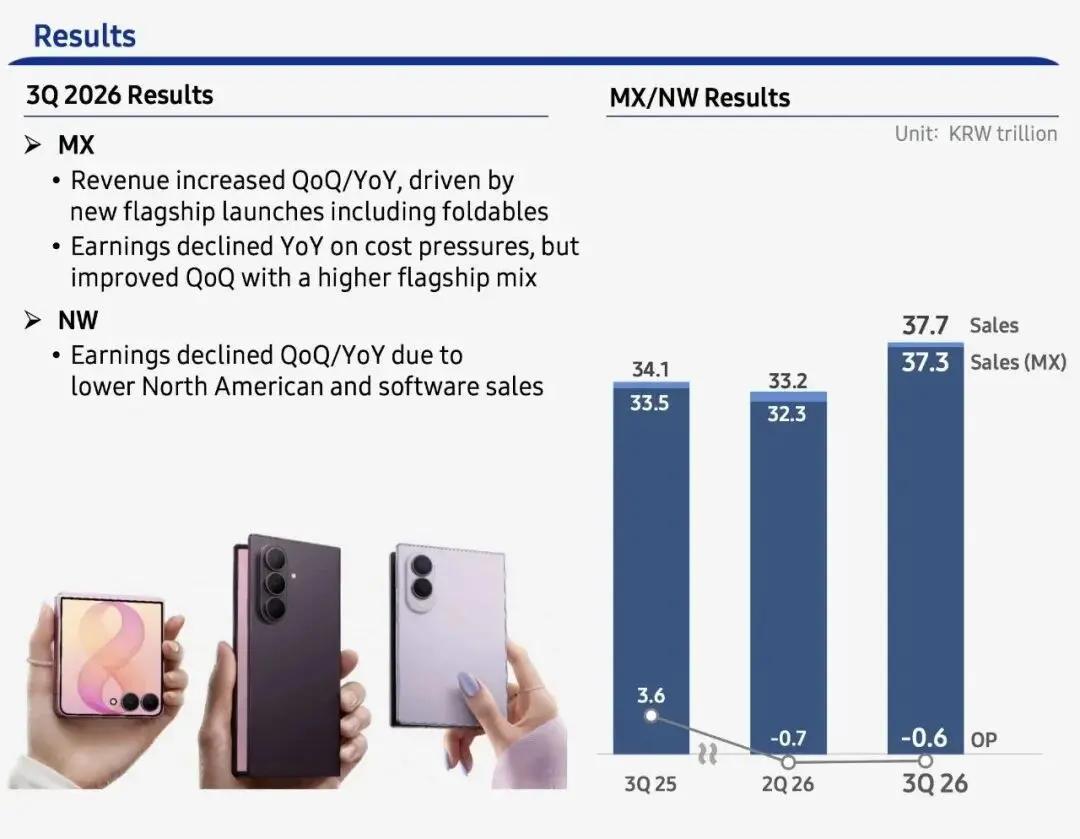
In the third quarter, revenue from the MX and network businesses reached $28.10 billion (37.7 trillion Korean won), compared to $25.41 billion (34.1 trillion Korean won) in the third quarter of 2025 and $24.74 billion (33.2 trillion Korean won) in the second quarter of this year; operating loss was $450 million (0.6 trillion Korean won), compared to an operating profit of $2.68 billion (3.6 trillion Korean won) in the third quarter of 2025 and an operating loss of $520 million (0.7 trillion Korean won) in the second quarter of this year.
The launch of new flagship products such as foldable smartphones drove revenue growth both quarter-on-quarter and year-on-year. As the sales proportion of flagship models increased, business profitability improved compared to the previous quarter, but year-on-year performance was still affected by rising costs.
In the fourth quarter, Samsung plans to leverage the year-end sales peak to focus on promoting high-end products such as the Galaxy S26 series, Galaxy Z Fold8 Ultra, and Galaxy Z Fold8, while controlling costs through improved operational efficiency.
In the network business, affected by declining sales in the North American market and high-profit software business, profitability in the third quarter decreased both quarter-on-quarter and year-on-year. In the fourth quarter, the company will strive to expand revenue in the North American, Korean, and Japanese markets. In 2027, with the slowdown in investment growth in the telecommunications industry, Samsung plans to drive business growth by securing new orders.
04 Television and Home Appliances Still Weighed Down by Costs
Samsung Electronics' display business revenue in the third quarter was $5.96 billion (8.0 trillion Korean won), slightly changing from $6.04 billion (8.1 trillion Korean won) in the third quarter of 2025 and $5.59 billion (7.5 trillion Korean won) in the second quarter, with operating profit of $820 million (1.1 trillion Korean won), higher than $520 million (0.7 trillion Korean won) in the second quarter and close to $890 million (1.2 trillion Korean won) in the third quarter of 2025.
The small and medium-sized display business was supported by demand for high-end mobile products, improving profitability; the large-sized display business was driven by growth in the gaming monitor market, with both sales and revenue increasing.
Samsung Electronics expects that the year-end consumer peak season and new product launches in the fourth quarter will provide some support for the display business, but external factors may still limit profit improvement.
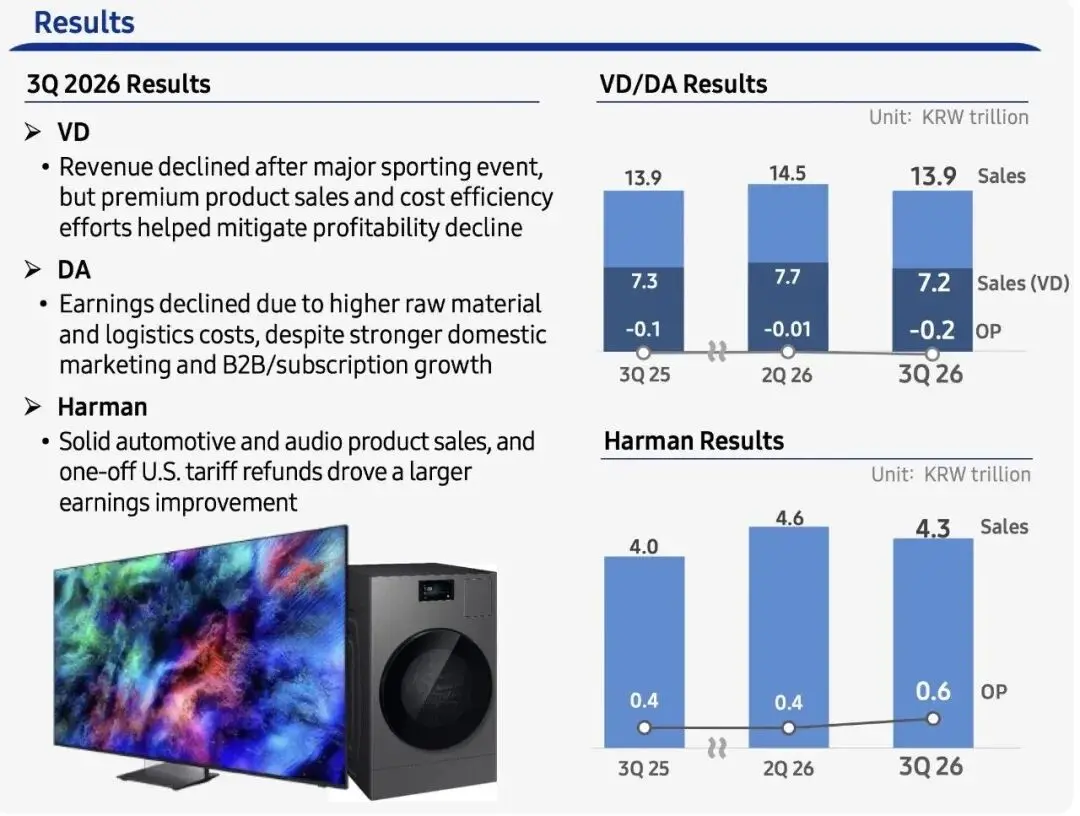
The performance of the television and home appliance business was relatively weak. The combined revenue of the visual display (VD) and digital appliances (DA) business in the third quarter was $10.36 billion (13.9 trillion Korean won), flat compared to the third quarter of 2025 and lower than $10.81 billion (14.5 trillion Korean won) in the second quarter; operating loss was $150 million (0.2 trillion Korean won), with the loss widening compared to $70 million (0.1 trillion Korean won) in the third quarter of 2025 and $7 million (0.01 trillion Korean won) in the second quarter.
The television business was affected by a decline in demand following major sporting events, leading to a drop in revenue, while rising costs further squeezed profits. The home appliance business, although benefiting from increased marketing efforts in South Korea and growth in B2B and subscription services, still faced pressure on profitability from rising raw material and logistics costs.
The Harman business reported revenue of $3.21 billion (4.3 trillion Korean won) in the third quarter, an increase from $2.98 billion (4.0 trillion Korean won) in the third quarter of 2025, but lower than $3.43 billion (4.6 trillion Korean won) in the second quarter; operating profit was $450 million (0.6 trillion Korean won), higher than approximately $300 million (0.4 trillion Korean won) in the previous two quarters.
This business benefited from increased sales of audio and automotive products, as well as a one-time gain from U.S. tariff refunds, leading to improved profitability. Samsung plans to continue expanding its automotive business and solidify its market position by upgrading its audio product portfolio.
05 Capital Expenditures Continue to Increase
In response to market demand brought by AI infrastructure construction, Samsung Electronics continues to increase capital expenditures to expand capacity and meet medium- to long-term business development needs. The company's semiconductor investments will mainly be used for new wafer fabs and related infrastructure to address the growth in AI and HPC demand; investments in the display business will be used for upgrading existing production lines.
In the third quarter, the company's capital expenditures reached $21.61 billion (29 trillion Korean won), an increase of $9.09 billion (12.2 trillion Korean won) quarter-on-quarter and an increase of $14.76 billion (19.8 trillion Korean won) year-on-year. Among them, capital expenditures for the DS division were $20.27 billion (27.2 trillion Korean won), and for the display business, $820 million (1.1 trillion Korean won).
In the first three quarters, Samsung Electronics' cumulative capital expenditures reached $42.41 billion (56.9 trillion Korean won), an increase of $18.41 billion (24.7 trillion Korean won) year-on-year. Among them, DS division expenditures were $39.35 billion (52.8 trillion Korean won), and display business expenditures were $1.79 billion (2.4 trillion Korean won).
Samsung Electronics expects that total capital expenditures for 2026 will reach $62.90 billion (84.4 trillion Korean won), of which approximately $57.24 billion (76.8 trillion Korean won) will be for the DS division and approximately $2.91 billion (3.9 trillion Korean won) for the display business.
In terms of shareholder returns, Samsung Electronics paid a cash dividend of $3.43 per share (4601 Korean won) to both common and preferred shareholders in the third quarter, with a total cash dividend amounting to $22.36 billion (30 trillion Korean won).
The company expects that the total shareholder return for the entire year of 2026 will be between $67.08 billion and $82.00 billion (90 trillion to 110 trillion Korean Won). Among these, the planned or completed returns amount to approximately $26.10 billion (35 trillion Korean Won), while the remaining approximately $41.00 billion to $55.90 billion (55 trillion to 75 trillion Korean Won) will mainly be realized through large-scale share buybacks and cancellations as well as cash dividends.
Samsung Electronics also stated that it will pay attention to the price difference between common stock and preferred stock, and adjust the proportion of preferred stock in the buyback based on market conditions. The specific arrangements for the next phase of the shareholder return policy, the final return amount, and the remaining funds will be determined and announced at the board meeting scheduled for late January 2027.
For Samsung Electronics, it is crucial to seize the demand for storage chips brought about by investments in AI infrastructure while also addressing the impact of high chip costs on terminal businesses. Whether AI demand can continue to grow and whether the mobile phone and home appliance businesses can gradually improve profits will be important points of interest for the company's subsequent performance.
 Risk warning Risk warning





Popular articles