Solana 2026: Research on Ecological and Market Strategies
 Core Viewpoint


 How Solana converts its technological advantages into ecosystem growth. Low fees and high speed lower the barriers to use, applications meet transaction demands, and community and marketing expand reach, forming a closed loop that attracts builders. With the layout of tokenized assets, payments, and AI, its long-term challenges lie in reliance on speculation, competition among major public chains, and how to better return ecosystem benefits to SOL holders.
As of October 24, 2026, Solana's on-chain transaction volume and application revenue rank first among all public chains, and it also leads in the x402 AI agent payment sector.
In almost all other metrics, Solana is also in the top three, including RWA value, number of holders, stablecoin supply, and total locked value (TVL).
The number of tokenized stock holders on Solana has reached 1.57 million, growing by 56.5% in the past month. The stablecoin supply peaked at $17.4 billion in late September, nearly five times that of two years ago; RWA value also reached a new high of $4.6 billion.
This report is compiled by Y Strategy, a market company focused on the future direction of the crypto market. We study Solana as a market entry system: where the demand comes from, how products reach users, what metrics Solana has taught the market to focus on, and why builders continuously choose to launch products here.
The core question we focus on is: how these elements reinforce each other, and which parts of Solana's practices can be practically referenced by other ecosystems. Throughout the report, we will distinguish its existing activities from interpretations of the strategies behind them.
On Solana, the cost of a transaction is far less than 1 cent, and the confirmation time is also well under 1 second. This combination makes Solana the main battlefield for on-chain transactions, with trading targets gradually expanding from meme coins and stablecoins to tokenized stocks. On October 24, Solana processed approximately 145 million non-voting transactions; on-chain, it holds about $15.8 billion in stablecoins, as well as some of the most well-known applications in the crypto space, including Phantom, Jupiter, Pump, and Raydium.
Data source: DefiLlama, RWA.xyz, Artemis, Solscan, and Blockworks, as of October 24, 2026.
Key Moments in the Past Few Years
2019 ------ Solana completed a $20 million financing round led by Multicoin Capital.
2020 ------ The mainnet beta launched. $SOL was priced at $0.22 in a public auction on CoinList, and for several months after the TGE, the trading price remained below $1.
2021 ------ Solana Labs completed approximately $314 million in financing, led by a16z and Polychain Capital. $SOL price reached $259.
2022 ------ The Wormhole cross-chain bridge was attacked, resulting in a loss of $320 million. FTX and Alameda collapsed and entered bankruptcy, dragging the coin price down to about $10 due to the large amounts of SOL they held.
2023 ------ A year of rebuilding. Solana continued to fund builders during the bear market and launched core upgrades.
2024 ------ Pump launched, marking the beginning of the meme coin era. Solana began to become the public chain with the largest on-chain transaction volume.
January 2025 ------ The $TRUMP meme coin was issued on Solana. SOL reached an all-time high of $293.
October 2025 ------ $BSOL was listed, becoming the first Solana spot ETF in the U.S.
2026 ------ March, the U.S. Securities and Exchange Commission (SEC) and the Commodity Futures Trading Commission (CFTC) jointly classified SOL as a digital commodity. BlackRock applied to issue tokenized fund shares on Solana, Western Union launched a dollar token on-chain, and wrapped XRP was officially launched.
Already familiar with Solana? You can skip directly to the second part.
Part One: Where Solana Stands Today
In the 30 days leading up to October 24, 2026, Solana's decentralized exchange (DEX) had an average daily trading volume of approximately $2.2 billion, with users paying about $14.4 million in fees daily for using Solana and its applications, of which network fees accounted for only about 6% (DefiLlama).
Solana Leads All Public Chains in Application Revenue
In terms of application revenue, which is the share of fees received by apps, Solana leads all public chains. In the past 30 days, its application revenue was approximately $158 million: 2.1 times that of Hyperliquid, 2.9 times that of Ethereum, 6.1 times that of BNB Chain, and 7.5 times that of Robinhood Chain (DefiLlama, data for the 30 days as of October 24, 2026). The low transaction fees on Solana mean that more value is reflected on the application side.
Architecture: How Solana Operates Today
Solana processes approximately 167 million non-voting transactions daily, equivalent to about 1,930 transactions per second (Solscan, data for the 30 days as of October 24, 2026). This scale of processing, combined with the fixed base fees set by the protocol, keeps transaction costs low.
Recent Upgrades:
Faster block times ------ Reduced from 0.4 seconds to 0.25 seconds, then to 0.2 seconds; a block time of 200 milliseconds was implemented on the mainnet on October 9, 2026.
Increased transaction capacity ------ The amount of data a single transaction can accommodate has expanded to 3.3 times the original (September 2026).
Firedancer ------ A new validator client developed by Jump (May 2026).
All these upgrades serve the market that Solana aims to support. Whether it's AI agents making payments far below 1 cent or tokenized assets requiring millisecond settlement, the blockchain must possess the capabilities of financial infrastructure, which is exactly Solana's goal.
Who Supports Solana
Solana has raised over $330 million in multiple disclosed financing rounds, with investors including a16z, Polychain, and Multicoin; this includes a $1.7 million public token sale on CoinList in March 2020.
Its institutional supporters are no longer limited to venture capital firms. SOL spot ETFs are currently trading in the U.S., including BSOL, GSOL, FSOL, VSOL, and TSOL; companies like Forward Industries and Upexi also hold SOL on their balance sheets.
Part Two: Where Activity is Concentrated
Solana's Ecological Landscape in 2026
Trading is the core of the Solana ecosystem, but the areas covered by this ecosystem go far beyond trading. Major categories include:
Token issuance platforms (Launchpads) ------ Pump, StonkFun
Decentralized exchanges (DEX) ------ Raydium, Meteora, PumpSwap, Orca
Aggregators and trading terminals ------ Jupiter, Axiom
Perpetual contracts ------ Phoenix, Jupiter Perps, GMTrade, Pacifica
Lending ------ Kamino, Jupiter Lend
Wallets ------ Phantom, Solflare, and wallets directly built into applications
Real-world assets (RWA) and tokenized stocks ------ xStocks, Backpack Securities, Ondo, PreStocks
Stablecoins / Payments / Digital Banking ------ USDC, USDT, PYUSD, Solana Pay, KAST, Avici
Others ------ Collectibles (Collector Crypt), decentralized physical infrastructure networks DePIN (Helium), staking (Jito, Sanctum)
The most popular project types are trading infrastructures, including launchpads, exchanges, and trading terminals. Ranked by revenue, the top five applications are Pump, Collector Crypt, Axiom, StonkFun, and fomo. Four of these are token trading applications, while Collector Crypt is a tokenized collectible trading market for TCG (DefiLlama, data for the past 30 days as of October 24, 2026).
The diversity of trading targets exceeds the impression of Solana being known for meme coins. In the third quarter of 2026, the SOL-stablecoin trading pair accounted for the highest proportion of DEX trading volume, at about 40%; meme coins accounted for about 30%; the remainder was made up of stablecoin exchanges, external tokens, project tokens, and tokenized assets. The scale of tokenized assets remains small, but their trading volume has set new highs for seven consecutive quarters, reaching $8.1 billion in the third quarter; in September alone, it reached $4.9 billion, about three times that of August, making it the highest trading volume month to date (Blockworks).
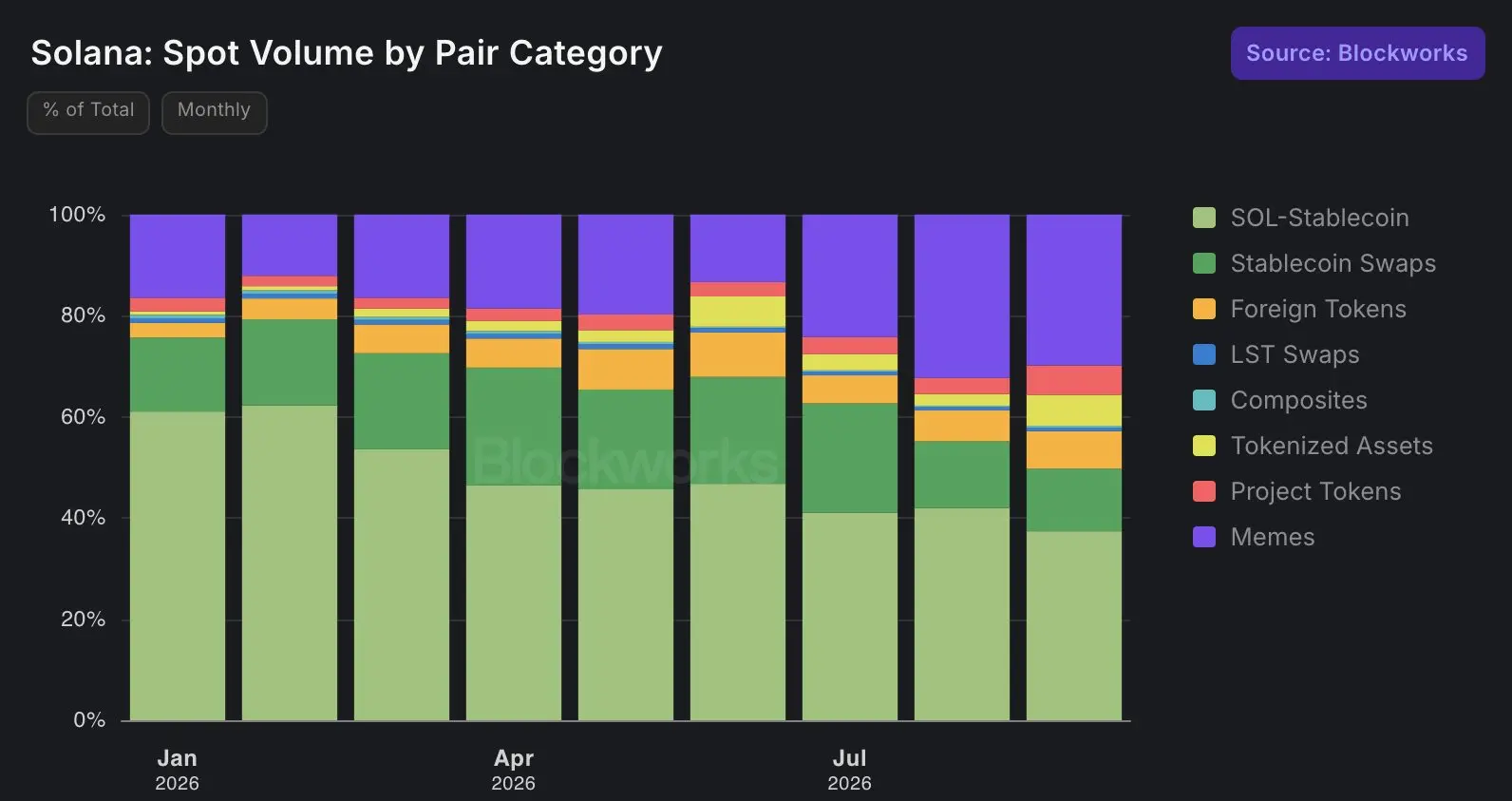
In the first nine months of 2026, Solana's spot trading volume categorized by trading pair type
Solana's Heavyweight Applications
All data in this section comes from DefiLlama, covering the past 30 days as of October 24, 2026.
- Pump ------ Achieves one-click token issuance through joint curves: no coding or liquidity configuration required, tokens are issued with an immediate trading market. Tokens that gain sufficient attention "graduate" from the issuance phase to Pump's own exchange.
In terms of revenue, Pump is the largest application on Solana: in the past 30 days, pump.fun and PumpSwap combined generated approximately $62 million in revenue, close to 40% of the total application revenue on the chain. Looking across all blockchains, it is also the third highest revenue-generating application, only behind stablecoin issuers Tether and Circle.
- Phantom------The most widely used Solana wallet, its onboarding process allows users outside the crypto space to truly get started. Built-in features include swapping, staking, perpetual contracts, prediction markets, and purchase buttons. It takes a small fee from swap transactions within the wallet and does not issue tokens.
Phantom's revenue exceeds that of any other wallet on any blockchain: in the past 30 days, it generated $7.1 million, about twice that of MetaMask's $3.6 million.
- Jupiter------The default trading entry on Solana, routing orders between various exchanges to obtain the best prices; it now also offers perpetual contracts, lending, and liquid staking.
In the past 30 days, the trading volume routed by Jupiter accounted for about 47% of Solana's aggregator trading volume and about 19% of the total chain's aggregator trading volume ($13.1 billion). This makes it the largest aggregator globally, operating solely on Solana.
- Raydium------After tokens graduate from the token issuance platform, they enter real liquidity pools on this exchange. Its LaunchLab product also supports other issuance platforms, including StonkFun.
In the past 30 days, Raydium processed $6.5 billion in trading volume and retained $3.7 million in revenue, as most of the fees flow to liquidity providers and token issuance platforms. About 60% of this revenue ($2.24 million) is used to buy back RAY.
Together, these four applications cover the mainstream path from project discovery to liquidity formation. Phantom serves as the entry point, Pump is responsible for creating and trading new tokens, Jupiter handles order routing, and Raydium converts attention into tradable liquidity pools.
From registration to the first trade, less than a minute
In the past, going on-chain meant first registering an exchange account, completing identity verification (KYC), creating a separate wallet, saving a mnemonic phrase, and then transferring funds. Now, new users can log in with social accounts, pay with Apple Pay within applications like Moonshot, or directly top up in Phantom using Phantom Cash, starting trading in less than a minute. The wallet is automatically created in the background during registration, eliminating the need for separate setup.
Tokenization and more: Solana's direction in 2026
In the field of tokenized stocks, Solana has been a major trading venue. Until mid-2026, it handled the vast majority of on-chain spot trading volume. After that, competition in this area became fiercer: Robinhood Chain and BNB Chain both launched stock trading venues this year, and trading volume has now spread across multiple chains. Solana still has one of the largest holder communities, with 1.57 million tokenized stock holders, second only to BNB Chain (Blockworks, October 2026).
Major protocols include Backpack Securities using the Sunrise protocol, as well as Ondo Global Markets, PreStocks, and xStocks.
Part of the reason lies in economics. Solana's low fees make small holdings, frequent trading, and retail holding feasible, allowing people to trade tokenized stocks around the clock, just like trading crypto assets.
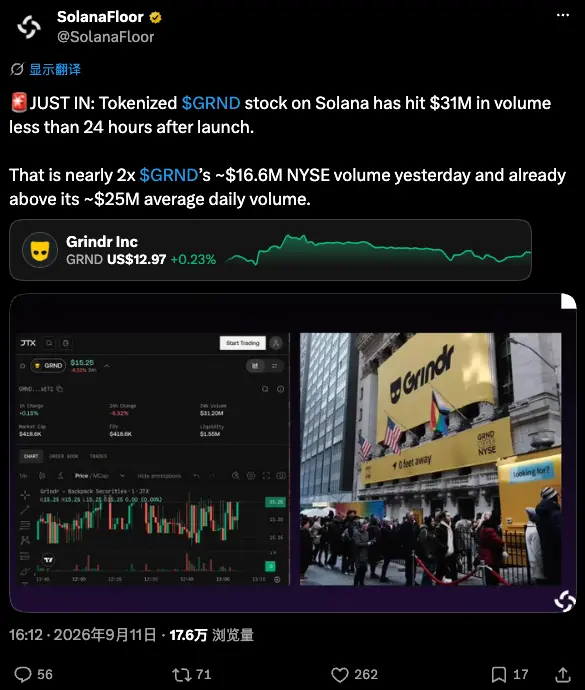
One evidence is that the tokenized $GRND (Grindr) generated $31 million in trading volume within 24 hours of its launch on Solana on September 10. The day before, Grindr's trading volume on the New York Stock Exchange was about $16.6 million, with an average daily trading volume close to $25 million.
Why StonkFun can break through
StonkFun best embodies Solana in 2026 because it combines the two most important aspects of this chain: token issuance and tokenized stocks.
It is a token issuance platform where new tokens can choose any asset specified by the creator as the pricing asset, including tokenized stocks and ETFs, rather than being limited to SOL or USDC. Its own token $STONK was issued using SPYx------a tokenized S&P 500 product------as the pricing asset. In just two months, StonkFun became the second-highest revenue-generating token issuance platform across the chain, second only to Pump, with revenue reaching $16.7 million in the past 30 days (DefiLlama, as of October 19, 2026).
In September, it had nine days of revenue exceeding both Pump's issuance platform and Pons on Robinhood Chain, peaking at $2.3 million on the 11th. For the entire month, Pump still led (DefiLlama).
We studied why it was able to spread rapidly (data from StonkFun, as of October 21, 2026):
A difference that can be explained in one sentence------issuing a meme coin priced in S&P 500.
A verifiable positive flywheel------platform revenue is used to buy back and burn $STONK, with revenue, buyback, and burn data available on a public dashboard. Cumulative revenue is $35.5 million, with about 60% used for buybacks: $21.2 million has been bought back, and the burned $STONK is valued at $26.4 million at current prices.
Built-in reward mechanisms------each token can distribute earnings to its holders in its pricing asset through transfer taxes or liquidity pool fees. Nearly $90 million has been distributed so far, with reward funds coming from the transfer taxes or liquidity pool fees of each token itself, rather than StonkFun's revenue.
Ecological integration and support------In early September, after StonkFun integrated and launched on Raydium's LaunchLab, $STONK rose about 250%, reaching a market cap of $140 million; Solana also publicly supported StonkFun by replying to its posts.
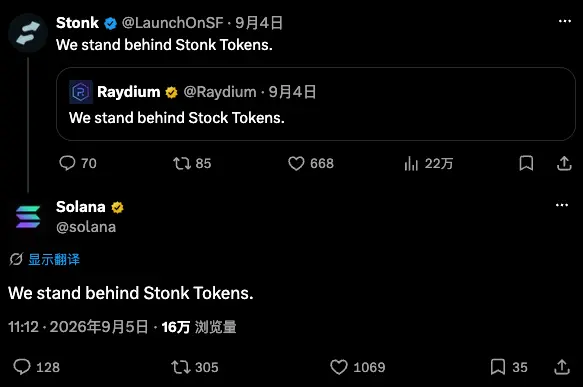
StonkFun combines simple and understandable product differences, transparent and verifiable revenue, tokens linked to revenue, and distribution channels from a broader ecosystem.
Part Three: Where Solana is headed
Token Supercycle
Meme coins have brought a large number of retail investors, trading activity, and network adoption to Solana, and they still do. What has changed is everything surrounding the entire system. Solana refers to it as the "Internet Capital Market": from stocks and funds to dollars and agent payments, anything can be issued and traded on-chain, operating around the clock without limits on transaction size.
In 2026, Solana further moves towards a "token supercycle": stablecoins, tokenized assets, payments, and AI-driven activities are migrating to the chain, while AI is accelerating the demand for capital, collaboration, and real-time settlement.
Solana's core judgment is that compared to the scale of global assets, the RWA market remains insignificant, thus offering enormous growth potential. The foundation is also investing resources accordingly, hiring talent in stablecoins, AI, and institutional business, and allowing flagship events like Breakpoint in London to revolve around this narrative.
Wall Street's Entry
Tokenized funds and credit------Industry giants have launched related products: BlackRock's BUIDL, Franklin Templeton's BENJI, and JPMorgan's $50 million commercial paper issued and settled on Solana. Additionally, through a new partnership with Allfunds, one of the world's largest fund distribution platforms, funds issued on Solana will reach over 3,300 institutions in the Allfunds network starting in Q4 2026.
More stocks, faster launches------Covering Pre-IPO companies, supporting round-the-clock minting and redemption, and able to launch corresponding assets on the same day stocks go public on Nasdaq.
Payments------Visa is settling USDC with banks in the U.S. on Solana; Western Union has launched its own dollar token on Solana; Solana Pay is piloting with over 330,000 merchants in South Korea; Samsung Wallet is also adding the ability to transfer USDC via Solana, targeting up to 82 million Galaxy devices in the U.S.
Institutional participation------Including spot ETFs and DAT companies. It also includes connecting the custody and token issuance of traditional assets through Securitize, Ondo, and xStocks, providing channels for institutional participation. In March 2026, the U.S. Securities and Exchange Commission (SEC) and the Commodity Futures Trading Commission (CFTC) jointly classified SOL as a digital commodity.
Solana's RWA ecosystem reached a peak value of $4.6 billion in late September, dropping to $4.38 billion on October 20 (RWA.xyz).
Speed alone cannot satisfy institutional issuers. They also need control capabilities, settlement certainty, and compatibility with custodians. Solana DvP launched in October, with JPMorgan participating and providing input. It offers institutions a reusable standard for securities settlement, eliminating the need to write separate settlement contracts for each transaction.
AI and Agent Payments
Solana is betting on becoming a venue for AI agents to make payments, primarily relying on x402. This open standard allows software to pay directly for APIs in ordinary web requests.
Agent payments------The foundation, in collaboration with Google Cloud, developed pay.sh, using the open x402 and MPP standards, supporting various mainstream stablecoins, with single-call amounts as low as $0.001. The foundation also operates a dedicated @x402 account to promote the application of this standard on Solana.
Payment channels------Now integrated with Alibaba Cloud's inference API, built specifically for micro-payments conducted at machine speed.
Setting Industry Standards ------ The Solana Foundation has become a Premier member of the Linux Foundation x402 working group alongside Visa, Stripe, Mastercard, Coinbase, and Google.
Agent Identity and Wallet ------ Providing agents with on-chain identities and wallets that can spend within preset limits.
According to Solana's report, it processed 76% of all x402 transactions in the four weeks ending in late September 2026.
Solana plays a settlement role in AI. Models run elsewhere, while agents facilitate small payments for APIs, data, computing power, and services to settle on Solana at machine speed.
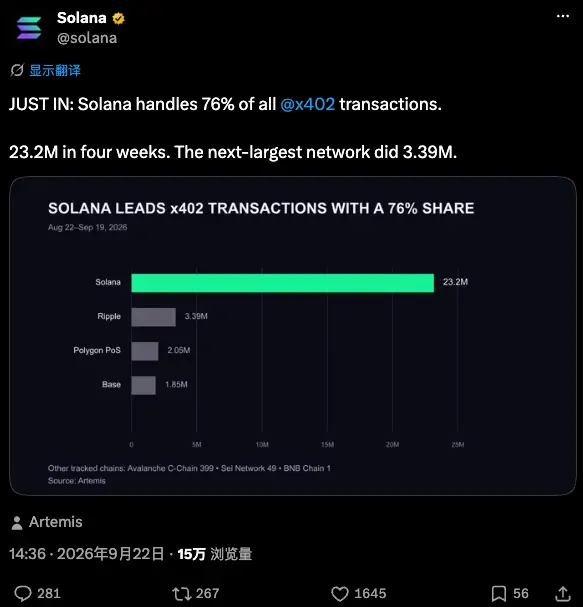
The foundation believes that in the coming years, agents may account for the majority of on-chain activities. If this judgment proves true, the chain with the lowest settlement costs and the fastest speeds will be best positioned to handle these activities.
Transactions, Perpetual Contracts, and Prediction Markets
These markets already have established players on Solana and other chains, but new products continue to emerge, and Solana is vying for market share in every area.
The leading prediction market on Solana, @world_xyz, accumulated over 1 million prospective users before its website launched. Its marketing is both clever and has a rare sense of authenticity.
Before its launch, World never clarified what it actually was, instead leveraging curiosity to attract users. As a new project on Solana, it naturally garnered attention. The first tweet on June 23 simply asked what World was, garnering 3.6 million views. In the following week, the team continued to release short, witty, and meme-filled content, keeping everyone guessing. Whenever a major creator showed interest, it would post; whenever someone discussed it, it would retweet; almost every creator, project, and news account received a reply, prompting everyone to search for clues and answers.
On July 1, World revealed its identity: a prediction market built into Phantom on Solana. Thus, the announcement reached Phantom's large existing user base from day one. Integration with Chainlink and Hyperliquid further enhanced its credibility. With the combined push of its own social channels, community spread, partnerships, and product integrations, the excitement continued until the website launched in early September.
In the realm of perpetual contracts, protocols like @PhoenixTrade are rapidly expanding their market share.
Solana's latest project is @joinfrontier ------ a community for traders that offers trading activities, prize pools, leaderboards, VIP programs, and exclusive gatherings.
The Underlying Upgrades Supporting All This
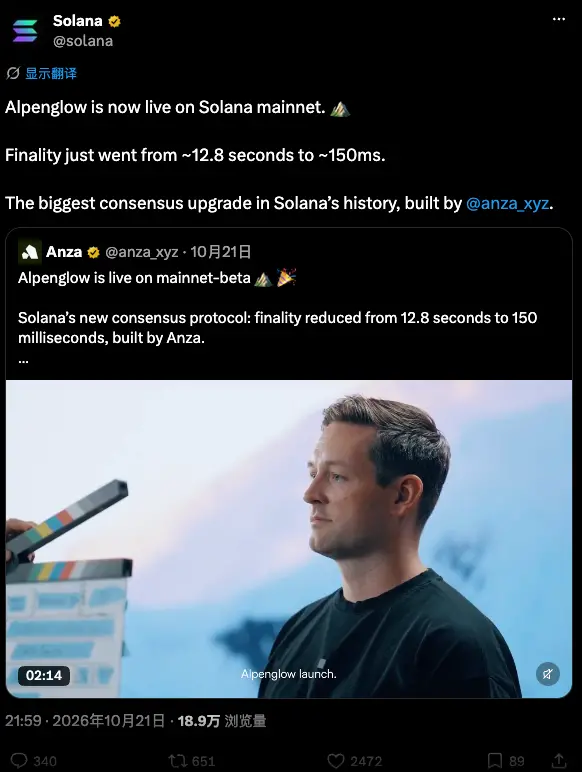
Alpenglow is the largest consensus upgrade since Solana's launch, which went live on the mainnet on October 21, 2026. It reduced the target final confirmation time for transactions from about 12.8 seconds to approximately 150 milliseconds, directly aiding Solana in creating the most desired market.
Tokenized stocks, professional traders, and AI agents all require settlement capabilities that match exchange speeds, making Alpenglow the foundation for all other developments.
How Solana Supports Builders
Solana funds builders through various channels: Solana Foundation Grants, which provide phased funding, including convertible grants; Superteam, which has local chapters worldwide offering small grants of up to $10,000 and paid bounty tasks through Superteam Earn; Colosseum, which hosts hackathons and provides seed funding for winners; and Hacker Houses located globally. When the foundation wants someone to develop a specific product, it publicly solicits proposals.
Solana's latest hackathon, Stocklana, focuses on developing innovative products around stocks on Solana, with a prize pool exceeding $125,000.
A Settlement Layer Serving All Markets
Looking ahead, Solana clearly focuses on trading, AI, payments, RWA, and institutional business, with prediction markets and perpetual contracts following closely behind. However, it seems to be competing for market share in every category simultaneously.
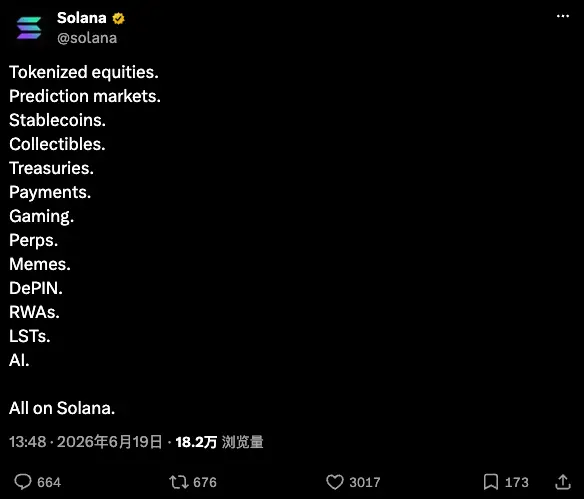
Trading remains the primary source of revenue. Tokenized assets and payments will extend the same settlement layer to institutions and consumers, while agent payments introduce machine-generated transactions. They all require low-cost, fast, and round-the-clock settlement, but each needs different market entry strategies. How Solana addresses these differences will determine its next phase.
Organizations are also adjusting accordingly. In September, the foundation appointed former Coin Security Ball Chief Marketing Officer Rachel Conlan as Chief Strategy Officer, responsible for institutional partnerships, ecosystem growth, and market entry strategies. Jamal Raees joined as General Manager of Payment Business. Distribution capabilities and enterprise adoption are gradually becoming central to Solana's strategy.
Part Four: How Solana Conducts Marketing
The Strategy Behind It
According to Y Strategy, Solana's primary marketing asset is its dissemination and reach system. Builders launch products, the ecosystem focuses attention on product releases, wallets and trading platforms convert that attention into transactions, and public data turns usage into evidence, which in turn attracts the next batch of builders.
A good application gives the network something concrete to promote. Distribution channels can help applications find users, while visible business progress provides the next founder with a reason to build here. When this process repeatedly proves effective, each successful launch can feed back into the ecosystem's attractiveness and support the next project.
This is the mechanism we observe in the following case studies. Its effectiveness depends on whether attention can be converted into sustained usage and whether the business can survive.
Solana also chooses its prominent data metrics. It has changed the way people measure a chain: from TVL to application revenue and transaction volume. TVL measures the funds deposited into applications, while revenue and transaction volume reflect how much those funds are actually used and how much users are paying for it.
Solana's application revenue and on-chain transaction volume have consistently outperformed all other chains; even without focusing on boosting TVL, it ranks third in that metric, on par with BNB Chain (DefiLlama, October 24, 2026).
Two Audiences, One Voice
Solana advances two sets of narratives simultaneously. Institutions hear "internet capital markets," a concept that has now expanded into "token supercycles," encompassing stablecoins, tokenized assets, payments, and AI. The community hears memes and trading battlefields. Solana speaks to both groups: its expression has both corporate institutional style and the temperament of speculative players, engaging with existing audiences while paving the way for new ones it hopes to attract. In its self-description, memes still rank alongside stocks and AI agents.
How Information Spreads
Solana's reach is built in layers. The main account conveys core information → associated accounts cover specific tracks, products, news, and regions → leading opinion leaders (teams, builders, and independent creators) relay new product launches to traders in real-time.
Its dissemination range is not limited to X; it also includes Instagram, YouTube, TikTok, and newsletters. Solana Media sets content directions for institutions, developers, payments, and the community, and produces its own podcasts.
Associated Accounts
The main account @solana is supported by 13 associated accounts, each with a specific focus. These include independent accounts aimed at the developer community, regional accounts like @Solana_zh, accounts responsible for AI payment work like @x402, and accounts covering the Solana perpetual contract space like @perps. One interesting account is @luminaries: this is a completely meme-centric account aimed at speculative players.
Leading Opinion Leaders
Solana's leading opinion leaders fall into three categories.
Team-led ------ Toly, Raj, and the core team continuously post, providing substantial dissemination coverage.
Builder Voices ------ Ecosystem founders and well-known figures like @mert, @armaniferrante, @SOLBigBrain, and @SolanaLegend.
Independent Solana Opinion Leaders ------ Accounts that primarily report on Solana and its staunch supporters, such as @SolanaSensei, @FabianoSolana, and @blknoiz06.
Ecosystem Marketing Support
Solana also invests its entire strength into ecosystem projects. When a release is significant enough, the main account publicly supports it, associated accounts bring it to their respective audiences, and leading opinion leaders amplify the dissemination.
Attention is just one part of it. Solana also brings real users and transaction volume to ecosystem applications. Its latest trading initiative, @joinfrontier, is currently collaborating with @PhoenixTrade and @solflare to conduct trading activities, bringing in real transaction volume. The entire track can receive the same support: when stocks become a focal point, it is set as the theme for the Stocklana hackathon.
This complete information dissemination path is the hardest part to replicate. Solana's marketing support shortens the distance between a usable product and potential users. A small team launching a product on Solana can receive sequential dissemination support from the main account, associated accounts, and leading opinion leaders within a day. In other places, achieving such coverage may require weeks of paid promotion and may never be realized. For founders choosing a launch platform, this gap is as important as cost or speed.
Anyone Can Become Solana's CMO
The foundation has left ample space for the community to shape its brand expression, and community language and activities are often amplified by official accounts.
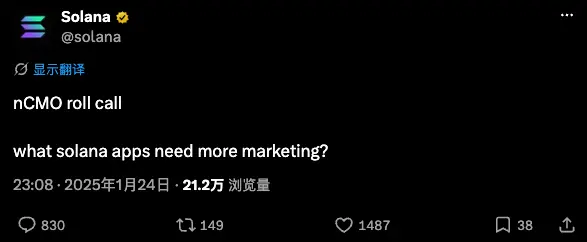
Solana places great importance on inviting the community to market for it. Anyone promoting Solana can call themselves Solana's nCMO and include this identity in their personal profile.
This mechanism works in reverse as well. When asked which Solana applications need more marketing, over 800 responses were received—equivalent to a continuously updated project list that informs the foundation where to direct its communication channels.
This approach is effective because the audience already holds $SOL or tokens based on applications built on Solana. The motivation already exists; Solana simply gave it a name and provided a direction for action. This also constitutes its limitation: if a company's audience does not hold any relevant assets, even conducting the exact same activities may yield little return.
Finally, content is produced by an internal team. Over the past two years, the foundation has established its own media operation system, creating and distributing content through its own channels.
Marketing through Product Launches
Solana continuously launches products, and each release creates its own news cycle: World for prediction markets, Frontier for traders, @tokens providing token data and pricing while offering APIs for developers, and pay.sh for agent payments.
Each release has its own marketing campaign, and a consistent and stable rhythm is more important than any single release. There are always new products or plans to discuss, so Solana rarely disappears from people's attention between announcements.
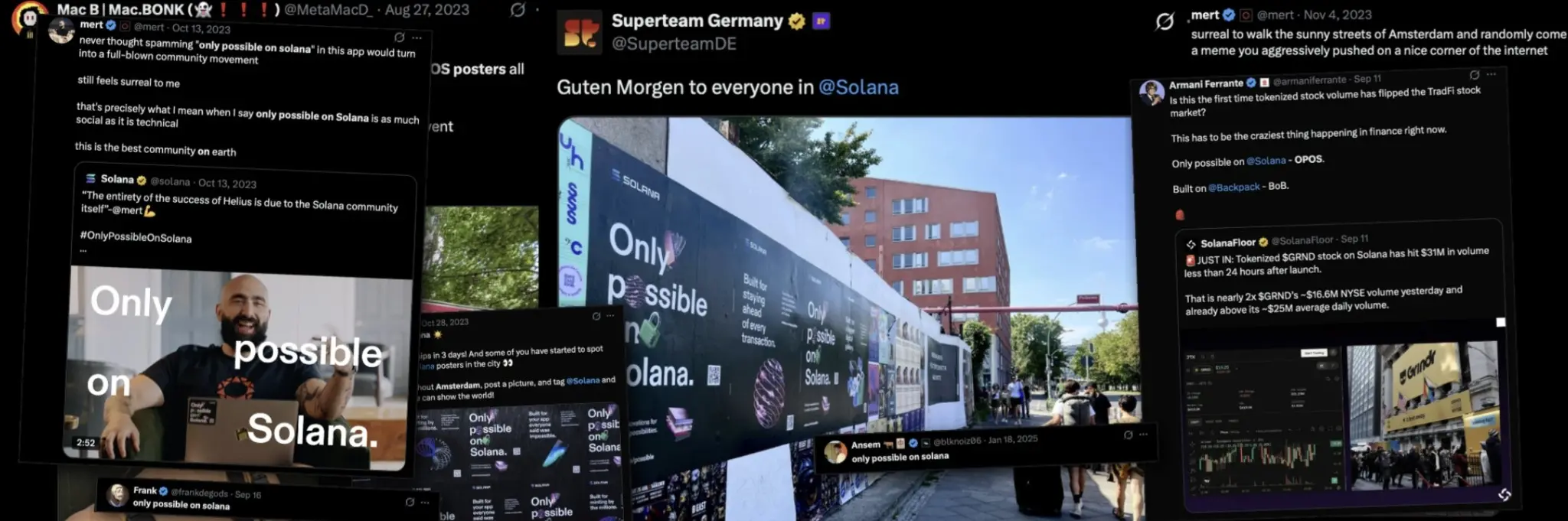
Only Possible on Solana
"Only possible on Solana" is one of the most impressive and widely used slogans on this chain today. It was originally proposed spontaneously by @mert and spread within the community, later being used by Solana's official channels for its own activities, including the title of the foundation's Breakpoint 2023 recap article.
This campaign also launched a landing page aimed at supporting developers and builders on Solana. The page showcases what this technology can achieve, such as high throughput and native scalability, and directly guides builders to resources and the community to help them start building.
Since this phrase originated from the community, it has persisted and is now integrated into the way people talk about this chain. Anyone can spontaneously use it to describe anything that can only happen here.
X Account Operation Strategy
Language Style. The Solana account writes like a member of the community and responds quickly to pop culture. Short posts that do not mention products often perform better than formal announcements; whenever there is a new trend in fashion or gaming, this account usually follows up the same day.
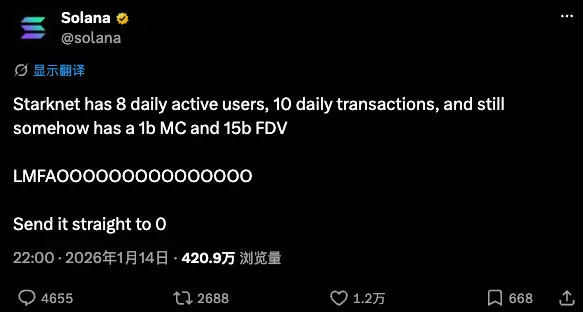
First, generate interest, then make announcements. Solana creates buzz before official news is released. For example, during the preheat of its collaboration with Starknet, it posted a message bluntly commenting on Starknet data, which sparked a discussion for an entire day, garnering 4.2 million views. The next day, the mystery was revealed: STRK would be launched on Solana.
Increase investment at critical moments. At truly important junctures, the production quality noticeably improves, and formal advertisements are released instead of just static images. When the U.S. spot SOL ETF made its debut, Solana released a well-produced advertisement that combined Wall Street imagery with crypto meme culture, achieving approximately 2 million views.
Unique activities. Solana frequently conducts such activities, such as auctioning ad space on its own avatar for charity. It sold nine ad spaces on its logo, raising $166,000 for flood relief in Nepal.
Quick actions also mean occasional missteps. In early 2025, a marketing video from the main account faced severe criticism and was deleted within hours; a few days later, Anatoly Yakovenko publicly apologized.
Superteam: Offline Grassroots Network
Superteam is the community layer of Solana and one of the largest initiatives in the crypto industry. It discovers, funds, and supports builders in the ecosystem, connecting creative talents, developers, operators, and ordinary Solana supporters.
It operates in most major countries, including talent matching, local workshops, funding, and the most interesting part—bounty tasks. Superteam Earn publishes paid tasks, design, and programming work, allowing anyone from anywhere to earn crypto assets and build an on-chain work resume. Most of the funding comes from companies and decentralized applications (dApps) operating on Solana.
Teams and contributors can also organize online or offline events with the support of local chapters; Superteam actively encourages members to organize these activities.
Superteam fills in a gap that cannot be completed online in this cycle. Social accounts can reach those already in the crypto industry but cannot help a developer in Lagos or Istanbul take the first step and complete their first paid task. Local chapters achieve this through workshops, local events, and bounty tasks: organized by locals in their native language. For markets where it is impossible for the core team to deploy personnel one by one, this is also the most cost-effective way to enter; the returns it brings include not only communication coverage but also loyalty—those who earn their first crypto assets through Superteam bounty tasks often continue to build on that chain.
Aligned with the foundation's direction, Superteam allows local operators to execute according to local conditions. A core team cannot staff every market, language environment, and builder community, but local chapters can. It is the combination of centralized coordination and local execution that allows Solana to be active in so many places simultaneously.
Part Five: What Other Teams Can Learn
Why Solana Succeeds
1. Solana Embraced the Trading Boom
From the beginning, Solana aimed for high speed and low fees, so when meme coin trading surged after the launch of Pump in 2024, this chain was able to accommodate the resulting demand. Solana's DEX trading volume rose from $54.5 billion in 2023 to $694.6 billion in 2024, approximately 13 times higher (DefiLlama). This is also part of the reason why $TRUMP chose to launch on Solana in January 2025, and Solana withstood the trading peak at that time.
The operation of the crypto market relies on both technology and attention, and Solana embraced the speculative attributes within it. After the influx of trading volume, Solana pushed its ecosystem applications to the forefront and shifted the metrics from TVL to its leading trading volume and application revenue.
2. One Chain, No Fragmentation
L2BEAT lists 95 layer two network projects on Ethereum, each with its own users, liquidity, and brand. On Solana, everything is on the same chain, so projects do not need to leave this chain or wait for exchanges to list tokens to launch, gain liquidity, reach traders, and earn revenue.
Tokens recognized by the market on Pump can directly "graduate" into trading pools, and financing support is also in place: in the first half of 2026, 2,857 teams submitted products to the Solana Frontier hackathon. The accelerator behind the event, Colosseum, subsequently selected 21 startups for investment from the hackathon award-winning teams and the ongoing Eternal sprint projects (Colosseum, June 29, 2026). Since each launch can simultaneously reach the entire ecosystem, this has become one of Solana's most underrated marketing advantages, making product building here exciting.
3. Everyone Has a Way to Make Money
Solana enables almost all participants to find ways to earn money. Most of the user spending is retained by applications: in the past 30 days, applications retained $158 million in revenue, while the chain itself retained only $3.3 million (DefiLlama, as of October 24, 2026). Phantom, Jupiter, and Pump have grown into well-known brands in this way, promoting themselves while also promoting Solana.
In addition to trading, community members can earn income through content creation, design, development, and more. To date, Superteam Earn has distributed over $16 million through 3,253 bounty tasks, short-term jobs, and funding, open to over 240,000 people (Superteam Earn). This has rewarded holders who endured the bear market; when so many people can earn from the ecosystem, many will naturally be willing to promote it.
4. Rebirth from the Ashes
After the collapse of FTX and Alameda, SOL fell below $10 in December 2022, accumulating a 94% decline that year (Decrypt). A few months later, as the SEC took action against exchanges, Robinhood delisted SOL from its app (The Block, June 2023). Nevertheless, Solana continued to fund developers, hold hackathons, and launch products during the bear market, with many betting on its comeback. It indeed did: in January 2025, SOL reached an all-time high of $293, about 30 times its low (CoinGecko). Those who held on were rewarded, and this recovery also turned many of them into Solana's loudest supporters.
5. Sense of Belonging Translates into Marketing Power
The crypto market is a social market where people seek belonging. Ethereum has built its identity around decentralization and research, while Solana has shaped its identity around speed, risk-taking, and continuous experimentation: the team continuously launches products, and the official account communicates with the community like family.
This sense of belonging makes the community itself a marketing force. Native creators on Solana report every product launch, members spontaneously create content, and anyone can call themselves nCMO, promoting and defending this chain. Offline, Superteam has branches in 25 regions; Breakpoint 2023 attracted over 3,000 people, including developers, traders, artists, and those interested in the crypto space. The combined efforts of so many groups allow Solana to reach audiences that no single official account could cover alone.
Solana's Shortcomings
1. Revenue Highly Sensitive to Speculative Heat
Launchpad alone contributes to more than one-third of Solana's application revenue; combined with trading applications and DEX, it accounts for about two-thirds. This tightly links Solana's revenue to market enthusiasm. After the market cooled in January 2025, Solana's application revenue saw the largest decline among mainstream public chains: by March, it had dropped by 79%, while Base fell by 57% and Ethereum by 30%.
2. Value Remains at the Application Level
Low fees attract users but leave very little revenue for the chain itself. In the past 30 days, applications on Solana retained $158 million in revenue, while the chain itself retained only $3.3 million. Stakers face the same disparity: in Q3 2026, about 98% of staker revenue came from newly issued SOL, so increased activity on Solana offers limited direct benefits to holders.
Holders voted in August to accelerate the reduction of the inflation rate, and the proposal to share priority fees with stakers has been approved. For institutions, the question remains: how much of the value generated by these on-chain activities will flow back to $SOL?
3. Areas Where Competitors Still Lead
Solana leads in on-chain trading, but other markets are still dominated by other ecosystems. Ethereum's DeFi TVL is $49.2 billion, while Solana's is $5.8 billion. Base can directly import users from the Coinbase app, and Robinhood Chain can import users from Robinhood, while Solana's main entry point, Phantom, is an independent company. External channels are just beginning to open up, such as Samsung Wallet adding Solana-based USDC transfer functionality for up to 82 million Galaxy devices in the U.S.
In the derivatives space, only Hyperliquid exchange generated $66.5 million in revenue in the past 30 days, equivalent to about 40% of Solana's total application revenue. Solana leads in spot trading and consumer-facing crypto applications but still faces strong competition, lagging in DeFi, perpetual contract DEX, and attracting mainstream users into the crypto space.
4. The Tokenized Stock Track is Rapidly Becoming Crowded
Until early June 2026, Solana accounted for nearly all tokenized stock DEX trading volume, reaching as high as 99.8% in January. However, the market size was still small, with weekly trading volume around $45.8 million at the beginning of the year, and other chains had yet to establish real trading venues. On June 11, bStocks launched on BNB Chain, changing this landscape.
Solana's trading volume continued to grow, but competitors grew faster: BNB Chain led in July and August, while Robinhood Chain captured 74% of the market share in the week of August 31. By mid-October, Solana's share was 31%, Robinhood Chain 26%, BNB Chain 25%, and Base 18%. Issuers like xStocks and Ondo have adopted a multi-chain approach, allowing liquidity to migrate freely, while Robinhood also has its own user base and stock brokerage license advantages.
Lessons for Other Teams
Make your ecosystem worth builders' investment. Teams will choose places where they can launch products, find liquidity, and earn revenue without waiting for tokens to be listed. Support through funding, hackathons, and activities that promote product usage, measuring effectiveness by active projects and users.
Understand your audience and communicate in their language. While communicating with existing users, include expressions that can attract target new users. When projects compete for attention, they face the most influential creators in the field, so short posts that don't mention the product often prove more effective than formal announcements.
Promote your ecosystem, not just yourself. Give applications and founders more exposure than the public chain itself, as promoting already used products is more convincing. But the cost is that you must be patient: you first need to have applications worth recommending.
Let the community own the brand. Use the language created by the community itself instead of replacing it with marketing-designed expressions, while accepting the fact that you cannot control the direction of its dissemination.
Choose metrics where you can excel. Highlight the data where you have the most advantage, but also be prepared that these metrics may turn against you when the cycle shifts.
Continue funding builders. Even when the market is quiet, keep investing: Tensor and Crossmint both emerged from the Riptide hackathon held by Solana in 2022. Such investment brings goodwill and recognition that no marketing campaign can buy.
Conclusion
Solana's technology, community, incentive mechanisms, and applications together form an ecosystem. Technology enables massive trading volumes, the community plays a crucial role in attracting and retaining users, and applications cover the complete lifecycle of liquidity, keeping the funds brought in within the ecosystem and continuously driving its economic growth. Creators, developers, traders, and enterprises can complete their full business cycles on Solana, with the activities of each group providing momentum for others.
The same cycle also carries risks. Most revenue still relies on trading and token issuance, with only a small amount of value flowing to SOL itself, while competitors remain ahead in DeFi, derivatives, and attracting mainstream users. The key for Solana's next step is whether it can transform its leading advantage in trading into lasting demand and momentum for entering other markets.
 Risk warning
 Risk warning
Popular articles