Stablecoin Positioning Battle Escalates: When Compliance is Just a Ticket to Entry, Will USD1 Become the Biggest Winner?
 Core Viewpoint

 How does the GENIUS Act reshape the stablecoin landscape?
Author: momo, ChainCatcher
It has been almost a year since the GENIUS Act was officially signed into law.
According to the regulations, regulatory agencies must complete the formulation of most final rules by the 18th of next month (July 18, 2026). The overall formal implementation of the Act will come 120 days after the final rules are published or before January 18, 2027.
As compliance regulations enter the final sprint phase, the competitive landscape for stablecoins is also undergoing significant changes. Among the top five stablecoins by market capitalization, besides USDT and USDC firmly holding the top two positions, the rankings of the others are shifting significantly, and a new player has emerged—USD1, backed by the Trump family. Since the beginning of this year, USD1's market capitalization has rapidly increased, growing by 50% from about $3 billion at the end of last year to around $4.5 billion now, making it the fifth-largest stablecoin by market capitalization, briefly surpassing USDe to rise to fourth place.
As compliance becomes the ticket to entry, where will the focus of competition for stablecoins shift? Who will become the biggest winner?
1. After the GENIUS Act, the logic of stablecoin competition has changed
Let’s first look at the progress of the GENIUS Act's regulations.
The Office of the Comptroller of the Currency (OCC) was the first to release proposed rules related to stablecoins in February 2026, followed by the FDIC, FinCEN, OFAC, and other regulatory agencies, which have successively introduced supporting frameworks. The anti-money laundering and sanctions rules recently concluded their public comment period, and the final version is about to be released.
From an overall structure perspective, a unified federal regulatory framework for stablecoins is taking shape, showing a clear trend towards standard convergence. Under this framework, issuers of payment stablecoins are uniformly incorporated into a standardized constraint system:
Reserve Asset Requirements: Must be backed by 100% highly liquid U.S. dollar assets, including cash, short-term U.S. Treasury securities, and repurchase agreements.
Information Disclosure and Audit Mechanism: Required to regularly disclose reserve structures and undergo audits or attestations by certified public accounting firms.
Financial Crime Compliance System: All issuers must be included under the Bank Secrecy Act (BSA) framework, establishing a complete risk control system covering anti-money laundering and sanctions screening.
Risk Control and Business Restrictions: Must establish capital buffers, liquidity management, and risk control mechanisms, and fulfill obligations for timely redemption at face value. The business scope of issuing institutions is strictly limited, and they are generally prohibited from engaging in high-risk activities such as lending, re-hypothecation, and paying yields to token holders.
As the regulatory framework and rules gradually unify, stablecoins essentially become a type of "bank-like currency," with compliance requirements rapidly standardizing and shifting from competitive advantages to industry entry barriers.
Once compliance becomes a unified threshold, the next focus of competition naturally shifts to who can more deeply integrate into the core regulatory and enforcement layers of the U.S. financial infrastructure.
In other words, after the GENIUS Act, the logic of stablecoin competition has shifted from "who is more compliant" to "who is closer to the center of power." Compliance is merely the ticket to entry; whether one can obtain a federal license, access the clearing system, and embed into the balance sheets of mainstream financial institutions will be the key variables determining the long-term landscape.
2. Will USD1 become the biggest winner?
With the change in competitive logic, the landscape of leading stablecoins is expected to undergo significant restructuring. Let’s first examine who will be more affected once compliance becomes the entry threshold.
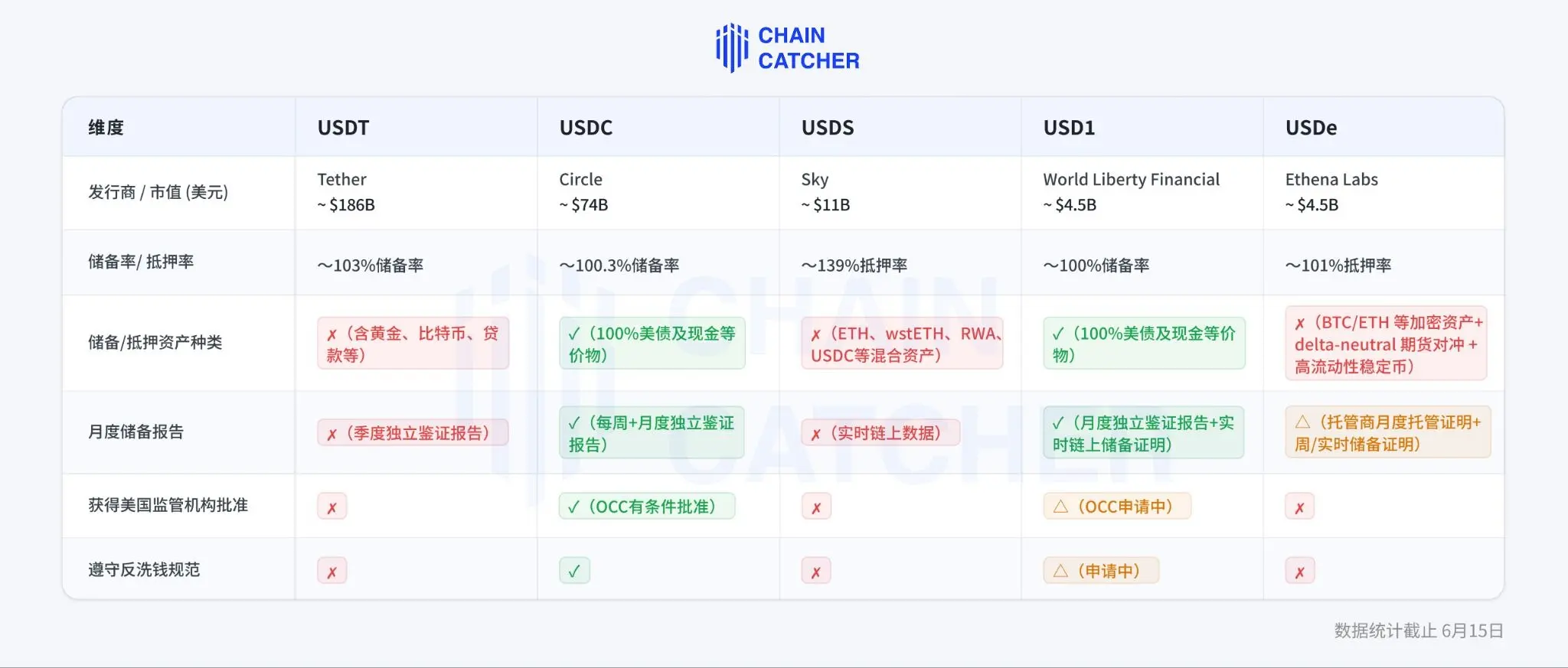
From the current structure, apart from USDC and USD1, most leading stablecoins face varying degrees of adjustment pressure under the GENIUS framework. Taking USDT as an example, its reserves include about $20 billion in gold and several billion dollars in Bitcoin assets, which do not meet the Act's whitelist reserve requirements. Tether's response has been to launch a compliant version, USAT, separating the compliant market from offshore USDT. Data shows that in the first quarter of 2026, the net supply of USDT decreased by about $3 billion, marking a significant contraction for the first time in recent years, reflecting that funds are migrating towards the compliant system.
If this migration continues, who will be able to absorb this new compliant capital?
An important signal is that leading stablecoin issuers are aligning with the federal regulatory system.
Circle has received conditional approval for a national trust bank license from the OCC at the end of 2025, while WLFI officially submitted its application for a national trust bank license in early 2026. For the stablecoin industry, this license signifies not just an additional compliance qualification but also means that issuers are beginning to enter the U.S. federal banking regulatory system and gain higher-level institutional recognition.
If the approval goes smoothly, with the full implementation of the GENIUS Act, both USDC and USD1 are expected to be among the first to complete the core puzzle under the federal regulatory framework. At that time, reserves, audits, information disclosure, and regulatory systems will tend to unify, and compliance itself may no longer be the main dividing line between the two.
What will truly determine the competitive landscape in the next phase may be institutional networks, financial infrastructure, and who is closer to the center of power in the U.S.
Currently, USDC still occupies a first-mover position. After years of development, it has deeply embedded itself in the U.S. financial system and established a mature institutional network and channel advantages.
However, in the new round of regulatory restructuring, USD1 is forming another type of latecomer advantage. This advantage does not come from scale but from timing.
USDC grew during a time when regulatory rules were not yet unified, and its structure and market network were gradually formed while adapting to rule changes. In contrast, USD1 was born when the GENIUS Act and federal regulatory framework were already taking shape, meaning it could design its structure in line with future rules from day one. In other words, USDC resembles an upgrade within an old system, while USD1 appears to be built anew according to a new system.
For large institutions, this "latecomer" status may not be a disadvantage. Because when rules tend to unify, the market may not need the earliest products but rather those that minimize friction with future systems and have the lowest access costs.
In addition, USD1 has another variable that other stablecoins find difficult to replicate—political resources.
Compared to relying solely on market competition, it has a stronger correlation with the U.S. political cycle and regulatory direction. When regulatory details still have flexibility and policy direction has not yet fully solidified, a project deeply tied to the governing cycle can often sense regulatory winds earlier and is more likely to gain institutional support.
Previously, the Middle Eastern sovereign fund MGX chose USD1 as a settlement tool for its $2 billion investment in Binance, which serves as a real-world example. Institutions may value not only USD1's current liquidity but also the regulatory certainty it represents and its potential position within future institutional frameworks.
If USDT won on the globalization dividends of the past decade, and USDC won within the traditional financial system, then USD1 is betting on the regulatory dividends of the next decade in the U.S.
If the GENIUS Act ultimately lands on the current path, then in this reshuffle of stablecoins driven by institutional reconstruction, USD1 may become one of the biggest beneficiaries, even having the opportunity to grow from a latecomer into a core variable in the next phase of stablecoin competition.
3. Behind the rapid growth of USD1
If the aforementioned political resources and regulatory cycle advantages give USD1 a regulatory tailwind, the rapid growth over the past few months also stems from a very pragmatic growth strategy.
This year, USD1 has quickly entered the ranks of leading stablecoins, with its scale growing from about $3 billion to nearly $5 billion, resembling a proactive "market-making expansion" around liquidity rather than a natural diffusion.
WLFI has launched a series of systematic incentive investments around USD1. Among them, exchanges are the most critical traffic entry points, while ecological assetization serves as its long-term support:
Exchange Traffic Tilt: Represented by Binance, over the past few months, WLFI has promoted the use of USD1 through large-scale subsidy mechanisms, including token airdrops, yield incentives, trading rebates, and margin usage rewards, directly lowering the costs for users to hold and use USD1. At the same time, with the launch of USD1 spot trading pairs and the first USD1-denominated perpetual contracts, USD1 has been embedded into the trading matching and derivatives settlement systems. Platforms like Bybit and Gate have further amplified USD1's circulation depth in the contract and spot markets through joint activities, trading task incentives, and margin discounts.
On-chain Ecological Cooperation: WLFI continues to promote on-chain ecological cooperation. Whether Aster uses USD1 as the exclusive settlement asset for TradFi perpetual contracts, or lending protocols like Dolomite providing yield incentives, as well as TownSquare's $100 million liquidity plan, all essentially increase the use cases for USD1, allowing it to be used not only for trading but also for lending, settlement, and earning yields.
Building Internal Financial Infrastructure: WLFI has also begun to build its internal financial infrastructure. As products like WLFI Markets gradually launch, lending, yield, and fund management scenarios are starting to concentrate within its own ecosystem. Compared to relying entirely on third-party protocols, this means USD1 can not only gain liquidity but also retain more funds within its own system, forming an internal cycle between stablecoins, lending, and yield products.
Locking in Users Early: WLFI is also locking in users and liquidity early through community whitelist programs, combining stablecoin issuance, ecological participation, and community building to further expand USD1's user base.
When looking at these factors together, it becomes clear that USD1's current growth is not just a regulatory dividend brought by political resources; it also relies on continuously expanding ecological cooperation and self-built financial infrastructure to seek more long-term growth momentum.
In fact, this has been a pattern in the competition among stablecoins over the past few years. The truly successful stablecoins have never been just a "dollar token," but a complete financial network. From the current development path, USD1 is attempting to replicate this model. By synchronously expanding exchanges, ecosystems, and financial scenarios, it aims to accumulate network effects within a short period.
Conclusion: The stablecoin war has just entered the second half
If we look at the stablecoin market over a longer cycle, we can see that different projects are moving towards different positions.
USDT represents globalization and the offshore dollar network. The liquidity advantages and network effects accumulated over the past few years still allow it to hold the largest market share. However, as the U.S. regulatory framework gradually takes shape, it is also actively stratifying the market by launching compliant versions to distinguish between the U.S. market and the global market.
USDC represents an extension of the existing U.S. financial system. Relying on the institutional network, payment channels, and compliance foundation established by Circle over many years, it remains the most mature and stable choice for traditional financial institutions entering the stablecoin space.
Beyond this, a new variable is rapidly rising.
Compared to scale and first-mover advantages, USD1's greatest characteristic is that it has almost hit several key windows of this round of industry reconstruction: the rebuilding of the regulatory framework, changes in the political cycle, and the expansion of the stablecoin ecosystem.
More importantly, compared to the already formed stock pattern, USD1 is competing for the new market.
With the full implementation of the GENIUS Act, more and more traditional institutions, payment networks, and cross-border funds will enter the compliant stablecoin system. For a market that is still in a phase of rapid expansion, the factors determining the allocation of new shares may not just be scale and first-mover advantage, but rather who can adapt to the new rules more quickly and gain institutional-level credit support.
The future stablecoin market may not simply be dominated by one player, nor may it just be a duopoly of USDT and USDC. Beyond the offshore dollar system and traditional financial systems, a new incremental market is gradually emerging, centered around the U.S. regulatory framework, policy resources, and institutional capital.
USD1 happens to stand at the entrance of this new market. With the final rules gradually being implemented by July 2026 and the full implementation of the GENIUS Act in early 2027, the stablecoin industry may witness the fastest reshaping since its inception. In the past, stablecoins competed on who could move the dollar onto the blockchain first; in the future, the competition may be about who is closer to the power center behind the dollar system.
 Risk warning




Popular articles