








The alliance of the US, Japan, and South Korea stock markets has collapsed!
 Core Viewpoint

 The short-term leverage bubble burst, geopolitical game disturbances, and valuation adjustments—these are all regular growing pains in the technology industry's growth cycle, unable to stop the wave of industrial transformation driven by artificial intelligence.
Author: Godzilla, Gelong
01
If I had to describe the global market over the past two days in one word, the most fitting would be "chain explosion."
First, last night's U.S. stocks, AI semiconductors collectively plummeted .
NVIDIA dropped nearly 5%, with its market value overtaken by Apple overnight, and the Philadelphia Semiconductor Index collapsed 5% at the opening.
SK Hynix was even worse, plummeting 7.47%, directly falling below the IPO price in the U.S. stock market, burying new investors;
Today, this panic in stocks has spread to the Asian market.
The Korean KOSPI opened with a direct plunge of 8%, triggering a circuit breaker, and after resuming trading, it continued to plummet, ultimately closing down 10.84%; the Nikkei 225 once fell over 2700 points during the session, closing down nearly 4%.
Among heavyweight stocks, SK Hynix plummeted 14.65%, with over $470 billion in market value evaporated in just over a month;
Japan's Kioxia fared worse, crashing 18.33% in one day, with six instances of single-day declines exceeding 10% since July, mockingly dubbed the "roller coaster."
The domestic market did not escape either.
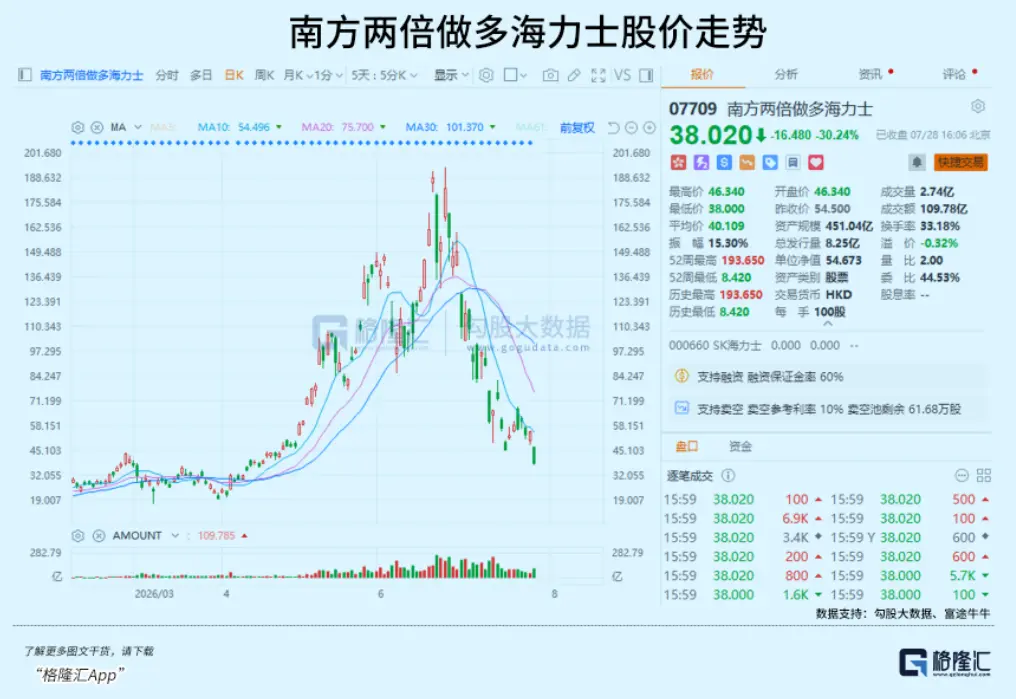
The ChiNext Index fell sharply by 7.35%, the Sci-Tech 50 dropped 6.33%, with the storage sector and CPO sector being heavily affected; the Southern Double Long Hynix ETF plummeted 29%, and the Southern Double Long Samsung ETF fell over 25%.
This is just one day's performance.
From the recent peak, many AI stocks have been halved, and for more aggressive ones, like the double long SK Hynix, the decline has reached as high as 80%.
A drop of 80% requires a 400% increase to break even.
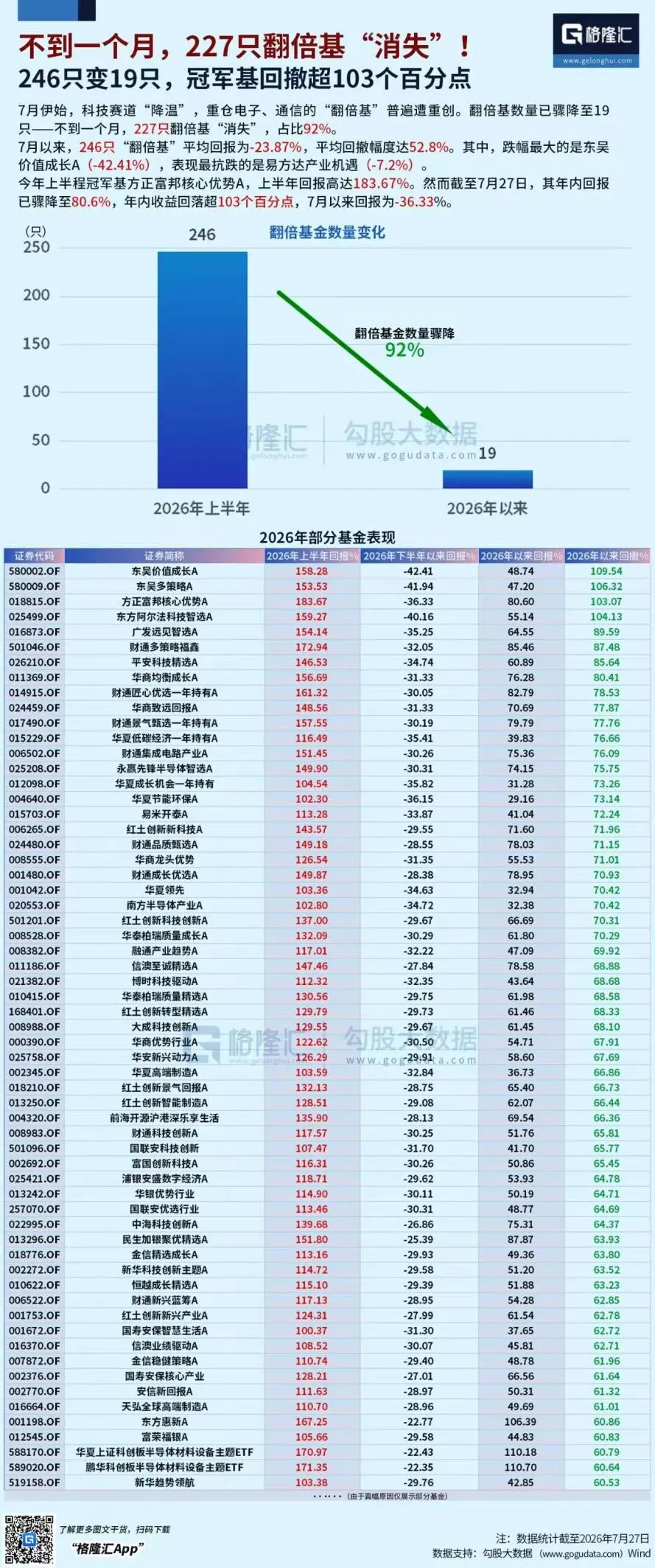
In the first half of the year, there were as many as 246 "doubling funds" in A-shares that saw their net value soar due to heavy positions in electronics and communications, but since July, the average return of these 246 "doubling funds" has been -23.87%, with an average drawdown of 52.8%! In less than a month, the number of "doubling funds" has plummeted to 19, with 227 "doubling funds" disappearing, accounting for 92%!
Today's decline can definitely be considered an extreme market crash globally.
02
I have to say, the simultaneous emergence of so many negative news in the AI sector these days is indeed strange.
First, regarding NVIDIA, reports indicate that NVIDIA has reached a $500 billion AI cooperation with SK Group and plans to provide $250 billion in financing guarantees for OpenAI.
Although this is not new, during the volatile period of the AI semiconductor sector, any non-positive factors are easily interpreted as negative.
Although capital expenditures for AI cloud vendors remain high, their consumption of corporate profits and cash flow has already heavily pressured the valuations of cloud vendors. Meanwhile, revenue growth on the AI application side is weak, and the "killer app" has yet to be widely implemented, leading to a serious disconnect between ROI and the trillion-dollar capital investment.
While NVIDIA remains the perfect "shovel seller" in AI, if the investment returns for AI cloud computing vendors and the killer applications downstream continue to fall short of expectations, NVIDIA will transition from a perfect "shovel seller" to an "infinite liability guarantor" in the chain of massive industry debt.
Once this domino is pushed over, the entire investment logic of the AI industry will change dramatically.
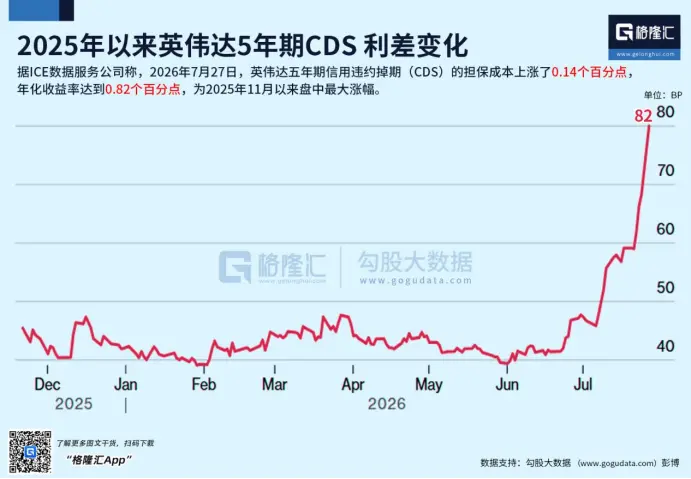
This was also evident last night when NVIDIA's debt issues surfaced first. The cost of credit default swaps (CDS) for NVIDIA's five-year term rose by 0.14 percentage points, with an annualized yield reaching 0.82 percentage points, marking the largest intraday increase since November 2025.
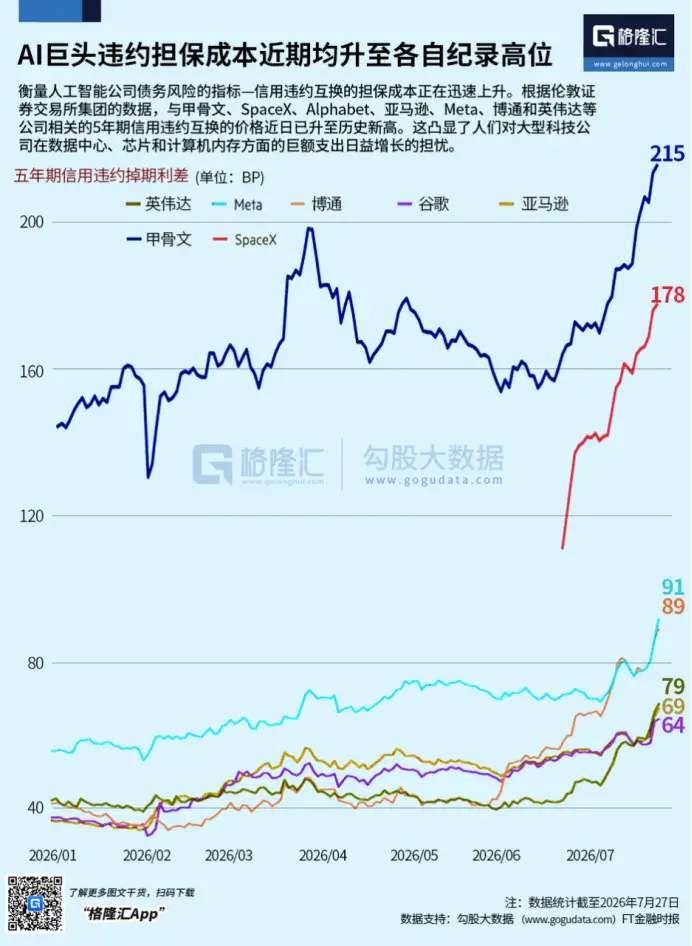
At the same time, according to data from the London Stock Exchange Group, the prices of five-year credit default swaps related to companies such as Oracle, SpaceX, Alphabet, Amazon, Meta, and Broadcom have recently risen to historical highs.
Secondly, there are narratives about the Chinese semiconductor supply chain reshaping the global competitive landscape.
The reason why AI giants in the U.S. and South Korea have seen their market values soar over the past two years is fundamentally due to their monopolistic (scarcity) premium in the AI hardware and software industry chain.
However, this narrative logic has begun to waver this year.
Since the beginning of this year, China's AI large models have been continuously impacting the global market. Recently, high-performance open-source models like Kimi K3 have rapidly iterated, significantly narrowing the technological gap with overseas closed-source models, further challenging the technological moats of European and American AI companies.
Open-source pressures have led to price wars, compressing profit margins, and downstream AI companies are under pressure, further inversely suppressing upstream computing power demand.
Then there is high-end storage, which is the second critical bottleneck beneath high-end computing chips in the AI hardware field. Domestic storage has long been dominated by the three giants: Samsung, SK Hynix, and Micron. However, yesterday, the domestic storage king Changxin Technology went public in A-shares, not only filling the critical gap in domestic storage but also accelerating the replacement of overseas products, breaking the long-standing monopoly of these international giants.
Additionally, today there are reports that domestic production of immersion deep ultraviolet (DUV) lithography machines has begun in bulk. The market interprets this as breaking the long-standing monopoly expectations of established semiconductor equipment giants, triggering a severe sell-off in the global chip manufacturing equipment sector.
ASML saw its stock drop over 8% during trading last night, and Tokyo Electron and Nikon both plummeted over 10%, possibly spurred by this news.
As of now, we have made significant progress in the most core and critical areas such as computing chips, storage chips, and lithography machines. Although we are not currently at the top tier and may lag behind by two or three generations, it is enough to reverse the situation and form a new narrative logic, but this is not good news for the corresponding AI giants.
03
I must say, the biggest driving force behind the global AI stock plunge is the series of unprecedented, suffocating super operations by the South Korean government:
First, they encouraged the entire population to leverage heavily, then, in the midst of the frenzy, they abruptly slammed the brakes and violently deleveraged.
On May 27 of this year, the Korean Exchange approved the first batch of 16 leveraged ETFs tracking individual stocks of SK Hynix and Samsung Electronics, claiming to allow citizens to share in the economic benefits of AI storage.
However, as the stock market soared, the South Korean government hastily slammed the brakes again by raising the minimum margin requirements for chip leveraged ETFs, prohibiting providers from launching new single-stock leveraged products, and other disruptive measures, forcibly deleveraging and ultimately cutting off the bull market process.
By mid-July, the cumulative forced liquidation scale in the Korean stock market reached 344.2 billion won, with over 1.2 million leveraged retail accounts hitting the margin call line. Among them, 320,000 to 360,000 accounts were fully liquidated by brokers, and some investors even owed funds to brokers, with market sentiment already extremely fragile, ready to collapse under the slightest pressure.
But unexpectedly, the South Korean government not only did not timely loosen restrictions but also joined forces with the South Korean central bank to further tighten funds, squeezing leveraged accounts.
As early as July 16, the South Korean Financial Services Commission introduced the first round of regulatory measures, suspending the launch of new individual stock leveraged ETFs, prohibiting related marketing promotions, and raising the cash margin for leveraged ETFs to 30 million won. Subsequently, regulation accelerated again, with the originally scheduled margin enhancement regulations for August being implemented ahead of schedule on July 31.
On the same day, the South Korean central bank announced an increase in the seven-day repurchase rate from 2.50% to 2.75%.
On July 28, the South Korean regulatory authorities released another ultimate signal of strict regulation. The Chairman of the Financial Services Commission, Lee Ik-hyun, publicly stated that if existing policies fail to cool the market, new regulatory measures will be introduced.
It is reported that the core plan includes strict control of leveraged investment ratios, limiting individual single-stock leveraged investments to within 20% of total financial investment assets, fundamentally preventing retail investors from heavily betting on a single track.
This is clearly aimed at completely eliminating leveraged accounts.
Thus, we witnessed this epic plunge in the Korean stock market.
In just seven months this year, the number of circuit breakers in the Korean stock market has already exceeded the total for the past 26 years.
I have to say, this is truly a makeshift operation!
In addition to events in the AI sector, there are also significant upcoming nodes that are causing the market to decline.
On July 28, a new round of nuclear negotiations between the U.S. and Iran will be held. If the results fall short of expectations, it could further disrupt the already fragile energy and risk assets;
Following that, on the 30th, the Federal Reserve's interest rate meeting will commence. If the newly appointed Federal Reserve Chairman Waller continues to release hawkish signals, it will again stir the global capital markets.
04
Many times, the market is like this; once it drops sharply, all sorts of ghost stories suddenly emerge.
But very few people truly reflect on whether these ghost stories are really reliable and whether they reverse market logic.
The current plunge in the AI sector is fundamentally due to the short-term surge being too crazy, now facing a backlash.
From last year to mid-this year, in just two years, the accumulated gains in the global market for optical modules, storage, and computing chips have indeed been exaggerated.
Not only have specific storage companies like SK Hynix, Samsung, Micron, and SanDisk seen gains of several times or even dozens of times, but there are also numerous AI concept stocks in A-shares that have soared dozens of times.
However, from January 2025 to the first half of 2026, there will be as many as 2750 stocks in A-shares that have seen maximum gains exceeding 100% from their lowest points during that period, accounting for exactly half of all A-shares.
Among them, 65 stocks have increased by more than 10 times, with the highest gainers being Honghe Technology, Shangwei New Materials, Dingtai High-Tech, and Yuanjie Technology exceeding 30 times, while Hongjing Technology, Tongguan Copper Foil, Nanya New Materials, Changfei Optical Fiber, and Zhongji Xuchuang have gains exceeding 20 times!
Focusing even more, if we look specifically at AI industry chain-related beneficiary concept stocks (components, semiconductors, chips, electronics, optoelectronics, computer equipment, communication equipment, etc.), there are over 600 companies, which is more than one-tenth of the total number of A-shares.
The market capitalization increase of these global AI sectors may exceed $5 trillion.
Such frenzied market behavior is reminiscent of the internet bubble era in 2000.
Therefore, the rapid pullback is also an inevitable fate.
However, we must deeply and clearly recognize that this round of plunge is essentially just a valuation bubble burst, a deleveraging, not a killing of growth logic.
In fact, if you are guided by long-termism in your investments, you will definitely be much calmer about this pullback.
Confidence comes from two core bases:
- The certainty and vast market space of the global AI narrative. Everyone now believes that AI, as a new productive force for human social development, is no longer just the business of a few tech companies but has risen to the level of technological competition among global nations. It is bound to be the "super main line" of future global economic and technological investment.
Since last year, at the enterprise level alone, global AI spending has been skyrocketing at a terrifying scale and speed, surpassing $2.5 trillion this year alone (including a total capital expenditure of $670 billion from the four major cloud vendors in 2026, an almost 80% year-on-year increase), and is expected to maintain close to 30% compound growth in the future.
These are real expenditures, and such a massive scale will drive other enterprises in the entire industry chain to invest, creating countless huge investment opportunities in the stock market.
As long as this number is not revised down, the story of AI hardware demand has not been disproven.
- Investment value laws. Any valuable investment must have its recognized valuation anchoring level. Taking SK Hynix as an example,
In Q1 2026, SK Hynix's revenue is expected to nearly double year-on-year, with net profit expected to grow nearly fourfold year-on-year; the market anticipates that the upcoming Q2 results will set new highs, with operating profit expected to increase nearly 600% year-on-year, and profit margins maintained above 75%.
Institutional benchmark expectations indicate that SK Hynix's net profit for the entire year of 2026 is expected to increase by approximately 420%--480%; entering 2027, after the base is raised several times, net profit year-on-year growth is still expected to be 40%--55%.
The growth rate of performance is astonishing.
However, SK Hynix's forward P/E ratio is only 7.8~8.5 times, and the forward P/E ratio for 2027 is only 4.6~5.3 times.
No matter which valuation model you look at, its valuation is already at a historically low level.
If it weren't for the deleveraging-induced sell-off, it would probably never have dropped to such a valuation level.
Similarly, AI hardware giants like NVIDIA, AMD, Micron, and Samsung, although their current valuation levels cannot be considered undervalued, given the strong growth momentum expected in the coming years, their valuations are certainly not overvalued.
Of course, relative to the AI narrative in the A-share market, the valuation levels are indeed generally higher than those of these international giants and are still not considered undervalued.
05
In simple terms, South Korea's current deleveraging wave is very similar to our situation in 2015, where the government first encouraged a bull market by issuing a large number of leveraged ETFs, then began to worry about excessive leverage and took tightening measures, leading to a crash.
Currently, the Korean index has already retreated 35% from its highs, which is comparable to the first wave of deleveraging in the A-share market in 2015, and valuations have become very cheap.
If we refer to our 2015 script, whether the Korean stock market can stop falling next and help restore market confidence is worth paying attention to.
Investment opportunities arise from declines and require patience.
Objectively speaking, the current global artificial intelligence revolution is still in its infancy.
Short-term leverage bubble bursts, geopolitical disturbances, and valuation corrections—these are all routine growing pains in the technology industry's growth cycle and cannot stop the wave of industrial transformation driven by artificial intelligence.
On the contrary, this is precisely the best time to select companies with real core advantages that are likely to grow into great companies.
Once this wave of leverage is cleared, more opportunities will emerge.
There is no need to rush; let the bullets fly for a while longer.

 Risk warning



Popular articles


