The real trump card of Pump.fun: 2 billion in funds, a 25-year-old team, and an ambition that does not believe in decentralization
 Core Viewpoint
 Pump.fun Co-founder: Pump Foundation's treasury is approaching 2 billion USD and is considering launching its own stablecoin. Rather than entering the fiercely competitive Perps market, it hopes to continue expanding its advantages in token trading.
Editor | Wu Says Blockchain
Noah Tweedale, co-founder of Pump.fun, stated in an interview that the Pump Foundation's asset pool is close to $2 billion. In discussing future product directions, he talked about potential paths for launching their own stablecoin. Rather than entering the highly competitive Perps market, he prefers to continue expanding the token trading market where Pump.fun already has an advantage, seeking the next phase of growth through social network effects, ongoing product experimentation, and potential acquisitions. He holds strong skepticism towards the value of "decentralization," believing that controlling the end user and providing the best experience is key, stating that what is truly worth considering is not how to raise the market cap from $2 billion to $3 billion, but how to achieve $100 billion or even $500 billion.
What is Pump.fun now?
Host: The last time we chatted, I remember it was right when Pump had just launched. At that time, Meme Coins were being issued almost daily, feeling like the beginning of a new era. Now, the app has officially launched, and the overall product's "dopamine effect" is very strong. So, what changes have occurred in the product or the entire industry over the past two years? How has your own judgment about this industry changed? Initially, it was essentially a Meme Coin Launchpad, right?
Noah Tweedale: If you look back to when Pump first launched, around January 2024, it has been over two years now. Looking at the entire market landscape today, not just in the Meme Coin space but the entire crypto industry, it has undergone a complete transformation. You could say it has changed 180 degrees, even 360 degrees; almost everything has changed.
Two years ago, if you wanted to get involved, you first had to go to a rather primitive website. Our website at that time, Pump.fun, could barely be considered usable. Then you had to get a Phantom wallet, download, install it, and deal with a whole set of processes afterward. At that time, transferring funds into the entire system was also very difficult, and only then could you truly start trading these tokens.
So the entry barrier was very high back then, right? But today, you just need to take out your phone, complete a recharge in seconds, and then immediately start trading Meme Coins, almost instantaneously. So this is not just a technical advancement; it’s not just that the application itself has added more and more features. More importantly, the entire trading experience has fundamentally changed—even how people initially participate in these token trades has become completely different.
Host: So, how do you view this business now? For example, how would you define the business you are doing internally?
Noah Tweedale: I would say, at its core, it is a trading platform, right? That’s how we define it internally.
Secondly, what we want to create is a social trading experience, preferably mobile-first. Of course, we also have different front-end products, such as a terminal for professional traders and a web version for web users. But overall, we hope to build a mobile-first social trading experience that allows anyone to trade any asset. That’s basically our current definition of the product.
Host: It sounds like you are already very much like an exchange or a perpetual contract DEX, rather than what people currently understand Pump.fun to be.
Noah Tweedale: Of course. That’s how I see it. For example, what is Coinbase at its core? It’s just a platform that allows users to trade a bunch of tokens, right? The only difference is that the number of tokens it can trade is limited, as usually only tokens that reach a certain scale have the opportunity to be listed on Coinbase.
What the Pump.fun app essentially wants to do is allow users to trade every kind of token. This certainly includes those large tokens, but more importantly, it also includes a large number of small tokens—tokens that are created every day and are continuously bought and traded.
Host: So, if a user opens Pump.fun today, what do you hope their usage path looks like?
Noah Tweedale: I hope you start trading on the app, generate trading volume, and ultimately become a long-term, satisfied user. I want you to enjoy the product, be able to make money, and truly like it. That’s basically it.
What changes have occurred in the Meme Coin market over the past two years?
Host: From your launch until now, what changes have you seen in the entire industry? Back then, it seemed like every time Elon Musk or Trump said something, someone would issue a Meme Coin around it. What changes do you think have occurred in the industry from January 2024 to now?
Noah Tweedale: That’s a good question. I think this market has indeed become more mature. 2024 can basically be seen as the phase when this bull market started, the market began to take off, trading volume kept increasing, and thousands of new coins appeared every day. Then there was the entire Trump craze, and even Trump himself issued his own Meme Coin. I think in a sense, that was about the peak of the bull market sentiment.
After that, the market began to cool down. Just like the cycles in the crypto industry, product revenue and usage also declined. This environment, however, is more favorable for crypto-native professional traders, as the entire market gradually shifted from a game involving ordinary retail investors to one dominated by more professional traders.
So over the past few years, market activity has increasingly leaned towards those "shark-type" players who trade around the clock, rather than ordinary retail investors. But in recent months, this trend has started to shift back towards being more friendly to retail investors. So I believe, like many things in crypto, the ultimate user experience largely depends on the market cycle.
However, fundamentally, the product we launched on day one hasn’t changed significantly compared to today. What we have primarily been doing is: how to improve user experience? How to add more features? How to make it easier and more convenient for users to operate?
But the core of the product has always remained the same, which is that anyone can issue a token with one click, and the entire process is very fast. It used to take two minutes, but now it takes less than 10 seconds, right?
You might ask, "This doesn’t sound like much has changed; why is the so-called innovation so limited?" But you can look at Instagram. What was Instagram at the beginning? It was just an app that allowed you to post photos to a feed, share them with friends, and let others like them. This app has existed for over a decade, but its core functionality hasn’t changed much since day one, right?
Many of the best and most beautiful products often have their core form remain unchanged from the moment they are born. Of course, we have now added a whole new layer of social features to the product, and we plan to further expand into more areas in the future. But the core product logic—anyone can issue a token and participate in the market around it—I think that itself is a very interesting mechanism.
Host: So, what do you want to achieve with these social features now? What is the so-called "social experience" on Pump.fun? What will it look like in the future?
Noah Tweedale: In fact, these features are already live, just like the app you mentioned earlier. Think about what most people are doing in crypto every day. Are they not spending all day on Crypto Twitter, right?
When you scroll through Crypto Twitter, you see all kinds of tweets, and what are those tweets usually about? Most of the time, they simply say a few words and then tag a token. This token could be ETH, Bitcoin, or it could be a Meme Coin, Utility Token, or anything else. It essentially acts like a kind of "minimum unit of social consensus": you post a message explaining why you think this coin is good or bad, and then below is the token or its price chart.
Our idea is to create a fully socialized experience. Basically, it’s about bringing what’s happening on Crypto Twitter into a mobile app. But the difference is that you can’t just say you believe in a coin; you have to actually "vote with your money."
If you believe in a coin, you can buy a certain amount. Then this transaction will be directly displayed on the Pump.fun app, and everyone can see how much money you’ve made or lost. This way, the opinions you express and your actual trading behavior are truly combined. This is basically the social trading experience we want to create.
What is the 80-person team at Pump.fun, with an average age of 25, doing?
Host: Great. I also want to delve deeper into the company itself and what you are building. Your core team is actually very young. How old is the founding team? If you could give a brief introduction.
Noah Tweedale: When I founded Baton Corporation, the company behind Pump.fun, I had just turned 19. Now I am 22. Baton Corporation has three co-founders: myself, Alon Cohen, and Dylan Kerler.
I am now 22, Alon is 23, and Dylan is 24. So yes, it is indeed a very young team. It has been quite a crazy journey so far.
Host: So, this very young team has raised billions of dollars. We will discuss financing and funding in detail later. But how large is the entire team around you now? Clearly, it’s not just you guys making decisions anymore; I guess you must have a development team, project team, and so on.
Noah Tweedale: Of course. Our team size, I remember, is close to 80 people now. This includes developers, content review teams, and other non-technical positions, etc. So the team has indeed expanded very quickly.
Host: What do you think the average age of the entire company is? If you count all 80 people, what would the average age be?
Noah Tweedale: About 25, I think around 25 or 26 years old.
Using high-frequency experiments to find the next growth point?
Host: So you are basically a group of young people with an average age of around 25. What exactly are you doing now? With a team of 80 people, what are these 80 people specifically developing? Where are the resources mainly being invested?
I ask this because I guess you must have quite a bit of cash on hand. A rough estimate—of course, we will discuss financing in detail later—I estimate that you currently hold around 1.5 billion to 2 billion dollars in cash. That's a significant amount of money, so what exactly are you developing? Where is this money primarily being spent?
Noah Tweedale: Of course. Baton is currently basically dividing its development work into three different directions. The first is obviously the mobile app, which we've talked about a lot already. Most of the development focus is here. We believe this is the part most likely to achieve massive scale growth.
For example, there may currently be only a few hundred users, but in the future, it could easily grow to 100 million or 200 million users. We believe this is the real growth space for the entire industry and the direction in which Pump.fun can maximize its user base.
The second direction is the web version. When you open the Pump.fun website, what you see is the web application that everyone is familiar with, which is also the second product line we are continuously working on. Here you can also see the Feed, which is the mobile information stream I mentioned earlier. This Feed is interconnected between the mobile app and the web version, and user profiles are connected in the same social relationship graph.
The third direction is after we acquired Padre, which we renamed Terminal. This is a trading interface aimed at professional traders, mainly serving those who spend a lot of time trading daily or invest significant amounts of money buying and selling tokens, needing to enter and exit positions very quickly. For these users, it provides a more professional and efficient trading experience. So currently, the entire business is basically divided around these three directions.
Host: So Padre was obtained through your acquisition. Currently, your team is mainly developing the app and social experience, which are also the products we can see and have gone live. But you must be working on other things, right? You can't just be focused on the app and the already launched social experience. You must have some longer-term, bolder projects as well?
Noah Tweedale: Of course. Recently, a relatively more "moonshot" attempt is GO (go.fun), which is the Bounties reward platform you see. The core idea is basically "paying anyone to do anything."
We often come up with this type of idea and quickly bring it out for experimentation to see if we can find product-market fit (PMF) and whether it’s possible to suddenly achieve 100x growth, truly changing the face of the entire company.
For example, look at Google; they did something very important and clever by bringing in a group of small teams, putting them in a room, and telling them, "Go experiment, try different things." Many people may not know that products like Google Docs and Gmail actually emerged from similar experiments, which later became core products for the entire company.
So for us, the key is to be very decisive and proactive in trying various ideas because you never know which one will ultimately succeed. Of course, we have also made many innovations at the Launchpad level. I think many people may not have noticed this, although the related content I posted on Twitter has about 1 million views. For example, the recently launched BOOST Mode.
Previously, each token would lock a portion of SOL during the Bonding Curve phase, and after the token migration was completed, this portion of funds would actually be locked there long-term and could not be effectively utilized. Now with BOOST Mode, whenever a token completes migration, the SOL that was originally left in the Bonding Curve and not utilized will be taken out and continuously bought from the market within 5 minutes after migration.
According to my rough estimate—this number may not be completely accurate—it can now inject about 5 million to 10 million dollars in liquidity to different tokens weekly. After this mechanism was launched, the number of token migrations and product usage both significantly increased, while also boosting the revenue of this part of the business and Pump.fun.
Host: How is GO doing? I remember there were all sorts of bounties on the platform, with some people tattooing things on their foreheads and others doing various crazy things. How has it developed now? How did this product perform in the end?
Noah Tweedale: Of course. To be honest, GO was created by three people in about two weeks. It was basically a quick assembly of something to see if anyone would use it. Many of Baton’s products are actually made this way, right? You first do an experiment, which is also our way of validating PMF.
See if anyone uses it. If no one uses it, then cut it; if someone uses it, then of course continue to iterate. In the case of GO, it did gain extremely large attention. For example, it received about 20 million views on Twitter. I think one of the videos might even be one of the most widely circulated videos in Crypto Twitter history, except for those related to FTX events.
But actual usage quickly began to decline and ultimately did not achieve the results we expected. So just like we treat many other products, we cut it and redirected development resources to other directions and experiments. This is the approach you must take: constantly experiment, some fail, some succeed, and then continue to the next round. Basically, every year, every month, or even every day, you have to conduct dozens of different experiments. That’s how it is.
Host: I actually want to hear your thoughts on this matter, and I have my own judgment. I pulled up the price chart for PUMP. You should be more familiar with this chart than anyone else. Something clearly happened here. For example, around mid-June, PUMP hit the bottom at about 0.1 cents, and since then it has doubled.
So I really want to know what happened. I think I might know the answer, but I still hope to hear it from you: what exactly happened during this period that caused this price chart to change like this? Because you can also see that the entire market did not show such a clear reversal. So I think something must have happened internally or externally at Pump.fun at that time. What exactly happened at that point?
Noah Tweedale: Of course. Regarding the price itself, I will be relatively cautious and not willing to make specific predictions. I can't say I'm sure where the price will go. But regarding the time point you mentioned, I remember that it should have been the token unlock. I might be mistaken, but I guess you are referring to that unlock.
For the audience listening to this episode, a portion of the tokens held by the team and investors completed the unlock, meaning these people could actually sell from that point on. The specific data can be verified on-chain, and the official Pump.fun Twitter and other channels have also released related information, so if I'm not accurate here, it can be verified.
But as far as I know, the vast majority of people did not sell. I believe over 90% of investors did not sell their tokens, and many of them are still holding today. The situation for team members is similar, I think.
Why did almost no one sell after the large-scale unlock of PUMP?
Host: You experienced such a large-scale unlock, yet almost no one sold. So my question is, what did you do? What kind of vision did you convey to these people that made them willing to stay? Because most of these people are quite young. I guess many of them may have never encountered such a large amount of cash in their lives. Suddenly, they faced their first real token unlock, able to liquidate these assets, yet almost no one is selling.
I even compiled a list of addresses and can see that almost no one is selling. I do have a list of wallet addresses, and we have been tracking these wallets, and basically no one is selling. So I wonder, how did you manage to do this? Is it because you painted a sufficiently attractive vision for them, or was there some arrangement, like a rule that they couldn't sell? I'm curious about how you managed to keep everyone from selling.
Noah Tweedale: Are you referring to investors or team members here?
Host: Mainly team members, right? That unlock was primarily for the team’s tokens, correct?
Noah Tweedale: There were also investors, right? I remember about 13% of the token supply belonged to investors, and the team had a corresponding share, and at that time, some were also entering the unlock phase. But if we mainly talk about the internal team, I think the Baton that the outside world sees, or the Baton / Pump.fun Foundation, is actually quite different from what we see internally.
In my view, we have one of the best teams in the entire Crypto industry internally. Everyone is very motivated and truly believes in the company's vision. They see what the industry is actually becoming, rather than what the so-called "old generation" thinks it should be.
I think many people not working in the Meme field would feel that this thing is like the next round of NFTs, and in the end, it will all go to zero. They haven't really seen what is happening here. The most important point is that the young people in Crypto, and more broadly, many young people, are either trading Meme Coins or playing prediction markets. This is the reality.
This is a young person's market. People aged 18 to 24 make up a very important, possibly the main group of users. So many people in Baton who receive PUMP tokens as compensation or incentives will realize, "Wait a minute, this actually matters."
Or it might not necessarily be "important," but they will realize that the future upside potential of this matter far exceeds the valuation the market currently gives it. And everyone thinks, "I want to be part of building a company that can have a generational impact, rather than one that just survives one cycle and then goes to zero in the next." So ultimately, on one hand, we have built a team that truly believes in the product; on the other hand, this team is smart enough to understand what such a company could potentially develop into in the future.
Why did Pump.fun almost stop external communication previously?
Host: Did any changes happen within the company? To be frank, I have talked to many of your investors. Some of them are early investors. My feeling is that the sentiment of your investors has clearly changed in the past few months.
There was a time when I felt they might be somewhat dissatisfied—I don't want to use the word "frustrated," but at least they weren't as excited as they are now. And now when I talk to them, their attitudes are clearly different. I have also talked to quite a few of your other investors, and I think we all know who some of them are. Suddenly, it seems they all started to believe that something indeed changed internally with you.
So I am very curious, what exactly happened within the company? Have you reflected on the way things were done before, or realized that you might have made some mistakes in the past? What exactly has changed?
Noah Tweedale: Yes, there has indeed been a change. Let me provide a bit of background first. Internally, our core focus has always been on the product of Pump.fun. We have been thinking about how to make it the best product possible, how to gain more users, higher usage, and more attention.
Our mindset has always been that if we make the product good, then the short-term token price is not that important. Because in the long run, what truly drives the token price up is the growth of platform revenue and the buybacks that come from it. This is what can make more people truly believe in this business and be willing to buy into this logic.
As for marketing around the token or doing some short-term operations, I think those things are very unnatural. They might create some exit liquidity in the short term or push the price up for a while, but that is not the way to build a company that can operate stably for 20 years, right? That is not a wise long-term decision.
However, I do agree with what you just said. We have heard a lot of feedback and have seriously absorbed these opinions. Many people have indeed complained that our communication has not been good enough, and we have recognized this and are actively improving. This is also why I am here participating in this podcast and have started posting weekly updates on Twitter, which everyone can see. But there is one more thing I think is also very important. If we look from the low point in your chart, the revenue of the Pump platform and the Pump.fun Foundation has actually grown by about 50% to 60%, right?
So you have to ask yourself: Is it the revenue growth that drove the change? Or is it the improvement in communication that drove the change? Or is it a combination of both? This is actually a question that needs to be thought about. Of course, for us, the rise in token price is also very important, and I want to emphasize that it is very important. But the real question is not: How do you increase a company valued at $2 billion to $3 billion?
The real question is: How do you go from $2 billion to $100 billion, and then to $500 billion? How do you become a true global giant? This is what we have been thinking about. So we do not set our goals on how to add an extra $200 million in market value.
Host: Why did you do so poorly in communication before? You raised a lot of money, but then your own Twitter was basically silent. Occasionally, we could see Alon tweet. Was this intentional on your part? Or did you later realize it was a mistake? What exactly happened at that time?
Noah Tweedale: I would say this was indeed a mistake. However, I also want to say that I am not here to defend myself, as the market has clearly given negative feedback on this matter through prices.
But from another perspective, I think continuous communication is certainly valuable, but it is not absolutely necessary. For example, how often does CZ specifically update on what has happened in the BNB ecosystem every week? Would Brian Armstrong do that? He might, but it probably wouldn’t reach the frequency we have now.
So, I think the current approach is certainly good, but it also has some corresponding drawbacks that we need to weigh. Additionally, I think there is another issue. When the token price keeps falling, it is easy to create a self-fulfilling prophecy. People will start saying, "The platform revenue is not real at all." Then the price continues to fall, and everyone believes even more that "the revenue is not real." It creates a downward inertia that is very difficult to reverse. Once it forms, you will be greatly affected.
But the fact is, during that time, the only thing the team was doing was focusing on the product, executing continuously, hiring better people, developing more features, and acquiring excellent teams. So ultimately, it is still a trade-off between short-term and long-term. Our mindset has always leaned towards the long term.
Host: To be honest, I think it is actually a combination of both sides. If the token price is falling and the market is filled with various FUD, but at the same time, the team keeps coming out to communicate, saying, "Everyone, we are currently focused on development, we will release this next week, and then we will launch that." Then these two things can actually balance each other out.
Because at least the market will know that you are still doing things. I myself am a holder of PUMP, and at that time, there was indeed a feeling that the team seemed to have "lost contact" directly. I even gradually got used to the idea that the team might just not come out to speak. So now seeing you appear more in public and communicate more proactively, I think it’s great. Because at least we can understand more clearly what you are doing, which indeed brings more confidence to the market and holders.
Noah Tweedale: Stability and a sense of security. Yes, we understand this, and I agree with your view. As I mentioned earlier, we are now also working hard to improve this issue.
How does the Pump Foundation manage nearly $2 billion in treasury?
Host: You just mentioned that the goal is to increase the market value from $2 billion to $100 billion. However, before discussing market value, let’s talk about money. How much money do you currently have? I know you also have quite a bit of expenditure now. Is my understanding correct that about 50% of the revenue is being used for expenditures?
Noah Tweedale: Let me explain this first, because for those listening, this is a very important distinction. The funds are held by the Pump Foundation, and there is also a UK development company, Baton Corporation, which charges the foundation for development and related costs. So when we discuss "who owns this money," these funds are actually within the Pump Foundation.
Let me provide some background on the expenditures. Currently, Baton Corporation charges the foundation about $100 million per year. This money is mainly used for development costs, technical infrastructure costs, and various operational expenditures. As for the funds held by the foundation itself, the relevant data is mostly public. This includes funds raised from the ICO and the ongoing revenue generated by the platform.
Host: So how much money does the foundation currently have from the protocol or foundation perspective?
Noah Tweedale: The assets in the treasury are close to $2 billion.
Host: And then Baton Corporation charges the foundation about $100 million per year for development costs?
Noah Tweedale: Yes, but this number will vary. Because like any company, for example, marketing expenditures may rise, and there may be other factors affecting Baton Corporation's overall expenditures each year. So the specific number is not fixed. But under the current situation, it can be understood as around $100 million per year.
Host: How is this $2 billion managed? Who manages it? Where is this money currently held? Is it cash, or is it held in SOL? What is the specific form?
Noah Tweedale: I cannot go into too much detail on this question, for obvious reasons. But I can say that it is not held in SOL. The funds are mainly held in stablecoins and other relatively stable asset forms.
These funds are managed by relevant personnel from the foundation, and the core goal is obviously to ensure that Pump.fun can operate sustainably in the long term. As for the specific allocation of funds and company-level arrangements, I would prefer not to elaborate further.
Host: From an overall structural perspective, including the daily revenue generated, how does it operate? In other words, after the protocol generates revenue daily, the foundation receives this revenue and then uses 50% of it to buy back and burn PUMP tokens.
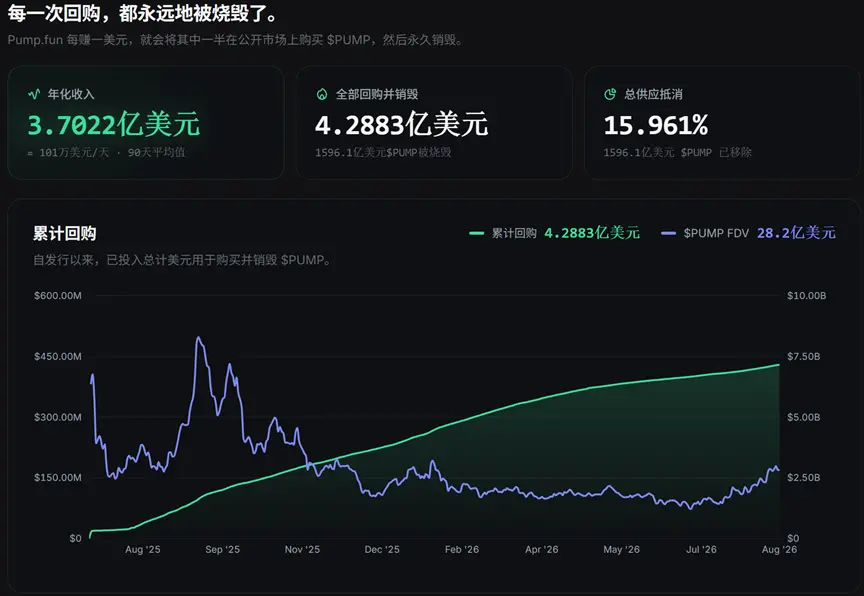
Noah Tweedale: Yes, that’s right. You can see this in the chart here. It shows the daily buybacks and burns, as well as how much revenue is allocated to buybacks. However, there is another metric that I find even more interesting, which is the number of active wallets.
This chart is actually very worth looking at. You can pull the time to the far right, where it shows the number of active wallets on Solana, and the line below shows the remaining active wallets on Solana after excluding those that have interacted with Pump.fun.
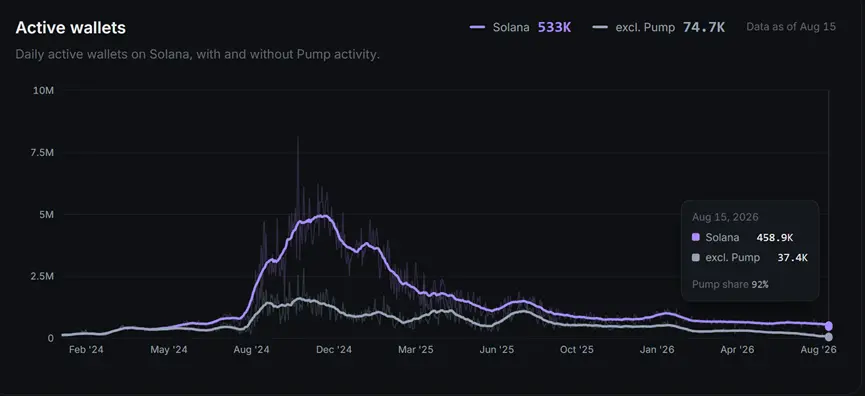
You will see a ratio here, with Pump.fun accounting for 92%. In other words, about 90% of active wallets on Solana are directly or indirectly related to Pump.fun. This is actually quite astonishing.
If you pull the chart all the way back to December 2024 or January 2025, which is when that huge peak appeared. Yes, right there. You will see that there were about 4.5 million to 4.6 million active wallets on Solana at that time.
But if you exclude the wallets related to Pump.fun, the number of remaining active wallets is very small. This means that almost all on-chain activity on Solana at that time largely came from Pump.fun.
Will Pump.fun launch its own stablecoin?
Host: You are clearly already a very important part of the Solana ecosystem. As you just said, about 90% of active wallets are interacting with Pump.fun, right? But at the same time, there have been some rumors in the market, and these rumors have resurfaced recently: Is there a possibility that Pump.fun will launch its own blockchain in the future?
Noah Tweedale: I mean, the Pump.fun mobile app has already become the main trading entry point. If you open the app, you will find that it is actually cross-chain. I want to emphasize this: you can trade assets on BNB Chain, you can trade assets on Ethereum, and you can trade assets on Base. Basically, as long as there is a certain trading volume on a chain, you can trade through Pump.fun. So from this perspective, we are actually already cross-chain.
Additionally, we really like Solana. We believe that for now, if you want to conduct on-chain trading, the experience provided by Solana is the best. Of course, the situation may change in the future. That’s about all I can say on this issue.
We certainly always have a clear plan, which is to continuously expand our business and grow the company as much as possible. However, there is something I find even more interesting. Now, whenever a token completes its migration, its trading pair is always paired with SOL, right? We have studied this matter, and just this mechanism alone has brought billions of dollars in incremental market value to Solana, because these tokens need to be paired with SOL.
But the more interesting question is: why not let them pair with stablecoins? Further, why can't this stablecoin be Pump's own stablecoin? Because in reality, not many people really want their assets priced in SOL; it doesn't make sense from a user experience perspective, right? The primary pricing asset globally is still the US dollar, not SOL.
So the question is, how can we provide the best experience for users? The answer is actually to price in US dollars. I believe this will be a very logical next step.
Host: So what you mean is that the most reasonable direction for the next step is for Pump.fun to launch its own stablecoin?
Noah Tweedale: That's right, yes. Of course, this could also further increase the usage of US dollar stablecoins on Pump.fun. You can already see that the liquidity pools priced in US dollar stablecoins on the Pump.fun App are increasing, and users have begun to get used to trading directly priced in US dollars.
So, once all this infrastructure is established, why wouldn't the Pump Foundation consider launching its own stablecoin?
Host: But if Pump.fun really wants to launch a stablecoin, how would it operate? How do you plan to get users to start using it? What would the specific mechanism look like? For example, would this stablecoin exist on different blockchains simultaneously? A bit like another Tether, which can be issued and circulated across multiple chains.
Noah Tweedale: Yes, it would basically be similar to Tether's model. Our early idea is to first launch a wrapped version backed by Tether or USDC, allowing it to quickly scale in usage and liquidity while gradually building user trust.
After all, stablecoins are a business that highly relies on trust. So we can first scale in this way, and once the market value and liquidity reach a sufficiently large level, we can consider gradually shifting the underlying reserves to assets like bonds.
Host: I still want to return to the question of "building your own chain," because this has been on my mind. You just said that you are basically already multi-chain. Users can trade on BNB Chain, trade on Solana, and trade on EVM chains, right? What about Hyperliquid?
Noah Tweedale: Not yet. But I believe there will be some relevant news soon.
Host: I did see some activity on Twitter. I'm not sure what it is specifically, and I haven't talked to the relevant team, but there have been some rumors on Twitter that you might be doing something with Hyperliquid. If you really launch your own blockchain in the future, what would be the biggest benefit?
Noah Tweedale: I think the core is still to provide the best experience for users. Currently, using blockchain involves various issues like Gas Fees. If you have your own chain, you can completely optimize around user experience.
For example, you can reduce Gas Fees to very low levels, or even achieve zero fees. In addition, there are many other aspects that can be optimized for the end user, making the overall experience ten times better than it is now. Plus, you can design the entire chain to be more mobile-centric. There are actually many interesting things that can be done.
Host: The reason I ask this is that I want to understand what can be further improved compared to Solana. I think this might be the real question I want to ask. Because I feel that in the future, there will likely be more and more App Chains: when an application scales sufficiently, it will eventually launch its own chain. One reason, as you just mentioned, is that it can control Gas Fees itself.
But from your perspective, you are a platform directly facing consumers, centered around front-end products. So if you really do this in the future, what specific benefits do you think building your own chain could bring to such products?
Noah Tweedale: I think there are actually many different benefits here. Of course, one of them is related to valuation. If we look back in history, for example, during the internet bubble from 1999 to 2000, what happened? Before the internet bubble burst, many infrastructure companies received very high valuations, and everyone thought, "This is the infrastructure for the next generation of civilization."
But what happened later? Many companies collapsed, some even went to zero. So who are the biggest tech companies today? Google, Meta, and of course Amazon. What do these companies have in common? They control the entire technology stack.
The reality is that as long as you have the end users, and users are actually using your product, it doesn't really matter what underlying infrastructure it runs on, as long as the final experience is good enough, right? In fact, I am quite pessimistic about "decentralization." I think a lot of the talk around decentralization is nonsense. I really don't believe in that.
For me, the only thing that really matters is user experience. If you can provide the best user experience, then no one will really care how decentralized the underlying blockchain is or any of those things.
This is also why a lot of on-chain activity has migrated to Solana. Compared to Ethereum, Solana can be said to be more centralized, but the user experience on Ethereum is poor, and that's a fact, right? And this is also one of the important reasons why Solana has developed to its current scale. So what really matters is always the end user. In the long run, this is the foundation on which you can build a highly valuable company.
Why Contracts Are a "Boring Business"?
Host: Understood. So now you have a professional trading terminal, a launchpad, and your own DEX. But I feel like there is still a missing piece in the entire product landscape, which is perpetual contracts. Does Pump.fun have plans to do Perps?
Noah Tweedale: We are always considering various possibilities. But to be honest, I think Perps is quite a boring business. I don't think perpetual contracts themselves are particularly special.
If you look at the Perps market, it might be one of the most competitive tracks in the entire crypto industry, right? Almost all major players are competing in this market, and the funds they have are not in the tens of billions, but in the hundreds of billions.
So the question is, why enter such a highly competitive track? Why rush in to compete with these people instead of expanding your existing market?
I think I also posted a related tweet recently. If we only look at on-chain revenue—here I mean on-chain, excluding off-chain. Off-chain centralized exchanges are certainly very large in scale and are one of the biggest businesses in the crypto industry—but if we only look at on-chain, the revenue generated by Meme Coins is actually much higher than that of Perps overall.
I think people need to understand that the business of Meme Coins actually has very strong sustainability. Given that, why not strive to form a monopoly in a market where you already have an advantage, and continuously expand the market itself, instead of rushing to enter another market and compete head-on with those already there?
Token Dissemination Forms a Unique Social Network Effect
Host: Okay, let's talk about market value. You just mentioned wanting to increase the market value from 2 billion dollars to 100 billion dollars. In my view, the only way to go from 2 billion dollars to 100 billion dollars is to build a real network. In other words, it must have a true network effect: every additional user will increase the overall value of the network to a greater extent, right?
But if I break down the Meme Coin Launchpad to its most basic form—I know this might be a bit of an oversimplification—but I don't see any network effect in the Launchpad itself.
Noah Tweedale: I completely disagree. That statement is incorrect. Why did you buy Bitcoin in the first place?
Host: Because it has a network effect.
Noah Tweedale: No, that's not it. What I mean is, if we go back to the most primitive, basic level, why did you or anyone else buy Bitcoin in the first place?
Host: Well, at the most basic level, it's because it is a scarce asset with a limited supply.
Noah Tweedale: Who told you that?
Host: Other people. People in the community, some I trust.
Noah Tweedale: People online, or friends in real life, right? Every coin you have bought is essentially because someone told you that you should buy it, right?
Host: Yes.
Noah Tweedale: In fact, what Bitcoin represents and how decentralized it is are not the most critical aspects. The reason you bought it is essentially because someone told you to buy it. That is the network effect that any token possesses.
To some extent, the entire crypto industry exists because everyone is saying, "Look at my Hyperliquid position," "Look at my Cardano position," "Come buy my coin," and then you buy mine, and I buy yours.
And the so-called Meme Coin Launchpad is not just a Meme Coin Launchpad, right? It is essentially a token issuance platform that allows anyone to have an experience similar to "issuing their own Bitcoin," and then tell their friends to buy it, and their friends get involved.
But the difference is that if I now tell my friends to buy Bitcoin, their purchases will basically have no impact on Bitcoin's price. But if I tell them to buy the token I issued on Pump.fun, or any token issued by someone else on Pump.fun, then in reality, their purchases are likely to really drive market price changes.
What does this mean? This itself is a very direct network effect, because the more participants and investors there are, the more money you make.
This is very different from Perps, because perpetual contract platforms do not directly benefit existing users with each new user added. The same goes for prediction markets. For example, in a prediction market, you have no incentive to tell others what positions you have opened on Polymarket. Because if you share your judgment with others, and they believe you and follow your bets, your potential earnings will actually decrease, right? From the perspective of expected returns, making your trades public can even lead to negative returns.
The same applies to Perps. Why would you tell others about your perpetual contract positions? It won't bring you extra benefits. So these products do not truly possess such network effects.
But tokens are different. You have a very direct incentive to loudly tell everyone, "I bought this coin." Because if others follow and buy, you will benefit from it. So if you say this product has no network effects, I strongly disagree.
Host: Yes, I actually think we might be talking about the same thing. I believe the real network effect lies in the social network formed around Meme Coins and token issuance platforms. This is also what I feel most clearly in the App. For me, this App itself is a very pure social experience.
People continuously tell others, "I bought this," "I just bet on this," "I called this coin when it was at a market cap of $3,000," "This person has been performing too well lately," "This thing is too hot, I need to check it out." Basically, these are the things happening in the App. I believe this itself is a network effect.
Noah Tweedale: However, even without a dedicated social layer, this network effect exists. Just look at Twitter, right? What is a network effect? For example, if you tweet that you bought a certain coin, that itself is a network effect. It doesn't necessarily have to rely on the social features within the product. Of course, you can build on this by adding a social layer to create more value for all participants.
But the basic logic is actually very simple: I bought a coin, so the most natural behavior is to tell my friends and get them to buy too. This is true for any token—"I am bullish on this coin, hurry and buy."
Even those investors we just talked about, they might have been telling you why they are optimistic about PUMP, right? What is this? This is actually the network effect. Because they want others to buy in, and when more people buy in, the assets they hold will also become more valuable. This is a fact and a very basic aspect of human nature. I think what Pump.fun's Launchpad captures is essentially this.
Host: So, I think what really excites me is the network effect formed through your social elements. You have essentially created the ultimate "dopamine machine," and it operates around money, which strengthens the entire mechanism. Because the dopamine mechanism requires motivation and rewards, and here the reward is even directly monetary.
So I find this very interesting. The real network effect is this social network, while the Launchpad is just the infrastructure that allows this mechanism to operate. What truly excites me is that I feel you are gradually getting this social network right. Of course, it is still in the early stages, but it has already started to find the right direction.
I think you might be among the first to truly combine Crypto, social networks, and dopamine feedback mechanisms, and actually do it right. There are almost no other Apps in the market that can achieve this. The only other one that might have a chance is Twitter, if it further develops in your direction, allowing users to issue and trade tokens directly within Twitter.
Noah Tweedale: Now everyone is discussing various small tokens inside, while also discussing mainstream tokens like Bitcoin and ETH. So what’s next? Why can’t you discuss your positions in prediction markets there? Why can’t you share your futures positions? Why can’t you share your positions in RWA?
Ultimately, these things will all be integrated. And this social layer will eventually cover the entire trading market. By that time, you won’t even have much reason to trade elsewhere. Because the reason you buy a coin or open a position is often because someone told you, "This thing is worth being bullish on." What the Pump.fun App wants to become is the place where all these opinions, trades, and positions converge.
Host: For me, what can truly take you from $2 billion to $100 billion is this "social position" and the entire social experience. Because this is much more interesting than scrolling through Meta, and much more fun than scrolling through Instagram.
As I mentioned earlier, I spent an entire afternoon playing with this, and I got hooked. I can't help but want to go back and see who is making money now. And when I see others actually making money, it makes me want to press that button because I want to participate too.
Noah Tweedale: Yes, you want to follow them, copy trade, and do various similar things.
Host: Besides these, what else do you think can help you go from $2 billion to $100 billion? Because I truly believe that if there is an App in the market that has the opportunity to achieve this, it might be you. What else do you have that you think can help you reach that scale?
Noah Tweedale: I think the core is still continuous execution and experimentation, right? You must keep doing things that are truly meaningful. What’s the next thing that can bring in users? What’s the next application that can attract a whole new batch of users?
Because the reality is that the Crypto industry has been competing for the same 500,000 people. The real question is: how do you bring in the next 500,000? Then the next million, and then the next five million. We have always been focused on these questions and will try to think on a larger scale.
I feel that many ordinary Perp DEXs have not really thought about, "How do I bring in another 10 million users?" They often think smaller, like, "How do I take a little market share from this competitor and then take a little from another competitor?"
But if you really want to change the world, is that a bold dream? I don’t think so. So we need to keep doing these larger-scale things. Of course, another very important part is building trust. We need to make people understand that there is actually a real team behind this, not some mysterious and suspicious team doing strange things behind the scenes.
We need to establish this connection between people, so that everyone is willing to truly understand us, comprehend what is happening here, and then be willing to tell these things to their friends and explain them clearly. In fact, behind the scenes, there is a very strong business running that people cannot see.
Additionally, there is also a very important direction, which is how to use the cash held by the foundation and how to advise the foundation to make good acquisition decisions. This is indeed a very large amount of capital. If you can acquire some businesses that can generate more income or companies that can synergize with existing products, or even some completely different businesses that can ultimately add value to the entire ecosystem, that would be very reasonable.
This is also an important way for many large companies to continuously expand. For example, Meta acquired Instagram, WhatsApp, and many other things. Sometimes you have to find the "next thing," but it doesn’t necessarily have to be built from scratch by yourself.
And if you have such a large cash reserve, then the foundation can completely consider and ultimately decide to acquire some larger businesses after receiving appropriate advice. That’s about it.
How many users does Pump.fun have in Asia?
Host: How big is your scale in Asia? I know it’s hard to judge where users come from just based on wallet addresses, but I guess you should have started to understand your user demographics by now. How many users do you have in Asia?
Noah Tweedale: About 20%. I think Pump.fun is still more of a product geared towards Western markets, but the proportion of Asian users is also quite considerable.
Host: And it’s still growing, right? Because Asia is one of the very important markets for Crypto.
Noah Tweedale: Of course. However, I both agree and do not fully agree with this. For example, the sports betting market in the United States is one of the largest markets in the world. And this data is indeed hard to track. Pump.fun itself is obviously decentralized, and we do not conduct KYC on users, so it’s difficult to accurately determine where users come from. At the same time, many places in Asia have various restrictions on Crypto, making actual usage even harder to quantify.
But my judgment is that the proportion of Asian users is around 20% to 25%, and this proportion is relatively stable within the overall user structure.
Host: For me, what excites me the most is the social network you are building. As I said earlier, I believe the real network effect that can take you from $2 billion to $100 billion is the network effect. And among the products I currently see, Pump.fun is the closest to this state. The desktop version is certainly good, but what truly shows me this potential is the mobile App.
Noah Tweedale: Exactly, that’s the key. Because everyone has a phone in their pocket that they can pull out at any time and start trading immediately. Including the Apple Pay feature we just mentioned, I think this is the real key to scaling up the user base significantly.
Host: Regarding the Apple Pay feature, for those who might not know, you can actually deposit directly through the App now. There is a "Deposit" button, and when you click in, you will see that you can use Apple Pay directly. Basically, just double-click to confirm, and you can directly fund the App to start using it.
Additionally, if anyone is curious why I am so excited about this product or doubts whether this is sponsored content by Pump.fun, I can clearly say this is a completely unsponsored interview. We have no commercial relationship with Pump.fun. I just really like this team; they are indeed working very hard, and I have been following their development for a long time.
When I opened this App and truly felt that "dopamine feedback," I thought, "Okay, I need to contact Noah and talk to him." Another reason is, of course, that the price of PUMP has been rising recently.
Thank you very much, my friend. I'm glad to invite you here today. I think we can have more exchanges like this in the future, which is also part of your continuous updates to investors about progress. Moreover, perhaps soon we can take off the masks and truly meet everyone. What I mean is, I know who you are, but maybe one day everyone can see the real you behind this project.
Noah Tweedale: Of course. Yes, I think it may not be immediate, but it shouldn't be too long. At some point in the future, several founders should reveal their identities, and we are considering this matter. However, obviously, once we do this, it will have a significant impact in real life.
Why do the founders still choose to remain anonymous?
Host: I'm actually very curious, why have you been reluctant to fully reveal your identities? You are actually already considered "semi-public." Your investors know who you are and have seen you in person, but the general public has not really seen you. So, why are you so insistent on maintaining anonymity?
Noah Tweedale: To be honest, I don't know either. I'm only 22, right? I still hope that I can live normally whether I'm in New York, London, or anywhere else, without constantly having people come up to recognize me and talk to me. From this perspective, I prefer to lead a quieter life and be able to relax a bit. That's the first reason.
The second reason, of course, is safety risks. Everyone knows that this platform is making a lot of money now, and PUMP itself is also a very actively traded token. If our identities were fully public, it would naturally be easier to become a target for others.
We actually already have security measures in place, etc. So ultimately, this is more of a choice to ensure our own peace of mind. I think we may need to wait until we grow a bit larger and the entire business develops to a more mature stage before we truly make the decision to reveal our identities.
 Risk warning


Popular articles