How far can the AI stock rebound go? The key depends on financing and profitability
 Core Viewpoint


 AI investment is entering a stage that places greater emphasis on financing conditions, execution capability, and capital returns.
TL;DR
·AI concept stocks have driven a rebound in U.S. stocks, but trading desk observations show that institutional funds have not fully replenished their risk exposure. ·Meta's stock issuance received enthusiastic subscriptions, and the $63 billion financing involving Broadcom has alleviated market concerns about tightening financing channels. ·Broadcom provides residual value support for the transaction, indicating that large AI financing has raised higher demands for risk-sharing mechanisms. ·The focus of major companies' earnings reports is shifting towards capital expenditures, utilization rates, depreciation, and cash flow; demand growth alone is insufficient to explain valuations. ·The expectation that the Federal Reserve will remain on hold is strong, and comments from Waller regarding future interest rate hikes may still change the valuation environment for tech stocks. ·The author believes that caution should be exercised regarding whether the rotation in the AI sector is accompanied by broader credit tightening; this is a risk scenario, not a fact that has already occurred.
With continuous progress in AI financing, U.S. stocks have rebounded accordingly. However, the willingness of capital to pay for expansion and whether that expansion can ultimately bring sufficient returns are two separate questions that need to be verified. Stephen Innes points out in this market commentary that AI investment is entering a phase that places greater emphasis on financing conditions, execution capabilities, and capital returns.
Financing Alleviates Anxiety
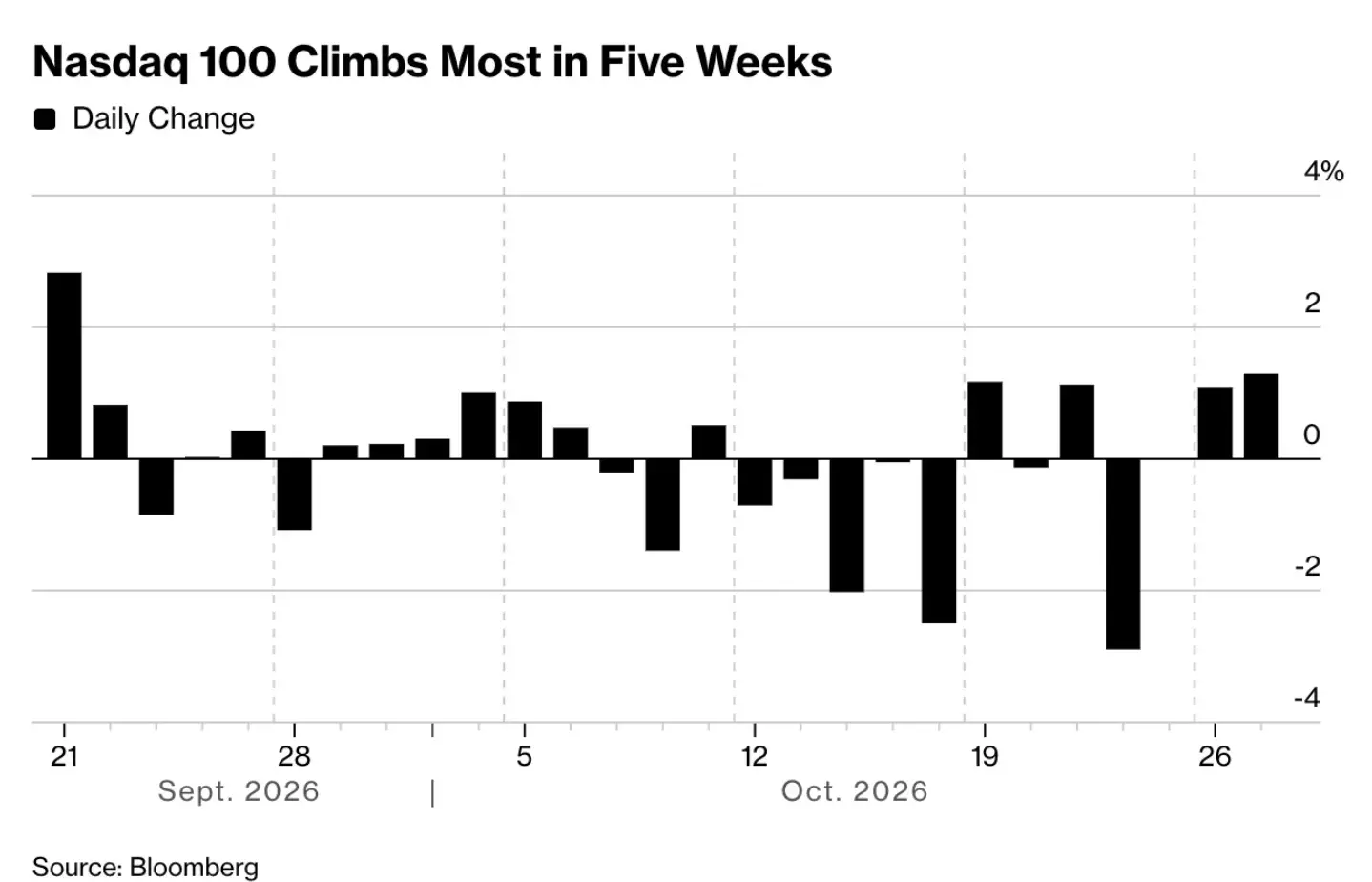
After last week's sell-off, AI trading has heated up again. On Tuesday, the Nasdaq 100 index rose by 1.3%, and the Philadelphia Semiconductor Index increased by 3.6%. The drop in oil prices also supported risk appetite, with major stock indices recovering some of the technical positions they had previously lost.
One important factor driving the recovery in sentiment is the market's renewed belief that AI infrastructure expansion can still secure financing.
Meta's $25 billion common stock issuance reportedly received about five times the subscriptions. The $63 billion financing arrangement involving Broadcom, along with Anthropic's IPO application, has also helped alleviate investors' concerns about the massive capital needs of the AI industry.
These developments indicate that the capital market is still willing to fund AI expansion. However, financing needs remain, and how much risk providers are willing to take and what conditions they require are gradually becoming important variables affecting this round of market activity.
The structure of the Broadcom transaction is particularly noteworthy. According to the company's announcement, Bank of America, Blackstone, Citigroup, and Morgan Stanley have committed to providing financing for a newly established special purpose vehicle (SPV), which will purchase Broadcom AI accelerators and networking equipment and lease them to Anthropic. Broadcom will provide residual value support equivalent to the first-priority financing amount. This means that the financing arrangement includes a risk-sharing mechanism for the future value of the equipment.
Therefore, this transaction cannot simply be understood as Broadcom borrowing $63 billion, nor can the completion of financing be directly equated with the verification of project returns.
In Innes's view, Meta's financing from the stock market and the introduction of large structured financing for computing power reflect changes in the AI investment cycle: the scale of construction continues to expand, and companies need to more actively mobilize external capital. Thus, financing capability has become part of industry competition.
Earnings Reports Must Address Return Questions
The rebound in stock prices does not mean that institutional funds have fully turned optimistic.
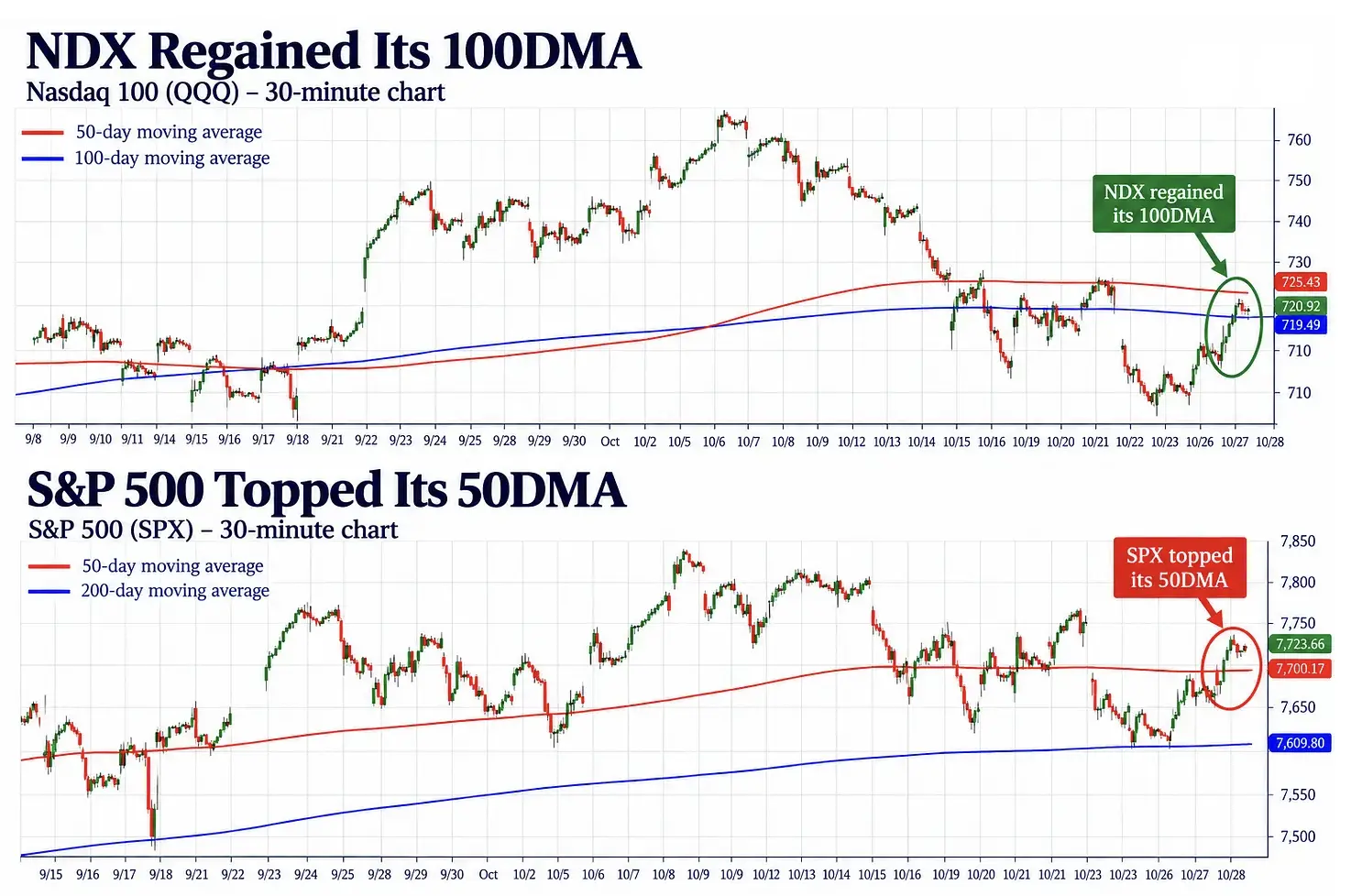
From a technical perspective, the Nasdaq 100-related ETF QQQ has regained the 100-day moving average, and the S&P 500 index has also returned above the 50-day moving average. However, price recovery does not imply that institutional funds have fully turned optimistic.
Innes cites observations from Goldman Sachs trading desks, stating that overall trading activity that day remained relatively light, with fund flows still leaning towards selling. Long-only institutional accounts continued to net sell in the communication services sector and macro products; although hedge funds slightly leaned towards net buying, the trading volume was limited. The risk exposure of fundamental long-short strategies also remains close to recent lows.
These observations correspond to the funds covered by trading desks and cannot directly represent the entire market. However, they highlight a noteworthy divergence: prices are recovering, yet positions remain cautious.
After a round of concentrated position reduction, short covering and buying on dips can drive a rebound. However, for the market to continue upward, stronger fundamental evidence is needed. Upcoming earnings reports and guidance from major cloud service providers like Alphabet, Microsoft, and Amazon will bear this verification task.
The questions of concern in the market are also changing. While the growth of AI demand remains important, investors also need to know whether this growth can generate returns sufficient to cover massive expenditures.
Capital expenditures (Capex), which include investments in building data centers and purchasing chips, will first consume cash; after equipment is put into use, depreciation will continue to be accounted for in costs. Utilization rates, service pricing, and customer demand determine how much revenue and profit these assets can contribute. Several factors combined create a complete picture of investment returns.
Therefore, even if major companies continue to increase AI spending, it may not be enough to drive stock prices. Investors also need to assess how long it will take for new investments to generate revenue, whether cash flow can keep up, and whether companies will need to continue financing in the future.
Innes's core judgment is that understanding the trend of AI proliferation and determining who can obtain sufficient profits from it are increasingly needing to be discussed separately.
The early AI market placed more emphasis on technological breakthroughs and scarce resources; now, financing, execution of construction, and capital returns are gaining higher weight. The industry's prospects remain attractive, but financial constraints are increasingly difficult to bypass.
Federal Reserve Influences Funding Costs
Whether AI companies can continue to secure financing also depends on the overall market's cost of capital.
At the time of publication, the market generally expects the Federal Reserve to maintain interest rates on October 28, but still sees the possibility of a rate hike in December. Therefore, the focus of this meeting is more on the press conference of Federal Reserve Chair Kevin Waller.
Innes believes that the resilience of economic data and the persistent inflationary pressures make it difficult for the Federal Reserve to clearly shift towards easing; however, in a situation where the market has fully anticipated a pause in rate hikes, immediate action could cause unexpected shocks.
Thus, the wording of the policy is particularly important. If Waller's statements lead investors to lower their expectations for future rate hikes, tech stock valuations may receive support; if he emphasizes the necessity of further tightening, short-term U.S. Treasuries may face selling pressure, pushing yields higher.
Bond prices and yields typically move inversely. For tech companies, rising interest rates can increase financing costs and reduce the present value of future profits. Companies whose valuations rely more on future growth are usually more sensitive to this.
The drop in oil prices has temporarily alleviated some inflation concerns. On Tuesday, Brent crude closed below $114 per barrel, with market expectations for progress in Middle Eastern diplomacy providing support. However, Innes warns that tight physical supply and unresolved regional issues mean that this drop may not be sufficient to establish a sustained downward trend.
He also observed that gold has risen above $4,050 per ounce, and Bitcoin has found support around $80,000. During the previous broad de-risking process, different assets were sold off together; the stabilization of these assets at least provides some signs of reduced forced selling pressure. However, a rebound in just a few asset classes is still insufficient to determine that the market has entered a new operating phase.
Next Steps Focus on Credit
The risks of this rebound may not first manifest as major stock indices falling sharply.
One downside scenario proposed by Innes is that funds first flow from the crowded AI sector to defensive industries and lower-volatility stocks, allowing major indices to maintain temporarily; if financing conditions subsequently tighten across a broader range of industries, the credit market may issue an early warning, leading to downward adjustments in corporate earnings expectations. If multiple asset classes begin to decline simultaneously afterward, systematic strategy reductions and risk mitigation may further amplify pressure on indices.
This is a risk transmission path that needs to be observed, not a result that the author deems inevitable.
For Tuesday, the market did show improvement: concerns about AI financing have eased, credit spreads have narrowed, oil prices have fallen, and tech stocks have regained some ground. The narrowing of credit spreads means that investors require less additional yield for holding corporate bonds compared to government bonds, which typically reflects a decrease in their concerns about credit risk.
However, these changes still need to be validated by earnings reports and subsequent financing conditions. If major cloud service providers can demonstrate that spending growth is supported by corresponding revenue and cash flow, and if the Federal Reserve's statements do not significantly raise interest rate expectations, the rebound may continue.
Conversely, if earnings reports reveal larger funding gaps and the cost of borrowing for companies rises again, the current sentiment recovery may still face challenges.
For the upcoming market, the variables worth tracking have become quite specific: whether the returns on new investments are clearer, whether financing conditions remain stable, and whether credit pressure spreads beyond the AI sector.
 Risk warning
 Risk warning



Popular articles