BTC $80,852.20 +1.57%
ETH $2,351.51 +2.11%
BNB $744.78 +1.23%
XRP $1.33 +2.31%
SOL $101.99 +2.25%
TRX $0.3309 +0.79%
DOGE $0.0796 +3.18%
ADA $0.2065 +1.60%
BCH $298.92 +6.47%
LINK $11.75 +3.67%
HYPE $81.43 +5.12%
AAVE $135.09 +2.72%
SUI $0.9376 +3.45%
XLM $0.1715 +2.35%
ZEC $1,314.84 +8.13%
AAPL $346.73 +1.00%
AMZN $254.00 +2.18%
GOOGL $325.27 +2.29%
MSFT $530.04 -0.21%
META $622.45 -1.42%
NVDA $218.99 +1.73%
TSLA $412.16 +5.26%
SNDK $1,370.77 +8.97%
INTC $95.46 +6.33%
SPCX $150.12 +2.00%
MU $971.32 +6.65%
AMD $570.41 +8.18%

kospi

All
Article
Flash

Goldman Sachs: Semiconductor exposure explains about 54% of the earnings difference, while oil prices account for only 2%

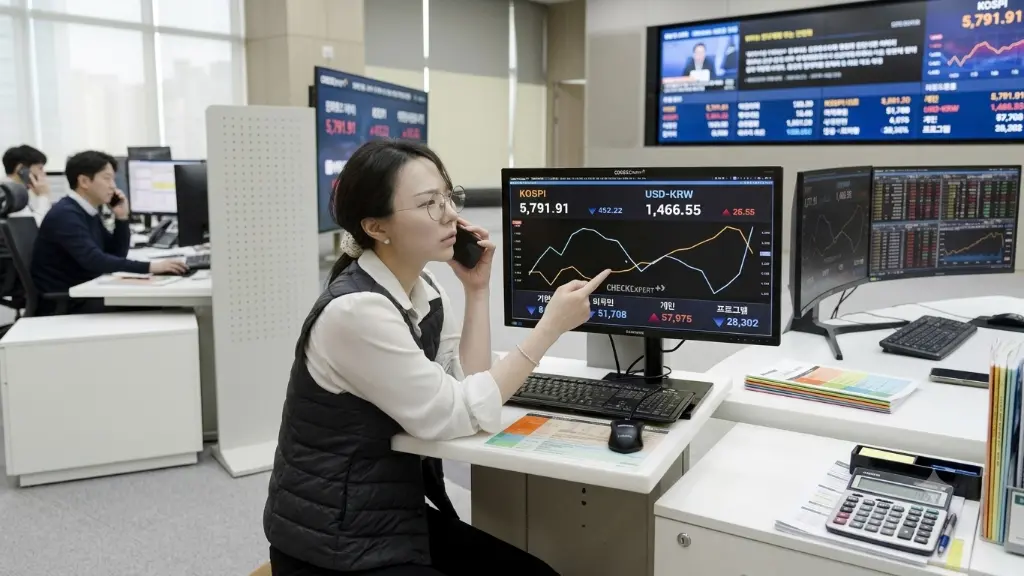
Goldman Sachs' latest research shows that over the past three weeks, semiconductor stock exposure has been able to explain about 54% of the return performance differences between different asset classes, while oil price exposure accounts for only 2%. As the influence of AI trading continues to expand, technology stocks are becoming an important factor driving global market risk appetite and asset performance differentiation.Goldman Sachs pointed out that recent investor risk appetite has been highly synchronized with the relative performance of large technology stocks. Last week, concerns about AI investment returns, financing costs, and capital expenditures intensified, leading to a sell-off in technology stocks and corporate bonds, with Goldman Sachs' risk appetite indicator falling to its lowest level since April 2025. The South Korean stock market has become a typical case of this impact, with the KOSPI rising 3.1% on Tuesday, and SK Hynix and Samsung Electronics increasing by 5.2% and 4.2%, respectively.Due to the high weight of semiconductor stocks in the Korea Composite Stock Price Index, changes in global AI investment expectations directly affect local market performance. Goldman Sachs emphasized that the 54% and 2% figures reflect a statistical relationship within a specific time window and do not imply that AI factors long-term determine global market fluctuations; the impact of high oil prices on inflation, monetary policy, and asset pricing cannot be ignored. Major technology companies such as Microsoft, Google, and Amazon are about to announce their earnings reports, and the market will focus on whether AI demand can continue to grow and whether massive capital expenditures can be converted into actual profits.

Bloomberg: South Korea's stock market becomes the first trillion-dollar market to fall below a price-to-earnings ratio of 5

According to Bloomberg data, the expected price-to-earnings ratio of South Korea's KOSPI index for the next 12 months has fallen to 4.2 times, becoming the first trillion-dollar market on record to drop below the 5 times threshold. Among the 18 markets with a market capitalization exceeding 1 trillion dollars at the beginning of this year, this situation has never occurred with a benchmark index before.The cooling of the AI boom has triggered a sell-off in technology stocks, putting pressure on the South Korean stock market. Although South Korea's exports are approaching 1 trillion dollars, the demand for chips from SK Hynix and Samsung Electronics remains strong, but investors are still unwilling to pay higher valuations for the earnings of related companies. The valuation of the South Korean stock market is now close to that of the Indonesian market, which is facing the risk of an MSCI downgrade, with the discount level further widening. Bloomberg comments that extremely low valuations may create space for future valuation recovery. If sentiment turns, South Korean stocks are expected to outperform other markets in the short term, but it is uncertain when the recovery will start and whether there will be further declines; a low price-to-earnings ratio itself does not mean that it has already hit bottom.

DeepSeek's new model adds to financing concerns, Asian chip stocks drop over 2%

According to Bloomberg, Asian semiconductor stocks continued to weaken on Monday. The Bloomberg Asia Chip Index fell more than 2%, reaching its lowest level since July, with TSMC, SK Hynix, and Advantest being the main drags. The Korea Composite Stock Price Index recorded its largest weekly decline since October 2008 last week, dropping more than 3% at one point on Monday before recovering some ground; the Nikkei 225 index fell 2.3% at one point, and the Taiwan Weighted Index dropped 2%.Market concerns stem from two aspects. First, the pressure on financing for AI infrastructure in the United States continues to ferment, with CoreWeave's financing capabilities being questioned and the IPO expectations for Anthropic and Nscale cooling. Second, Chinese AI company DeepSeek released a new model update over the weekend, claiming faster operation speeds and lower resource consumption, raising concerns about the potential decrease in storage capacity required for AI models and the possible impact on chip demand.Kang DaeKwun, CEO of Life Asset Management, stated that the market uncertainty is too high, making it difficult to determine when the Korean stock market will bottom out. Financing for U.S. corporate AI projects is one of the main risks, and the profitability of Korean chip companies still heavily relies on continuous investment in AI infrastructure by U.S. companies. This week, the earnings reports from tech giants like Meta and Tesla will be an important window to observe the growth momentum of AI capital expenditures.
app_icon
ChainCatcher Building the Web3 world with innovations.