Morning Report | Fidelity Q3 Signal Report: The net unrealized gains and losses of BTC, ETH, and SOL are all at historical lows, with multiple indicators approaching the capitulation zone; the South Korean Financial Commission plans to submit a unified digital asset bill, while the opposition party is simultaneously pushing for the repeal of the crypto tax

 July 29 Market Important Events Overview
Compiled by: ChainCatcher
What important events have occurred in the past 24 hours?
Thailand SEC accuses Bitkub executives of concealing $50 million hacker losses, has filed a criminal complaint
According to ChainCatcher, the Securities and Exchange Commission (SEC) of Thailand has filed a criminal complaint against the cryptocurrency exchange Bitkub Online and two former directors, Sakolkorn Sakavee and Thaweesap Rawan, accusing them of submitting false financial reports between May and October 2021. The case has been referred to the Economic Crime Suppression Division (ECD) for investigation, and the prosecution will decide whether to formally charge them. The SEC stated that Bitkub suffered a cyber attack in May 2021, resulting in the theft of 16 types of digital assets and losses exceeding $50 million. Regulatory investigations revealed that Bitkub did not reflect the related losses in its daily net capital report Form DA 1 from May 10 to October 30, 2021. The SEC claims that the relevant executives are suspected of making false statements in official company documents, leading regulators to believe that customer assets were intact and that the company did not suffer financial losses. Bitkub subsequently completed the acquisition of alternative assets in late October 2021, but the SEC believes that the reports during this period constituted false statements. Bitkub stated in a July 23 announcement that existing customer holdings are safe and accounts are complete. Bitkub claims that its co-founders purchased alternative assets of the same quantity and currency to bear the losses and reported the cyber theft incident to law enforcement on May 10, 2021.
Solana Policy Institute urges Senate to vote on Clarity Act cryptocurrency bill as soon as possible
According to ChainCatcher, the Solana Policy Institute in the United States has sent a letter to bipartisan leaders in the Senate, urging them to push the Clarity Act digital asset bill into the voting process before the congressional legislative window closes in early August. The bill aims to provide regulatory clarity for U.S. cryptocurrency developers, institutions, and consumers, and establish a "non-money transmission" safe harbor for non-custodial software developers through the Blockchain Regulatory Certainty Act. The latest Republican version also adds ethical provisions that prohibit federal officials and their spouses from issuing or sponsoring digital assets, with these provisions set to expire on January 20, 2029. The SPI stated that the bill helps prevent regulatory and criminal enforcement "overreach" against software developers, maintaining the momentum of domestic construction in the U.S.
Bitwise CIO: Interest rate decisions in the next five years will have less impact on Bitcoin than in the past fifteen years
According to ChainCatcher, Bitwise Chief Investment Officer Matt Hougan posted that interest rate decisions in the next five years will have less impact on Bitcoin than in the past fifteen years. He noted that since Bitcoin's inception, interest rates have fluctuated significantly between 0% to 2.5%, 0% to 5%, and 3.5%, with changes measured in whole percentage points, but future adjustments may be more moderate, with CME expecting interest rates to rise by only 50 basis points in the next year. Matt Hougan assesses that the Federal Reserve under Warsh may be closer to the slight adjustment style of the mid-1990s under Greenspan rather than the recent models of Bernanke and Powell. If this is the case, the smaller magnitude of interest rate changes will also weaken their impact on Bitcoin; while interest rates remain important, the weight of other factors will increase.
Goldman Sachs: If the Federal Reserve remains inactive today, the foreign exchange market will focus on future rate hike probabilities
According to ChainCatcher, Goldman Sachs economists expect the Federal Reserve to remain inactive before announcing its interest rate decision, with the uncertainty surrounding this decision exceptionally high. They predict at least one dissenting vote in favor of a rate hike. In a report, they stated that energy price fluctuations caused by the war have cast a shadow over the outlook. Current market pricing shows that the probability of a rate hike today is about 30%. Goldman Sachs stated that if the Federal Reserve maintains interest rates today, the focus of the foreign exchange market will be on how much of the previously reflected rate hike expectations will shift to subsequent meetings. Data from the CME shows that investors have priced in expectations for a rate hike in September.
Today's key focus on important economic data and events from Switzerland, the UK, and the US
According to ChainCatcher, today's key economic data and events to watch include: 16:00 Switzerland July ZEW Investor Confidence Index, 16:30 UK June Bank of England Mortgage Approvals, 22:30 US EIA Crude Oil Inventories for the week ending July 24, EIA Cushing Crude Oil Inventories, and EIA Strategic Petroleum Reserve Inventories, followed by the Bank of Canada releasing the monetary policy meeting minutes at 01:30 the next day, the Federal Reserve FOMC announcing the interest rate decision at 02:00 the next day, and Federal Reserve Chairman Warsh holding a press conference at 02:30 the next day, with Meta, Microsoft, Qualcomm, and ARM releasing earnings reports at 04:00 the next day.
Analysts: Any dovish signals from the Federal Reserve could benefit Bitcoin
According to ChainCatcher, analysts stated that any dovish signals from the Federal Reserve could benefit Bitcoin. There is significant divergence in the market regarding whether the Federal Reserve will raise rates on Wednesday—CME FedWatch data shows a 70% probability of maintaining rates and a 30% probability of an unexpected 25 basis point hike. Block Scholes analyst Thahbib Rahman pointed out that the Federal Reserve Chairman Kevin Warsh's reduced use of forward guidance has increased market uncertainty, making this FOMC meeting one of the most uncertain in years. Bitcoin has risen about 6% so far in July, while the S&P 500 has remained flat, and the semiconductor sector has dropped nearly 20%. K33 Research's research director Vetle Lunde stated that the Nasdaq was previously strong and positions were stretched, while Bitcoin has continued to consolidate near multi-year lows, with the correlation between the two weakening. The impact of this week's FOMC meeting on BTC may be limited. Rahman stated, "Any dovish signals could drive Bitcoin to continue outperforming."
Bank of Japan needs to accelerate interest rate hikes to support yen appreciation
According to ChainCatcher, T. Rowe Price portfolio manager Vincent Chung stated that the Bank of Japan is expected to maintain interest rates on Friday but may signal a faster pace of rate hikes. He pointed out that if the Bank of Japan accelerates the normalization of its policy, there could be two more rate hikes this year. For the yen to achieve significant and sustained appreciation, a faster tightening of monetary policy, a decrease in energy prices, and more coordinated exchange rate intervention measures are needed.
South Korean Financial Commission plans to submit unified digital asset bill, opposition party pushes for repeal of crypto tax
According to ChainCatcher, the Financial Services Commission (FSC) of South Korea plans to draft a unified "Basic Law on Digital Assets" government bill in collaboration with the ruling Democratic Party, covering stablecoin issuance and circulation, digital asset business rules, exchange admission requirements, information disclosure, internal control, and system resilience standards. Currently, there are 10 related bills pending review in the National Assembly, but there has not been consensus on core disputes such as whether the issuer of stablecoins must be a bank holding company and whether to implement shareholding restrictions on major exchanges. The FSC has not yet determined the timeline for submitting the bill. Meanwhile, the opposition People's Power Party lawmaker Song Yeon-sik's amendment to repeal the crypto income tax, proposed in March, was submitted to the National Assembly's Finance and Economy Planning Committee for review on Wednesday. Additionally, a petition to repeal the tax, supported by over 50,000 people, is expected to be submitted to the petition subcommittee. According to the current plan, starting January 1, 2027, annual crypto transfer or lending income exceeding 2.5 million won will face a 20% income tax plus a 2% local tax. The government and ruling party support timely implementation, while the opposition believes it is unfair to tax crypto when most ordinary stock investors remain tax-exempt.
AI security company Cyera agrees to acquire Oasis Security for $1 billion
According to ChainCatcher, AI data security company Cyera announced on Tuesday that it has signed a letter of intent to acquire Oasis Security for approximately $1 billion, with the transaction expected to be primarily in cash, with the remainder paid in Cyera shares. Cyera recently completed a $600 million financing at a valuation of $12 billion. Oasis focuses on non-human identity security, such as AI agents, and was founded in 2022, raising approximately $195 million in total funding from investors including Accel, Craft Ventures, and Cyberstarts. Cyera and Oasis share some investors and have recently acquired Ryft and Genie Security. After the acquisition, Cyera plans to integrate Oasis's technology into a unified identity and data security platform. Cyera has an annual recurring revenue of over $150 million but is not yet profitable, having raised approximately $2.3 billion over five years.
Central Bank of Russia releases draft regulations for cryptocurrency exchanges and custodians
According to ChainCatcher, the Central Bank of Russia (CBR) has released a draft of regulatory rules for the cryptocurrency market, covering registration and operational requirements for cryptocurrency exchanges, digital custodians, and token issuers. The draft stipulates that the minimum net assets of digital custodians must be between 50 million and 250 million rubles (approximately $600,000 to $3 million), with the specific amount depending on the nature of the business. These rules will complement the "Digital Currency and Digital Rights Law" passed by the State Duma of Russia earlier this month, which is expected to come into effect on September 1, 2026. Under the new framework, non-qualified investors can only purchase mainstream assets like BTC, ETH, and USDT each year, with a cap of $4,000; industry participants will have a transition period until March 1, 2027, to complete compliance and approval procedures.
Morgan Stanley MSSE ETF listed, Ethereum spot ETF saw total net inflow of $14.53 million yesterday
According to ChainCatcher, on July 28, Eastern Time, the Morgan Stanley Ethereum Trust (MSSE) was officially listed on NYSE Arca, bringing the total number of listed ETH spot ETFs to 11. According to SoSoValue data, the net inflow on the first day of MSSE's listing was $5.15 million, with a trading volume of $19.03 million and a total net asset value of $6.18 million. The Ethereum spot ETF with the highest single-day net inflow yesterday was Blackrock's ETF ETHB, with a net inflow of $5.91 million, bringing ETHB's historical total net inflow to $529 million. As of the time of writing, the total net asset value of Ethereum spot ETFs is $10.5 billion, with an ETF net asset ratio (market cap compared to total Ethereum market cap) of 4.53%, and historical cumulative net inflow has reached $11.21 billion.
HSBC: Federal Reserve's decision to maintain interest rates could lead to a weaker dollar
According to ChainCatcher, HSBC analyst Daragh Maher pointed out in a report that given the market has digested some rate hike expectations, if the Federal Reserve announces that it will maintain interest rates, the dollar may weaken. He stated that at least three Federal Reserve members would need to vote in favor of a rate hike to suppress the dollar's initial decline. Maher said, "If the pace of rate hikes is faster than expected, it will force the market to consider whether this is the first hike in a series of rate hikes."
JPMorgan: Federal Reserve maintaining interest rates is the baseline scenario, dovish stance is most beneficial for U.S. stocks
According to ChainCatcher, JPMorgan expects the Federal Reserve to maintain interest rates, with the scenario of "maintaining rates but leaning hawkish" (probability of 50%) as the baseline scenario, which could lead to the S&P 500 remaining flat or declining by 0.5%. The scenario of "maintaining rates but leaning dovish" (probability of 28%) is viewed as the most beneficial for the market, potentially driving the index up by as much as 1%. A 25 basis point rate hike (probability of 20%) could lead to the S&P 500 declining by 1.5% to 2%.
Circle EU Policy Director: MiCA stablecoin regulation has significant gaps, need to introduce recognition mechanism for foreign tokens
According to ChainCatcher, Patrick Hansen, Circle's Senior Director of Strategy and Policy in the EU, pointed out that since the implementation of the EU's Markets in Crypto-Assets Regulation (MiCA), approximately 35 electronic money tokens (EMTs) have received compliance certification from 21 institutions, with banks and electronic money institutions entering the market and local issuance momentum being good. However, among the top 50 stablecoins globally, only USDC, USDG, and EURC currently meet MiCA requirements, while the rest fall outside the regulatory framework, leaving EU users facing a dual dilemma of lack of protection or being forced to cut off access. Hansen believes that for MiCA to truly become a global regulatory blueprint, it must achieve two goals simultaneously: first, to promote local EMTs to go global through competitive systems; second, to establish a recognition mechanism for compliant foreign stablecoins to attract global issuers into the MiCA regulatory framework, rather than making local issuance the only entry path.
Binance to add 10 bStocks tokenized securities as collateral assets
According to ChainCatcher, Binance will add 10 bStocks tokens—Apple (AAPLB), Bloom Energy (BEB), Amazon (AMZNB), Direxion Semiconductor Bear 3X ETF (SOXSB), Dell (DELLB), Fluence Energy (FLNCB), Applied Materials (AMATB), PayPal (PYPLB), Goldman Sachs (GSB), and VanEck Semiconductor ETF (SMHB)—as eligible collateral assets on July 29, 2026, at 20:00. Eligible users can use these bStocks tokens as margin collateral, expanding the collateral options for margin trading.
Federal Reserve meeting voting preview, two hawkish dissenting votes basically locked in
According to ChainCatcher, institutions are conducting a preview analysis of the Federal Reserve meeting voting situation. TD Securities and JPMorgan expect two hawkish dissenting votes, mainly from Harmack and Logan. Commonwealth Bank of Australia and Citibank believe there may be one or two officials dissenting in favor of a rate hike. UBS predicts that if rates are maintained, there will likely be 8 to 10 votes in favor. Prediction markets show that the probability of Harmack and Logan casting dissenting votes is 58% each.
UK FCA: Stablecoins have the greatest potential for cross-border payments, domestic retail adoption remains limited
According to ChainCatcher, the UK's Financial Conduct Authority (FCA) released a policy research report on "Stablecoin Sprint," gathering opinions from industry participants including banks, payment companies, and stablecoin issuers. The report pointed out that stablecoins have recently shown the most significant advantages in cross-border payments, especially helping emerging markets with limited access to dollar channels; however, in the UK domestic retail payment scenario, the existing payment system is already relatively fast and inexpensive, leading to a lack of consumer motivation to switch, and the pace of adoption is expected to lag. The findings of this research have been incorporated into the final regulatory rules released by the FCA on June 30, which require that stablecoins issued in the UK must be fully backed by reserve assets and redeemable at par value.
Federal Reserve decision could push USD/JPY to 164 yen level
According to ChainCatcher, Hirofumi Suzuki, chief forex strategist at Sumitomo Mitsui Banking Corporation, stated that the Federal Reserve's interest rate decision and Chairman Warsh's speech could push the USD/JPY exchange rate to the 164 yen level. If this occurs, given that Japanese financial authorities have already intensified warnings, the possibility of foreign exchange intervention will significantly increase. If the yen continues to depreciate after the Bank of Japan's monetary policy meeting on Friday, this could trigger intervention.
Binance adds bStocks trading pairs
According to ChainCatcher, Binance will launch bStocks tokenized securities trading pairs on July 29, 2026, at 20:00, including Apple (AAPLB), Applied Materials (AMATB), Amazon (AMZNB), Bloom Energy (BEB), Dell (DELLB), Fluence Energy (FLNCB), Goldman Sachs (GSB), PayPal (PYPLB), VanEck Semiconductor ETF (SMHB), and Direxion Semiconductor Bear 3X ETF (SOXSB) for spot trading. Users can enjoy a fee-free exchange service within one hour after the launch, and withdrawal services will open at 21:00 on the same day.
Oil price trends significantly impact Federal Reserve interest rate expectations
According to ChainCatcher, Bas Kooijman, an economist at DHF Capital S.A., stated in a report that oil price trends have become a key driver of U.S. Treasury yields and market expectations for the Federal Reserve's interest rate path. The outlook may change with the evolution of the situation in the Middle East and oil prices. A further sustained decline in oil prices could exacerbate inflation slowdown pressures and suppress expectations for monetary policy tightening, while a resurgence in tensions could reignite inflation concerns and push up U.S. Treasury yields.
RL1 blockchain network launches operations, underlying platform processes over 700 million euros in transactions in three years
According to ChainCatcher, ten European financial institutions have jointly launched Regulated Layer One (RL1), which has been established and begun operations in Luxembourg as a European cooperative, targeting regulated financial markets and tokenized assets. Founding members of RL1 include ABN AMRO, Cecabank, Chartered Investment, Crédit Mutuel Alliance Fédérale, DekaBank, DZ BANK, LBBW, Natixis CIB, SC Ventures, and Seturion. RL1 stated that each member has equal decision-making power in network governance and development. This private permissioned network is based on infrastructure developed by the German fintech company Secure Worldwide Interbank Asset Transfer (SWIAT), which has transferred ownership of the network to the cooperative. SWIAT stated that the platform processed over 50 transactions, amounting to more than 700 million euros, during its three years of production use. RL1 is designed for digital currencies, tokenized bonds, collateral, and blockchain-based settlement. RL1 will be led by former SWIAT Managing Director Henning Vollbehr, with KfW and L-Bank continuing to support the initiative, and RL1 is in discussions with more institutions like NatWest to join the network.
Probability of Federal Reserve maintaining interest rates is 69.5%, probability of rate hike in September rises
According to ChainCatcher, CME "Fed Watch" shows that the probability of the Federal Reserve maintaining interest rates in July is 69.5%, while the probability of a cumulative 25 basis point rate hike is 30.5%. By September, the probability of maintaining rates drops to 23.4%, while the probability of a cumulative 25 basis point rate hike rises to 56.4%, and the probability of a cumulative 50 basis point rate hike is 20.2%.
Fidelity Q3 Signal Report: BTC, ETH, and SOL's net unrealized gains and losses are at historical lows, multiple indicators are close to the capitulation zone
According to ChainCatcher, Fidelity Digital Assets released its Q3 signal report for 2026, indicating that the prices and market sentiment indicators for BTC, ETH, and SOL are generally at historical lows, with multiple indicators approaching the capitulation zone. Fidelity believes that the current valuation levels may correspond to attractive long-term entry conditions. As of the end of the second quarter, the weighted net unrealized profit and loss (NUPL) net value was -0.01, with BTC being the only asset with a positive unrealized profit, approximately 10% above its cost basis, with an unrealized profit of about $108 billion, while ETH and SOL are approximately 30% and 41% below their cost basis, with unrealized losses of about $87 billion and $29 billion, respectively, and BTC's market share has risen to 68% quarter-over-quarter. The report states that historical backtesting shows that the current NUPL readings for the three correspond to one-year median returns of 53%, 70%, and 542%, but the reliability of the samples decreases sequentially, with SOL's reading having only occurred 21 times historically and concentrated at the end of 2025, making it statistically limited. On the fundamental side, the stablecoin transfer values for ETH and SOL have both reached new highs, exceeding $20 trillion and $2.6 trillion, respectively, over the past 12 months, but network fee revenues continue to decline. Additionally, the report attributes the 22% decline in BTC hash rate from its peak to miners shifting computing power to AI and high-performance computing, as AI contract revenues are more stable due to low coin prices.
Stablecoin lending protocol Ebisu Finance announces gradual shutdown, front end will be deprecated in three months
According to ChainCatcher, Ebisu Finance, a stablecoin lending protocol, announced today that it has decided to gradually shut down the project. Users need to quickly close remaining Troves, withdraw Stability Pool deposits, and DEX liquidity for ebUSD, as ebUSD minting has been suspended, and the front end will be deprecated in three months on October 30. The protocol is a fork of Liquity V2, supporting new collateral types and adjustable risk parameters, having operated for over a year and passed two audits. Ebisu aimed to provide fixed-rate, open-term credit through ebUSD, with collateral including blue-chip yield-generating assets like LRTs, but the team failed to expand ebUSD liquidity to support meaningful lending scales. The project explored multiple solutions, including liquidity optimization, multi-chain expansion, structured products, and acquisition opportunities, none of which resolved the core bottleneck of the CDP protocol: stablecoin liquidity and sustainable demand. The team stated there are no plans for an EBISU token launch or airdrop and thanked supporters, welcoming other teams to contact them for licensing their tech stack.
Grayscale CEO applies to sell shares of GXRP ETF, becoming the third insider to cash out
According to ChainCatcher, Grayscale CEO Peter Mintzberg submitted Form 144 to the U.S. Securities and Exchange Commission (SEC) to sell 2,611 shares of the Grayscale XRP Trust ETF (GXRP), valued at approximately $53,400, equivalent to $20.45 per share. Previously, founder Barry Silbert and Chief Legal Officer Craig Salm submitted similar applications in January, when the price per share was about $37, making Mintzberg's selling price about 45% lower. Notably, the number of circulating shares of GXRP has plummeted from 5.79 million to 2.84 million over the past six months, a decrease of about 51%, reflecting ongoing redemption pressure exceeding subscription. Currently, the total net asset value of the U.S. spot XRP ETF is approximately $971.6 million, with GXRP accounting for about 6%.
ING: Middle East conflict reminds investors to remain cautious about the euro
According to ChainCatcher, Francesco Pesole, an analyst at ING, pointed out in a report that the resumption of military strikes in the Middle East reminds investors to remain cautious about the euro against the dollar exchange rate. He stated that for the euro to ensure a sustained rise above $1.15, the market needs to lower expectations for U.S. rate hikes through data or communications from the Federal Reserve, while risk sentiment also needs to stabilize. If the market's general optimistic expectation that the conflict situation will ease is correct, then the euro against the dollar exchange rate has likely bottomed out.
Rising oil prices exacerbate inflation concerns, UK government bond yields rise
According to ChainCatcher, due to the resumption of hostilities between the U.S. and Iran, rising oil prices have intensified inflation concerns, leading to an increase in UK government bond yields. Tradeweb data shows that the yield on UK 10-year government bonds rose by 1.2 basis points, currently reported at 4.969%. Investors are awaiting interest rate decisions from the Federal Reserve and the Bank of England.
Meme Popularity Rankings
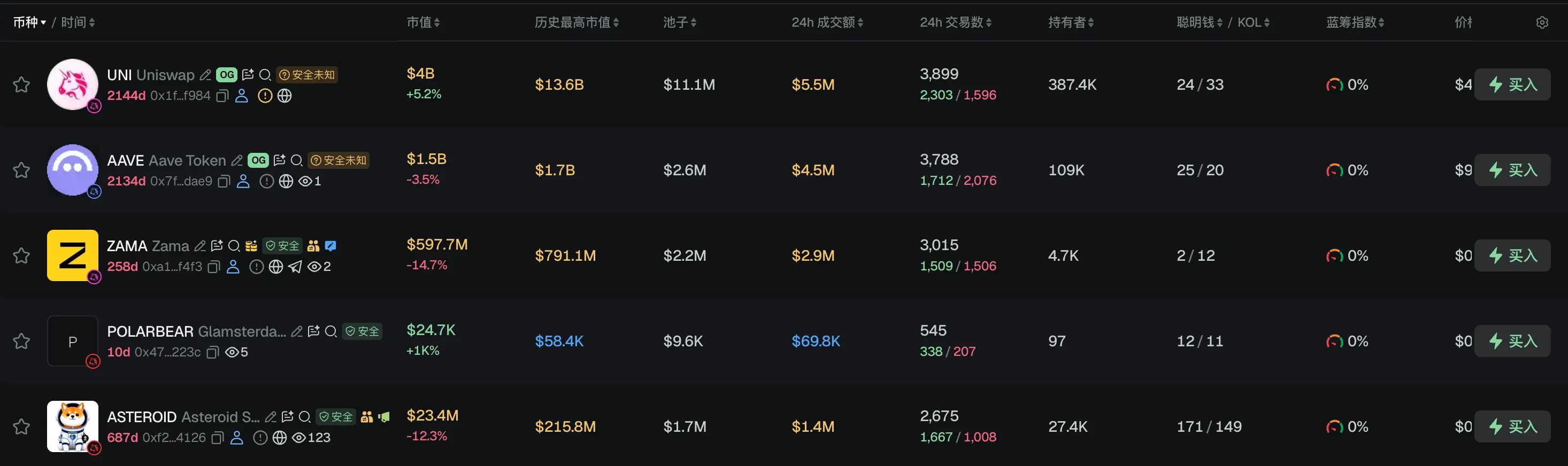
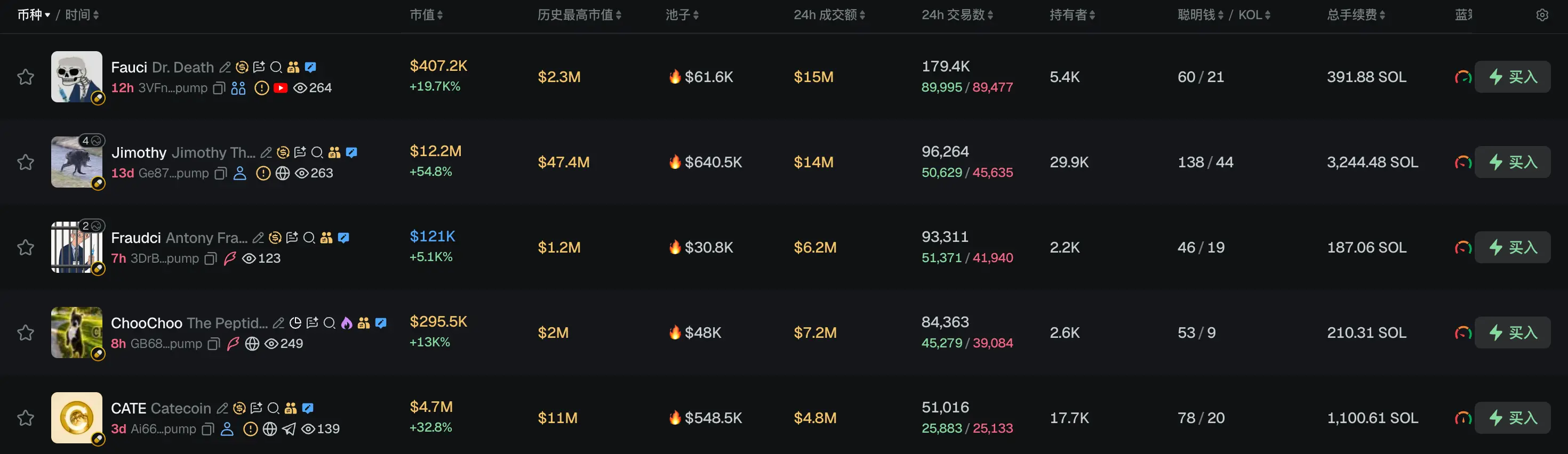
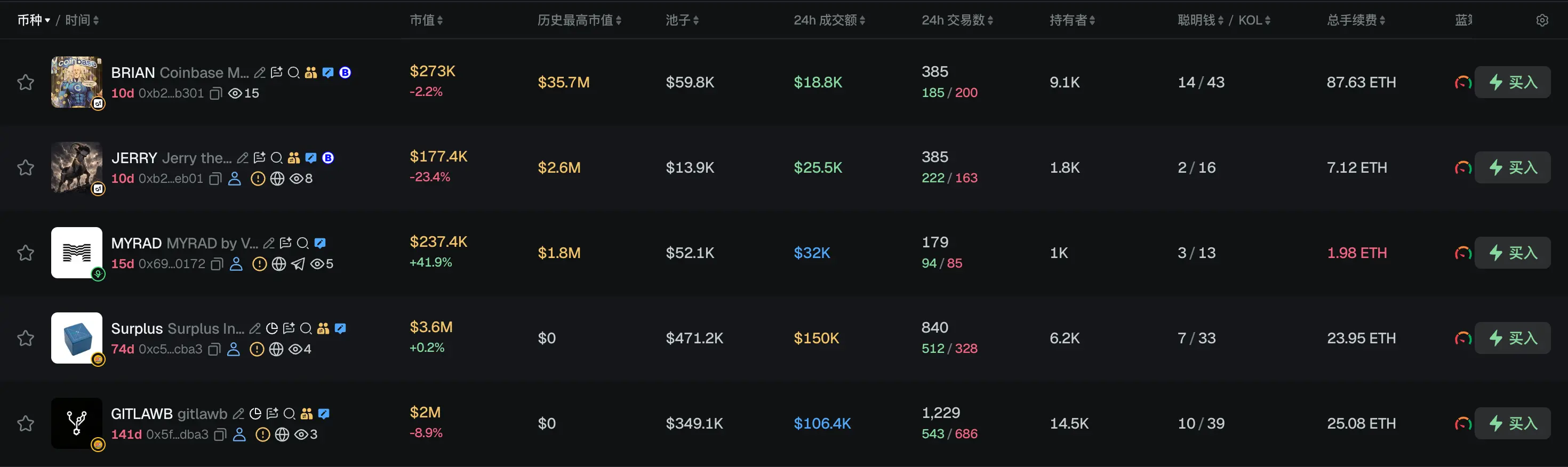
According to the meme token tracking and analysis platform GMGN, as of July 30, 09:30,
The top five popular tokens in the past 24 hours for ETH are: UNI, AAVE, ZAMA, POLARBEAR, Ferret
The top five popular tokens in the past 24 hours for Solana are: Fauci, Jimothy, Fraudci, ChooChoo, CATE
The top five popular tokens in the past 24 hours for Base are: ELSA, O, OPG, SOSO, EDEL
What are some noteworthy articles to read in the past 24 hours?
What is Coinbase restructuring with five executives changed in a month?
Conclusion: In the context of pressure on trading volume, regulatory phase victories, and leaps in AI capabilities, what kind of company does Coinbase want to become? The answer is beginning to take shape. This adjustment may aim to reduce reliance on a single cryptocurrency trading cycle, using broader asset coverage and higher operational efficiency to exchange for a more stable base, while also laying out in advance for the payment and trading demands that AI agents may bring. This round of leadership adjustments addresses the issues of organizational priorities and strategic focus. The real test is whether this combination can deliver results during a weak cycle.
In the early days of BTC, ETH, and SOL, a large amount of asset supply was moved or allocated without public market prices. For example, some early BTC tokens were transferred when market prices had not yet formed; ETH and SOL experienced early token issuance, presales, pre-mining, seed round financing, and foundation allocations. These early distributions can affect realized prices and are sometimes accounted for at costs above subsequent public market prices. When market prices fall below realized prices, the cumulative unrealized losses across the network may exceed the current total market value, pushing NUPL below -1.0. As the network matures and on-chain transaction history accumulates, realized market value will reflect more of the true market transactions rather than early distribution events. Therefore, the reference value of NUPL typically increases as the network matures.
Why is the "last mile" of the CLARITY Act not feasible?
From a timing perspective, the midterm elections in November 2026 are a key variable affecting the subsequent process of the bill. Most analyses suggest that if the window before the August recess is missed, the likelihood of the bill resuming discussions in the fall will be significantly compressed due to disputes over appropriations bills and the approaching election cycle, with substantial progress likely to wait until 2027, which itself will be in a political reshuffling phase after the midterm elections, greatly reducing the chances of the bill continuing the previous bipartisan consensus. Some industry lobbyists have proposed an alternative path to incorporate the core provisions of the CLARITY Act into a comprehensive bill that must be passed by the end of the year, but so far no senator has publicly confirmed that this strategy is being seriously considered.
The most uncertain one in years! Will tonight's Federal Reserve meeting give a "shock"?
In commodities, Goldman Sachs' oil trading desk stated that the risk premium for oil is rapidly dissipating due to a de facto ceasefire between the U.S. and Iran over the weekend, and negotiations to reopen the Strait of Hormuz are advancing. However, the upside risks have not disappeared; if attacks on Saudi oil facilities or production continue, oil prices may rise again. Gold has fluctuated within a range of about $250 over the past two months, and the trading desk remains bullish in the long term but prefers tactical trading around news events. This means that tonight's key is not just whether interest rates change, but how Warsh explains "no change" or "change." With the market already pricing in the risk of a rate hike and economists almost unanimously expecting a pause, whichever side the Federal Reserve chooses may bring a significant shock to the market.
Storage plummets, a night of fright
Although it typically takes 18 to 24 months for a wafer fab to go from construction to capacity realization, Samsung's P5 factory is scheduled for mass production in the second half of 2027. TrendForce also judges that before then, the supply-demand imbalance for DRAM is unlikely to fundamentally change, but stock market trading is always about expectations rather than the present. It can be said that Korea's super expansion plan has shattered the market's fantasy of "sustainable high chip prices." The "night of fright" in the storage sector is essentially a disconnect between fundamentals and expectations. Now, the sensitive capital market has begun to price in the potential oversupply for 2027 in advance. According to "big short" Barry's expectations, the time window for concentrated mass production of new factories in Korea from the second half of 2027 to 2028 is the real test for the storage industry.
The breadth of coverage reflects the converging judgment throughout: macro and micro transaction models may start in independently existing ecosystems, but over time, they are likely to connect through shared trust, identity, and settlement layers. This market is still in its early stages, and many key infrastructures have yet to be solidified. Those institutions that participate now in building trust mechanisms, expenditure controls, and protocol interoperability are most likely to continue to occupy core positions after agent-based commerce scales up.
What do I actually do with all this? I won't provide you with a portfolio, nor will I tell you when the market will bottom. Thirteen years of experience tell me I can't predict market timing, and neither can you; pretending you can will only lead you to sell at $2,000. What I want to tell you is what my earlier frankness really means. This is a long-term game, and it's emotional because all our livelihoods are tied to it. The ultimate winners are not those with the highest trading skills, but those who truly understand the assets they hold, firmly believe that network adoption is inevitable, and can withstand the 50% declines that occur every few years like clockwork. Zoom out. Eliminate distractions. Control the treasury, control the track, and let the curve do the work I've been trying to beat for ten years.
The company stated that thanks to record profits and cash generation capabilities, financial flexibility has significantly improved. However, strong demand also means greater capital expenditure pressure. SK Hynix expects capital expenditures to reach the upper end of the range of 40 trillion to 50 trillion won in 2026. The company is accelerating the mass production schedule of M15X and preparing to rapidly expand capacity after the cleanroom of Longyin Phase I is put into use in early 2027. Additionally, the company mentioned medium to long-term investment plans for P&T7 advanced packaging facilities, M17 NAND production bases, and new semiconductor clusters. These projects will be advanced in phases based on customer demand and investment efficiency. For investors, the key question will be whether SK Hynix can maintain capital expenditure discipline while AI demand remains high, and avoid oversupply expansion that could erode profit margins in the next phase.
 Risk warning




Popular articles