Castle Labs: Why did the six major protocols earn 7.4 billion dollars this year while the coin prices are still falling?
 Core Viewpoint

 Since the beginning of this year, crypto protocols have generated a total revenue of $7.42 billion, but most tokens have not increased in value as a result. This article takes six leading protocols, including Aave, Hyperliquid, Pump, and Uniswap, as examples to explain why the profitability of protocols does not equate to profits for holders, from four dimensions: sources of income, value distribution, token unlocking, and incentive spending.
Author: Castle Labs
Compiled by: Jiahua, ChainCatcher
Since the beginning of this year, crypto protocols have generated a total revenue of $7.42 billion. Despite delivering such impressive numbers, the prices of most crypto tokens still do not reflect the success of the protocols themselves.
The reason lies in the fact that not all revenue holds the same value. This disconnect is related to the long-standing project architecture and token design in the crypto industry. However, the situation is changing, and the way investors evaluate tokens is also evolving. They are increasingly focused on how products generate revenue, how that revenue is distributed, and whether token holders can truly share in the value brought by the growth of the protocol. This marks a shift in the market from speculation to investment.
Most of the time, token holders want to clarify the following questions:
How does the protocol generate revenue, and is that revenue sustainable?
How is the revenue distributed by the protocol, and can token holders derive value from it?
How much of the value created by the protocol is diluted by token issuance, unlocking, and incentive spending?
Does the project have an equity structure that grants shareholders greater economic rights than token holders?
Answering these four questions can essentially determine the true quality of a project, but most projects cannot provide clear answers. Each token's value capture mechanism is different, and some even lack a value capture mechanism altogether. Even if the protocol does return value to holders, the performance of the token price may not meet expectations.
Take @PumpFun as an example. Since the token was launched, the protocol's annualized revenue has been about $450 million, but the token price has continued to decline due to multiple factors, including rapid token unlocking and unmet market expectations for airdrops.
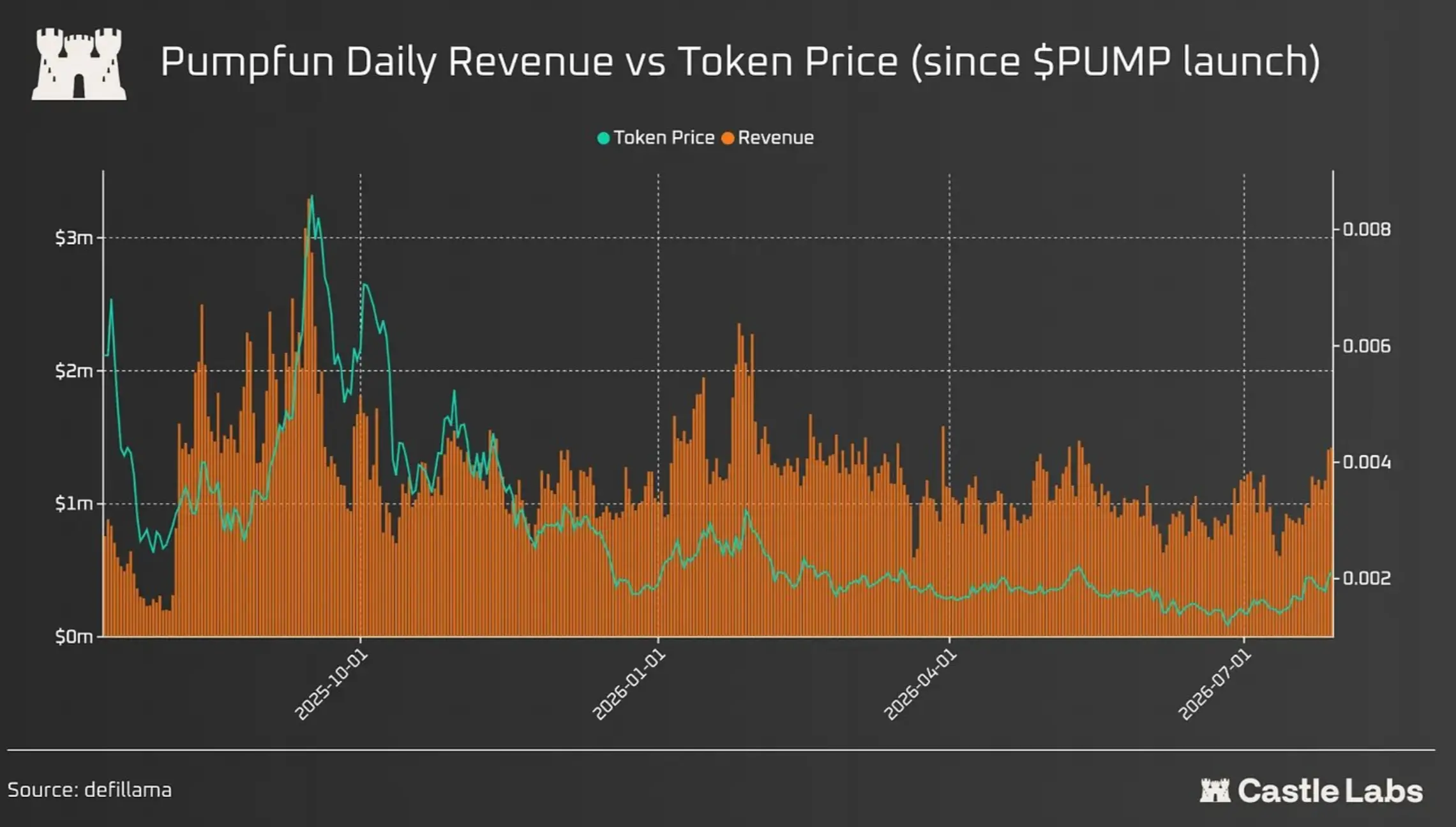
This article will outline the different ways top protocols create and distribute revenue, and will include token issuance, unlocking, and incentive spending in the calculations, presenting the subtle differences that investors need to consider when evaluating a protocol or token.
Sources and Distribution of Revenue for Crypto Protocols
Before discussing how token holders capture value, a fundamental question must first be answered: How much revenue do these protocols' main products generate, and how is that revenue distributed?
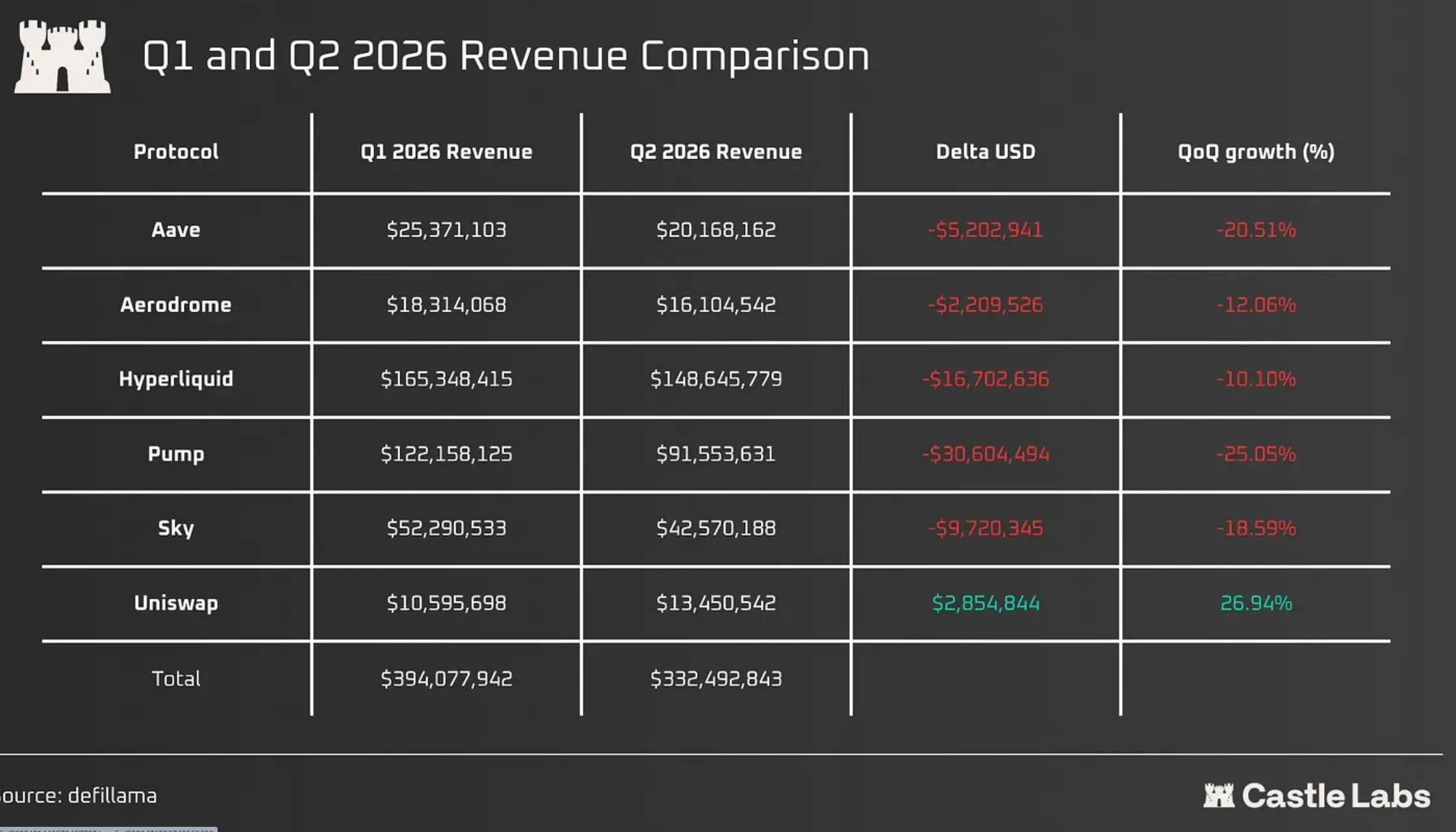
This article selects six protocols for analysis: @Aave, @AerodromeFi, @HyperliquidX, Pump, @SkyEcosystem, and @Uniswap. Together, they generated a total of $726 million in revenue in the first half of 2026.
Higher revenue usually indicates that the product has reached a certain scale, but looking at revenue alone is still insufficient to determine whether the business is sustainable. To eliminate the impact of short-term fluctuations, a more reasonable approach is to observe revenue performance over different time spans to assess whether the revenue is stable.
Therefore, the following sections also compare the revenue of these protocols in the first and second quarters of 2026 and calculate the changes between the two. For most protocols, this change is negative, reflecting a decline in performance in the second quarter amid a weakening overall market environment.
First, let's look at the sources of revenue for these protocols. Hyperliquid's revenue primarily comes from perpetual contract exchanges, including trading fees from the native market and HIP-3 market, as well as spot market fees, Builder Code auctions, priority fees, and gas fees from HyperEVM.
Aerodrome is a decentralized exchange, with revenue mainly coming from exchange fees and external voting incentives; Uniswap also generates revenue through exchange fees. Sky's revenue comes from multiple businesses, including stability fees from DAI and USDS lending, liquidation penalties, trading fees from the Peg Stability Module (PSM), and interest income from the Direct Deposit Module (D3M) and Real World Assets (RWA).
Aave's revenue comes from the portion of borrowing interest attributable to the protocol, as well as flash loan fees, liquidation penalties, and interest income from the native stablecoin GHO. PumpFun's revenue primarily comes from trading fees and fees charged when newly created tokens reach a specified market cap and "graduate" from the joint curve.
After sorting out the sources of revenue, it is also necessary to compare holder income with token issuance, unlocking, and incentive spending. The value returned to holders by the protocol may be high, but if new supply and incentive spending are higher, the actual value capture will still be diluted.
A protocol could generate $100 million in revenue each year, but if it needs to issue $200 million worth of token incentives annually to maintain operations, the value of that $100 million in revenue would be significantly discounted. Token issuance and unlocking are important because they reflect how much new tokens flow into inflationary issuance, team and investor unlocks, and, most critically, ecosystem incentives.
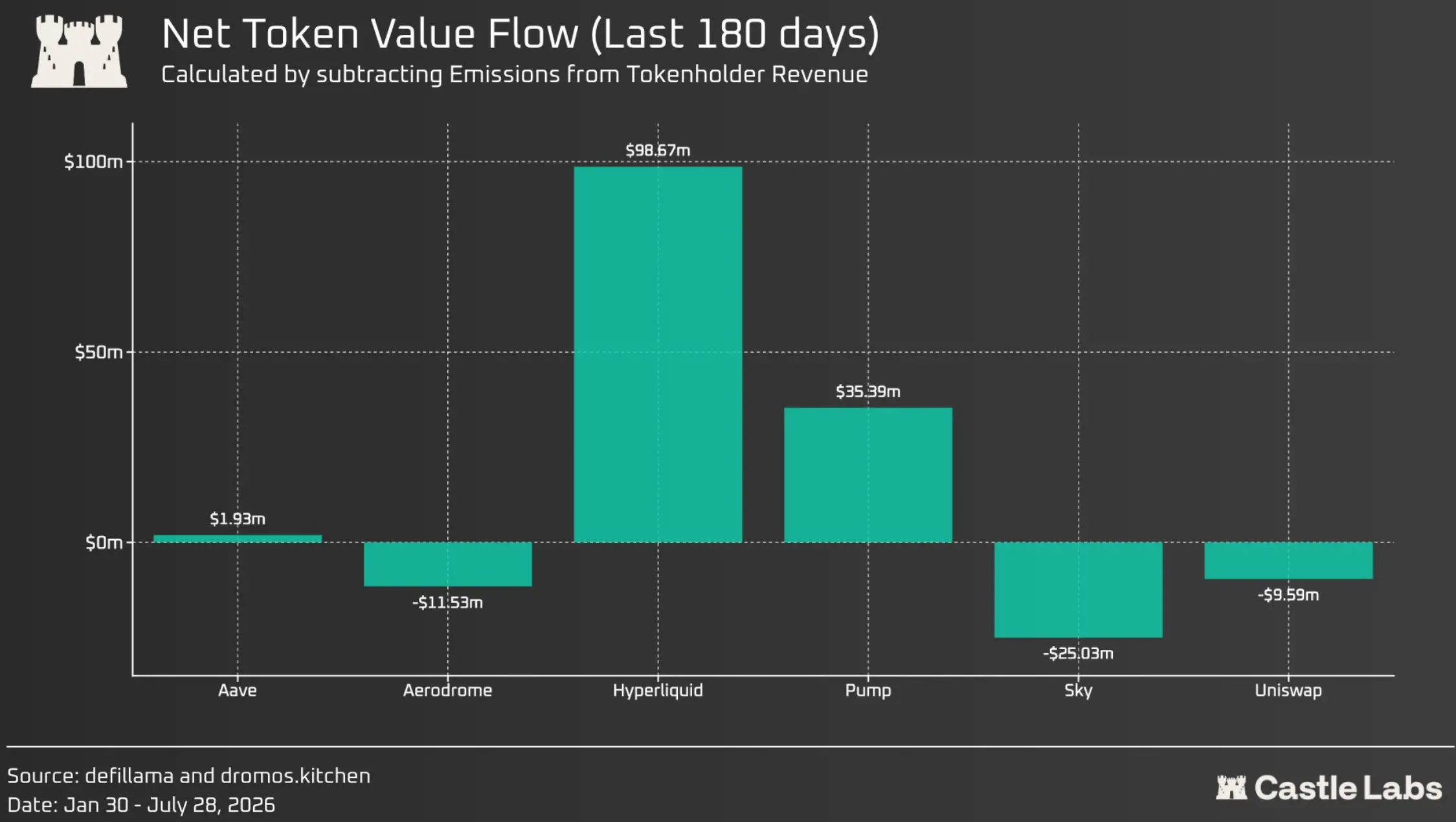
Most protocols will distribute revenue between token holders and the protocol treasury, and the specific distribution depends on each protocol's mechanism design and governance arrangements. To measure the dilution effect of new supply on token value, we subtract the value of token issuance, unlocking, and incentive spending from the income of token holders.
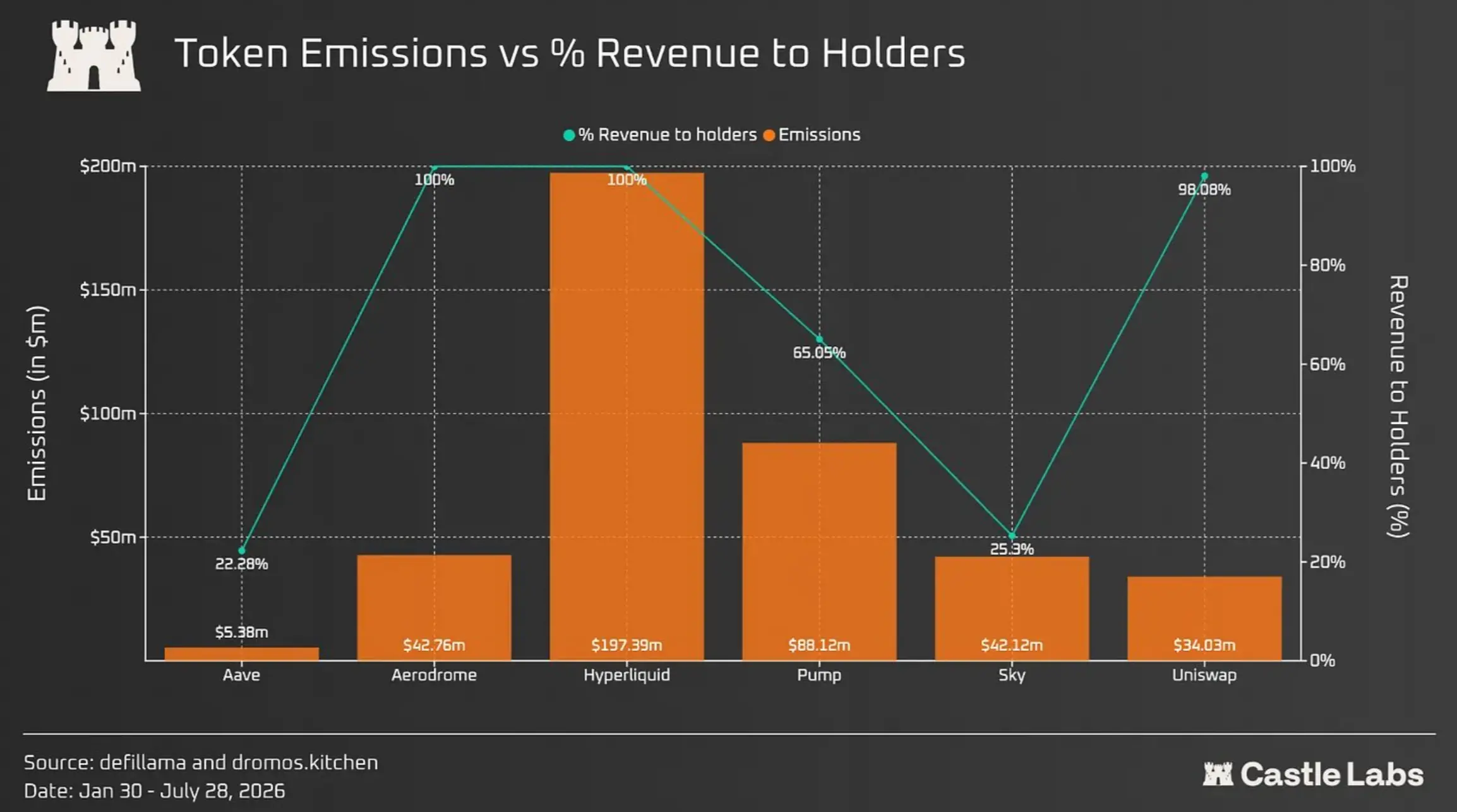
For Aerodrome, Sky, and Uniswap, after accounting for these expenses, the net value flowing to holders turns negative, even though these protocols do distribute some revenue to holders. This indicates that to maintain current revenue and liquidity levels, these protocols have incurred higher token incentive costs, compressing the net value that ultimately flows to holders.
Currently, there are mainly two ways for token holders to capture value: buybacks and fee distribution.
Buybacks
Buybacks are one of the most direct ways for protocols to return value to token holders. The protocol uses revenue to buy tokens on the secondary market, creating real buying pressure. The repurchased tokens can be burned or placed into the protocol treasury for future incentives, governance, or staking rewards. For example, Aave allocates the tokens acquired through buybacks to the protocol treasury.
To further strengthen the connection between protocol growth and token value, some protocols directly burn the tokens acquired through buybacks, thereby reducing supply. For instance, @Lighter_xyz has burned approximately 15.6 million LIT tokens acquired through revenue buybacks, accounting for 6.6% of the total token supply, valued at around $36 million.
Hyperliquid executes buybacks and burns in a programmatic manner and has burned over 47 million HYPE tokens to date, accounting for about 4.72% of its supply. Uniswap burned 100 million UNI tokens in a one-time event in December 2025. Since then, the protocol has continued to reduce supply through buybacks supported by its fee mechanism, with a total burn of approximately 107 million UNI, accounting for about 11% of the total supply.
Not all protocols will burn the tokens acquired through buybacks, and the specific execution methods for burning can vary significantly. For example, BNB used to implement quarterly burns, but some of the burns targeted tokens that had not yet entered circulation, thus having a relatively limited direct impact on short-term secondary market supply and demand.
Users need to clearly understand the specifics of the burn mechanism: where do the burned tokens come from? Do they truly come from the market circulation supply?
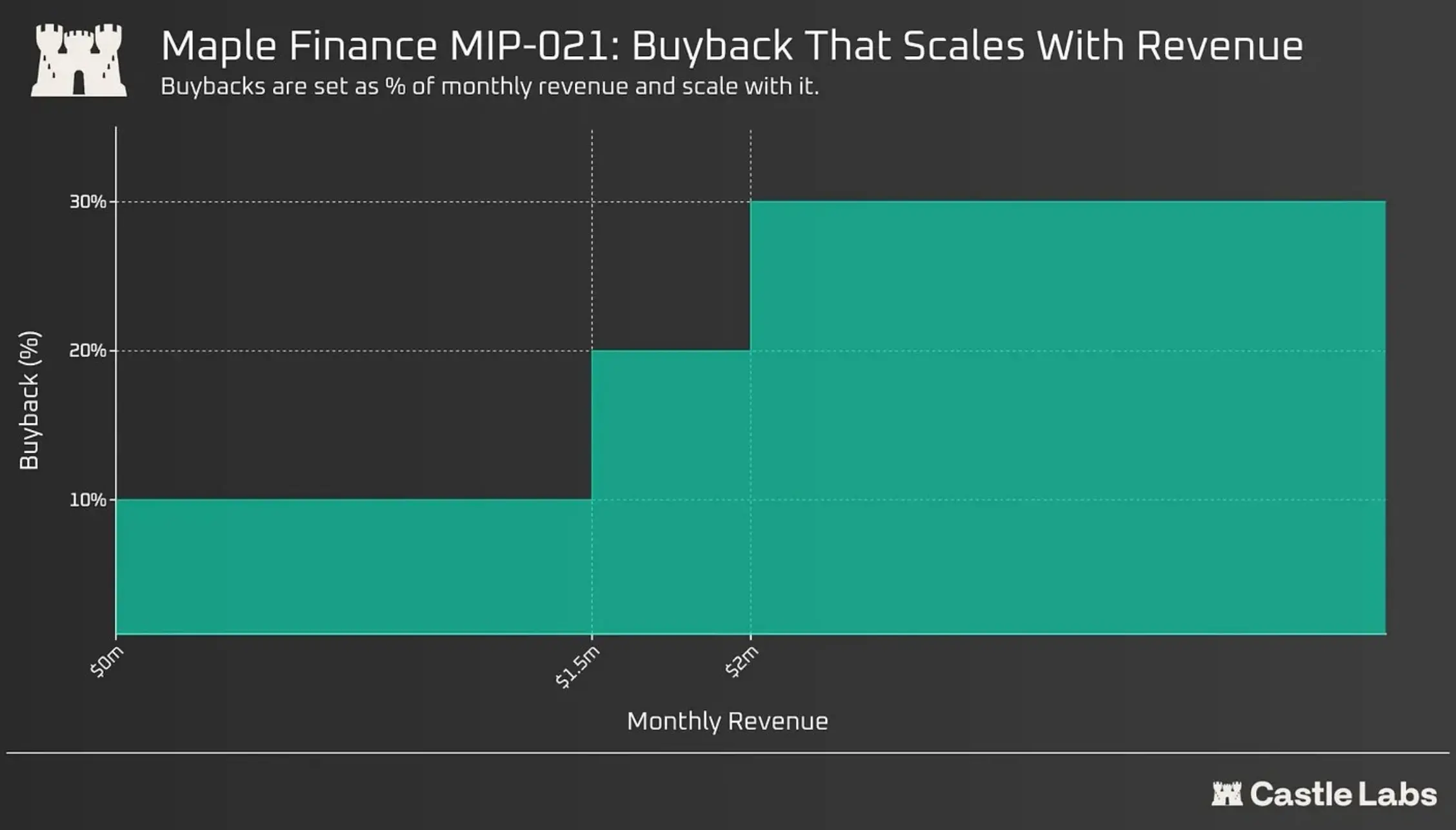
Each project's buyback method also varies. @maplefinance's token holders recently passed a buyback plan linked to revenue levels. Under the new mechanism, the higher the protocol's revenue, the higher the proportion allocated to token holders.
This is an update to the original MIP-019 plan, which fixed 25% of revenue for token buybacks. Based on an average revenue of about $1.15 million in the first half of 2026, the applicable buyback ratio will drop to 10%. This means that the proportion of revenue used for buybacks is lower than the original plan, but the proposal still passed with a support rate of 99.97%.
In addition to buybacks, token holders can also stake their tokens with the protocol and earn staking rewards from the treasury or future emission reserves. After the recent token economics update, Lighter's target staking yield is 6%. Based on the current staking scale of about 125 million LIT, the protocol will distribute approximately 7.5 million LIT annually.
Similarly, there are currently over 430 million HYPE tokens staked, with stakers earning about 2.1% from future emission reserves.
However, relying solely on buybacks and burns cannot save a continuously declining token model, nor can it compensate for the ongoing decline in protocol revenue. Buybacks and burns must be viewed within the overall framework of the protocol's buying and selling pressure.
Token incentives can be used in the early stages to kickstart liquidity and drive ecosystem growth, and then gradually decrease as organic demand for the product forms. In contrast, buybacks and burns can create buying pressure from platform revenue and reduce supply, thereby offsetting the dilution brought by inflationary token economics.
Fee Distribution
Other protocols, such as Aerodrome and @CurveFinance, adopt a ve token economic model to directly distribute fees to holders. Under this model, holders need to lock their tokens and convert them into voting escrow tokens, such as veAERO or veCRV.
The ve model primarily creates value for holders in three ways.
First, protocol trading fees. These protocols distribute 50% to 100% of trading fees to ve token holders.
Second, yield boosts. Holding ve tokens can increase the mining rewards liquidity providers earn in the relevant liquidity pools.
Third, voting incentives, commonly referred to as "bribes." Projects pay rewards to ve token holders in exchange for their governance votes, directing subsequent token emissions to designated liquidity pools.
However, the design of ve-type protocols can also drive higher token emissions. This means that the seemingly substantial holder income under the ve model is often partially built on high token incentives.
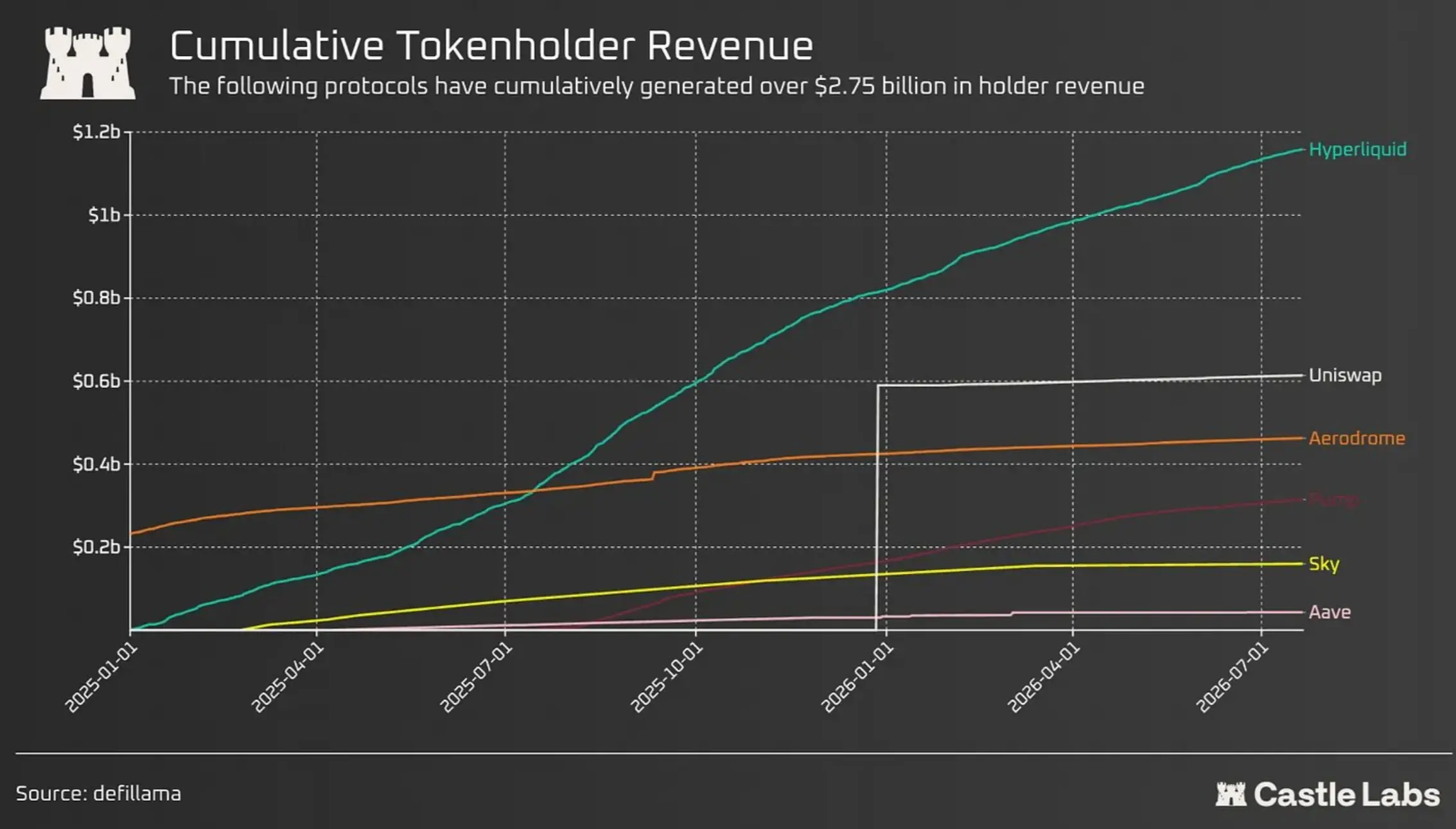
According to the statistical criteria used in this article, the aforementioned protocols have cumulatively returned over $2.75 billion in value to holders, most of which comes from Hyperliquid and the large-scale UNI burn implemented by Uniswap in December 2025.
But as mentioned earlier, merely having value capture is not enough; the dilution caused by token issuance and unlocking also needs to be balanced. The next section will explore what other factors, aside from holder income and token releases, may suppress token price increases.
The Quality of Tokens
Over the years, crypto products have continued to grow and generate substantial revenue. However, the generation of revenue by a protocol does not necessarily mean that its token will perform better.
The struggle of tokens from high-revenue protocols often results from a combination of the following reasons.
Revenue does not flow to the tokens.
Even if a protocol generates real revenue, this portion of value often remains in the protocol treasury and does not reach the hands of token holders. How buyback funds are utilized is crucial.
Funds in the protocol treasury are discretionary assets, and their specific use depends on the protocol itself. Since projects typically do not have contractual obligations to continue buybacks, the protocol can suspend, reduce, or even cancel buybacks at any time. Although these decisions require governance procedures, most voting power is often still held by the project team, investors, or a few large holders.
The dual structure of equity and tokens may render token holders "second-class holders."
An increasing number of projects adopt a dual structure of company equity and crypto tokens, but the economic rights enjoyed by these two types of assets are not the same. XRP is a typical example.
According to pricing data from private equity trading platform Forge, since 2025, the indicative price of Ripple Labs' equity has increased by about 105%, while the XRP token has decreased by about 45% during the same period.
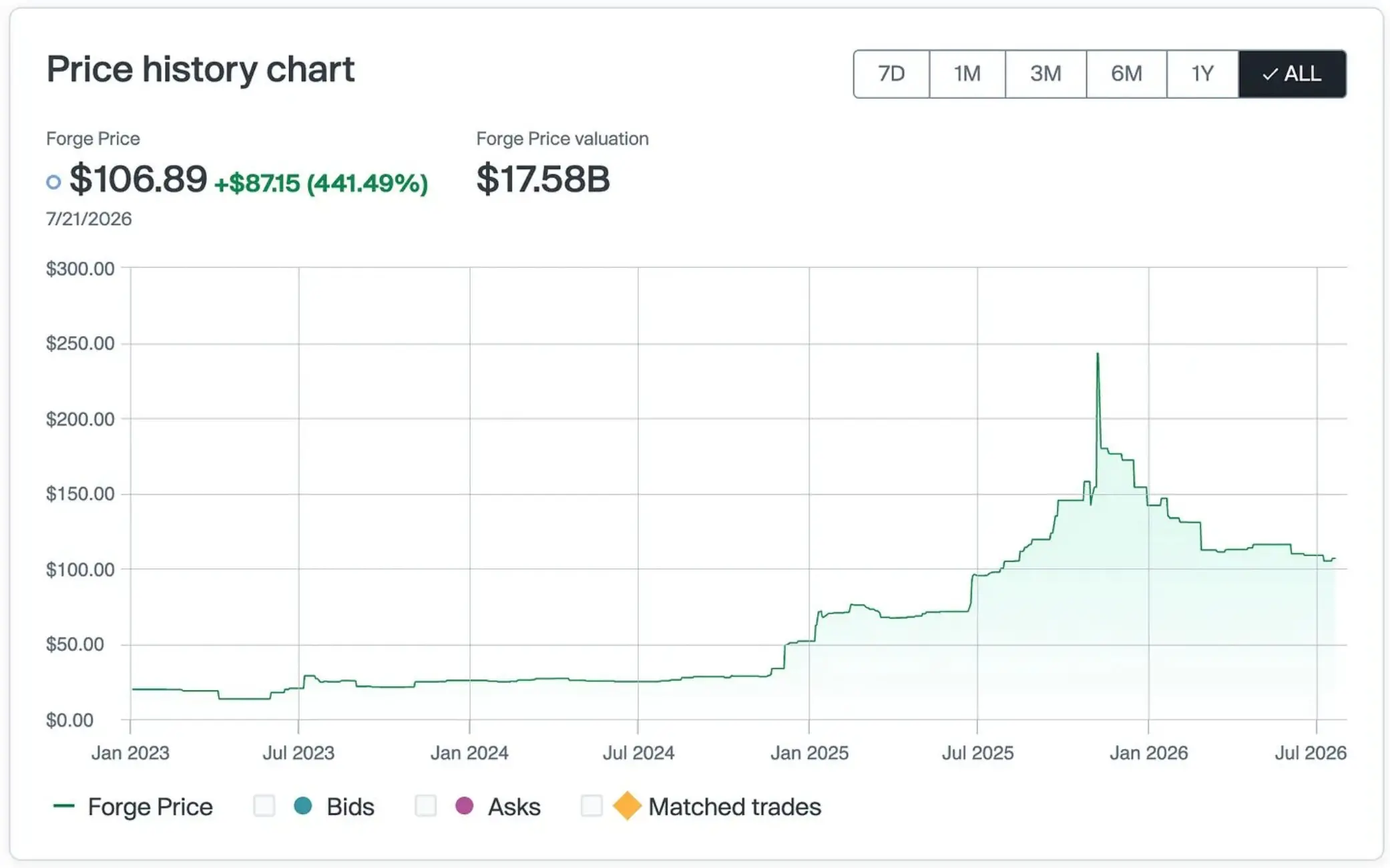
Ripple simultaneously holds company equity and XRP tokens, but XRP holders do not automatically enjoy Ripple Labs' company income or residual claims. Therefore, the value created by the company's business growth may be more reflected in the company equity rather than in XRP itself.
Faster unlocking speeds can lead to greater expected selling pressure.
Even if a protocol shares revenue, a faster token unlocking pace may still depress token prices. Another compounding factor is the low circulation and high FDV token structure, as there is still a large supply waiting to be unlocked and absorbed by the market.
If the market capitalization is calculated solely based on the current circulating market value, these tokens often appear "cheap." However, when the yet-to-be-unlocked supply is included in the fully diluted valuation, their true valuation may not be low, and future unlocks may continue to create selling pressure.
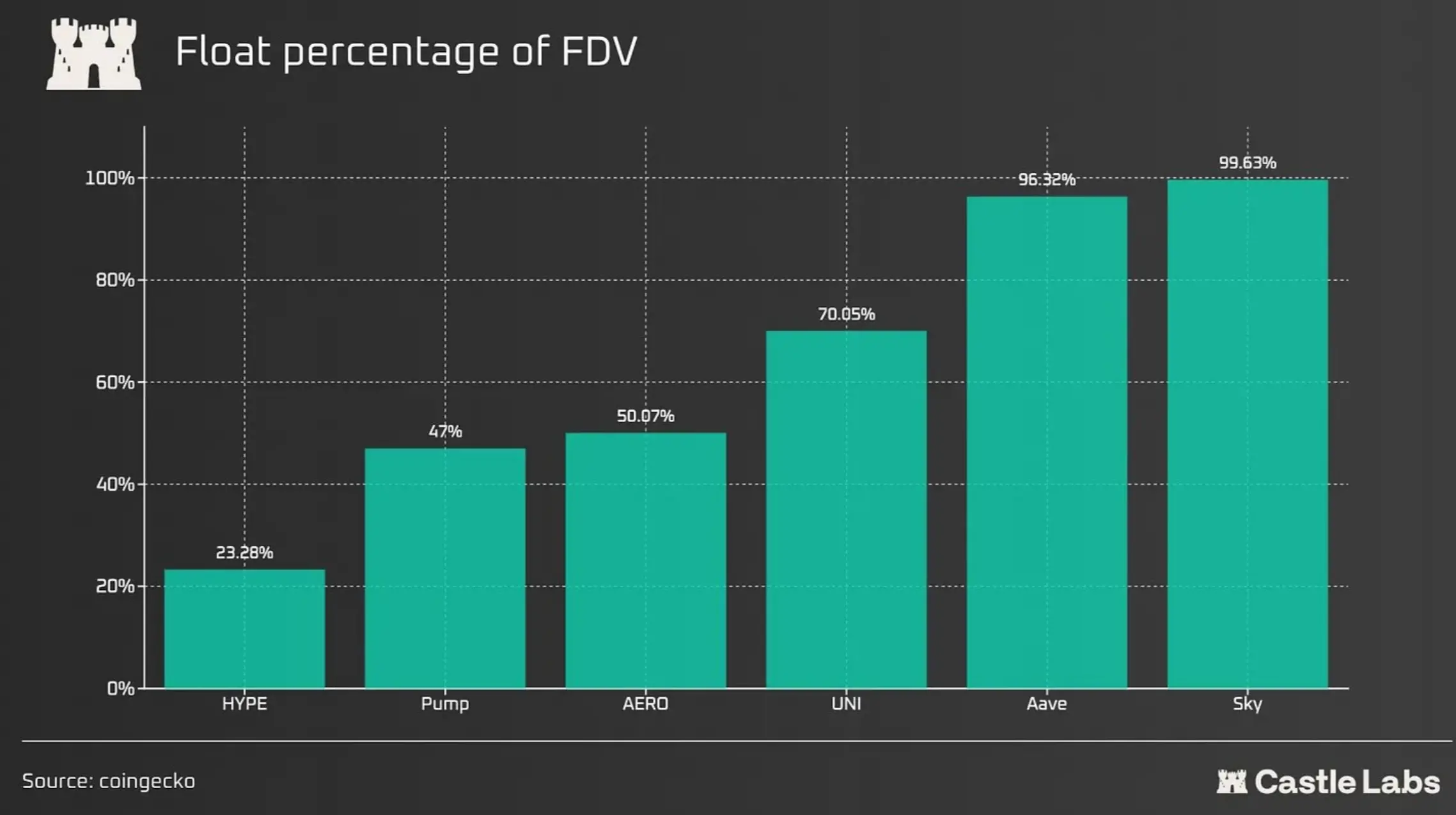
Only by considering these factors together can one reflect the true nature of a token and explain price trends in most cases. Of course, in addition to this, market conditions, investor sentiment, and competitive landscape also influence token performance.
The PUMP token has dropped 60% since its launch, even though the project has completed over $315 million in buybacks. On the other hand, HYPE has risen 1400% since its launch and has returned about $1.2 billion in value to holders through buybacks.
Both are continuously buying back, but PUMP's price performance remains unsatisfactory. The market usually attributes this to poor team communication, unmet airdrop expectations, a rapid unlocking pace, and the sale of related tokens by the team.
The AAVE token has also struggled since the beginning of the year. Its buyback plan has completed about $45 million in buybacks since it started in April 2025 and is currently paused due to the Kelp DAO incident.
AAVE's performance is under multiple pressures, including the exit of DAO service providers like BGD Labs and ACI, the impact of the Kelp DAO incident, and increasingly fierce competition from Morpho in the institutional market.
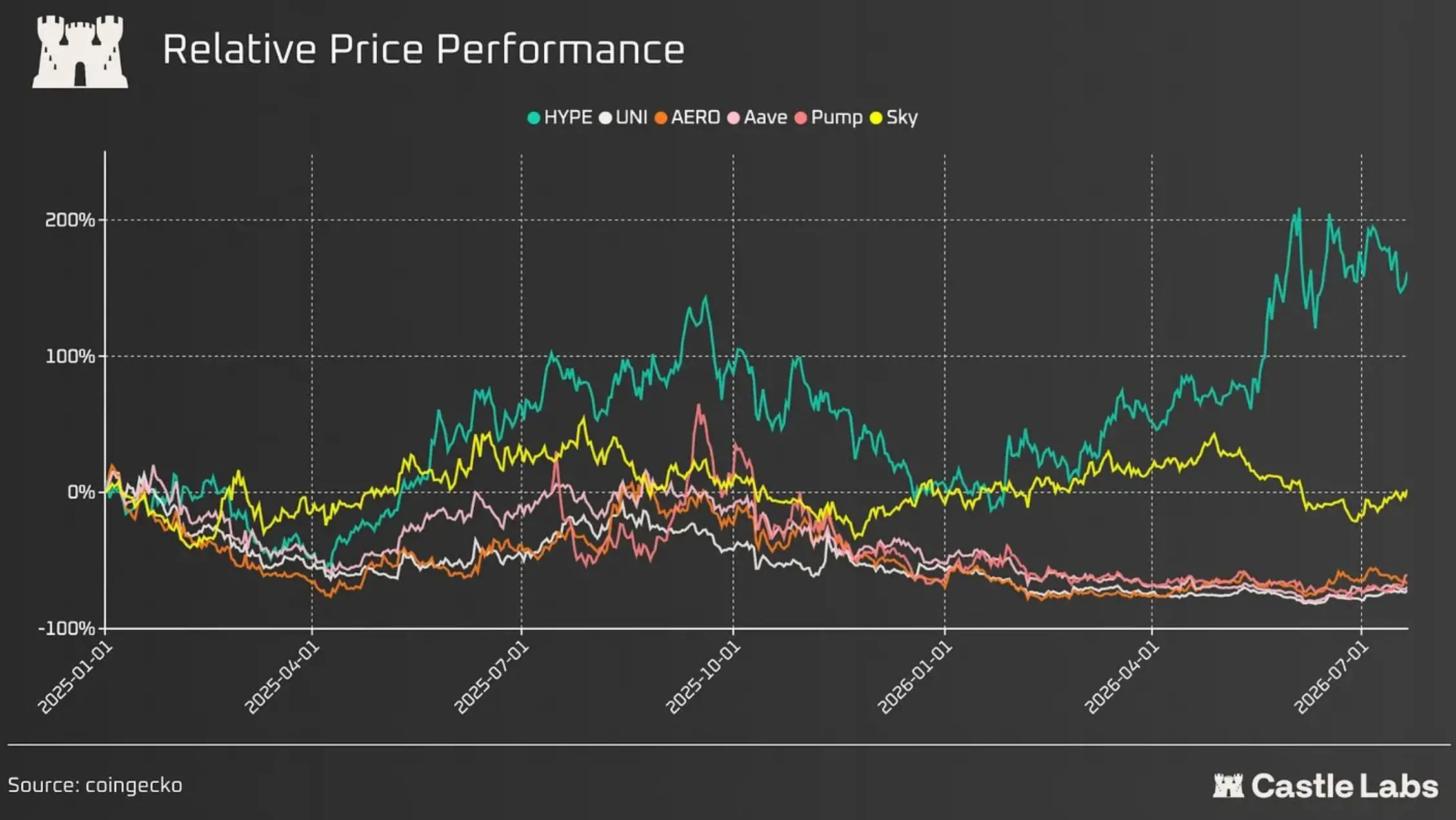
Meanwhile, as AAVE's price declines, the protocol's paper losses on these buybacks have exceeded $23 million. Its average buyback price is about $182, while the current price is around $90.
This indicates that while buybacks can create real buying pressure, they do not guarantee the efficiency of fund usage. If the timing of purchases is not optimal, it may also erode the value accumulated by the protocol.
However, buybacks remain one of the easiest ways to verify and directly connect protocol revenue with token demand. Buyback actions can be tracked on-chain, and the protocol must genuinely buy tokens from the market, creating direct buying pressure with revenue.
Thus, it establishes a positive reinforcement relationship between protocol success, revenue growth, and token supply contraction. But buybacks are not inherently superior to other distribution methods.
On the surface, direct dividends may seem more attractive. Users can receive stablecoin cash flow based on the tokens they hold and decide how to use it. In contrast, buybacks create direct buying pressure in the market, but the ultimate effect still depends on the buyback price, how the repurchased tokens are handled, and the overall market selling pressure.
There is no universally applicable advantage or disadvantage between the two; the key lies in what development stage the protocol is in and what functions the token still serves.
Directly distributing fees also has another layer of controversy. If the token lacks governance, staking, or product use cases aside from receiving cash flow, its valuation may gradually approach that of a mere income certificate. Supporters argue that it is precisely because tokens can continuously receive dividends that more people are willing to hold them long-term.
Currently, most projects still choose buybacks, indicating that they generally believe the market buying pressure and supply contraction brought by buybacks are more attractive.
Conclusion
Many crypto protocols have established substantial revenue, but just because a protocol is profitable does not mean that its token can capture that value.
Whether revenue flows to holders is only part of the evaluation framework. Unlocks for teams and investors, liquidity incentives, negative events, competitive landscape, and market sentiment can all create greater selling pressure, offsetting the buying pressure from buybacks, burns, or fee distributions.
Therefore, investors cannot just look at how much money the protocol makes; they need to continue asking: Where does the revenue come from, and is it sustainable? How is the revenue distributed? How much dilution will token issuance and unlocking cause? Do equity holders have superior economic rights compared to token holders?
Becoming a business that can continuously generate revenue is the first step for a protocol. The next step is to establish a clear, credible, and verifiable value return mechanism that truly translates protocol growth into benefits for token holders.
Hyperliquid demonstrates what effects can arise when such alignment of interests is written into token design from the start. It returns most of its revenue to holders, and protocols like Aerodrome and Uniswap are also trying to establish more direct value distribution mechanisms.
Protocol teams are increasingly realizing that a good token must have a good value distribution mechanism. As investors pay more attention to real revenue and value capture, the long-standing disconnect between protocols and tokens may gradually narrow.
But ultimately, the winners will not just be the protocols that make the most money, but those that can both generate profits and effectively retain value for token holders.
 Risk warning



Popular articles