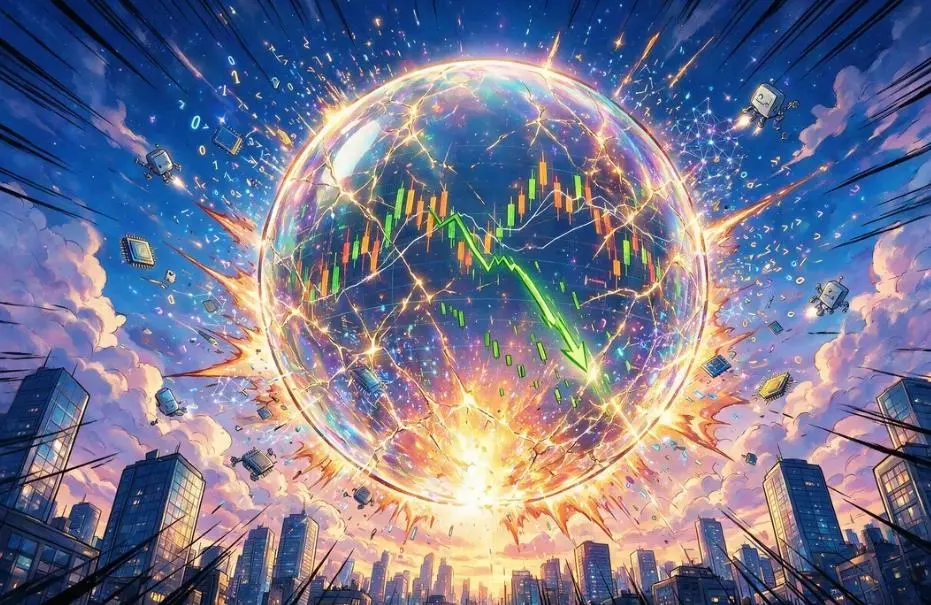
The Night Before the AI Bubble Burst
 Core Viewpoint


 Technology is always changing, but human nature remains the same.
Author: Orange AI
Today is October 31, 2026, Saturday. The U.S. market just closed on Friday.
The Nasdaq fell by 2.86%, which isn't a particularly alarming number, but there is a lot of wailing online.
Intel dropped by 28.58% on Friday, marking its largest single-day decline in forty years. Its EPS for the third quarter was 0.52, far exceeding the market expectation of 0.40.
Just yesterday, Google fell by 12.64%, closing at $283.82, its worst day since going public in 2004. It lost nearly $500 billion in market value in one day. However, its revenue was only 0.2% to 0.4% below market expectations. Its cloud revenue doubled, and the growth rate of search queries was the highest in five years.
SanDisk's revenue increased by 23% quarter-over-quarter, with an adjusted EPS of $49.51, more than 40 times year-over-year, and it has $91.1 billion in signed orders. Despite exceeding expectations, its stock price still fell by 13.47%.
The market's first reaction to these events is: the AI bubble is about to burst.
There is definitely a bubble in AI, and it will surely burst; whether it bursts today, I don't know, and it doesn't matter.
This article does not constitute any investment advice, and investment is not the topic I want to discuss today.
I want to talk about whether AI is currently creating incremental value.
The Value of AI is Hard to Understand
This year, the biggest impact for us may be the rising prices of memory and flash storage.
The rise in hardware prices directly resulted in a decline in PC and smartphone sales.
The memory in Apple's smartphones now accounts for 40% of the cost. The standard version of the iPhone has been discontinued.
The new iPad mini sells for 5499, but it only comes with 128GB of flash storage, which can't even hold two large games.
Many Android manufacturers are also no longer releasing low-end thousand-yuan phones.
Intel predicts that the PC market will shrink by 12% in 2026 and by another 10% in 2027, with the downturn continuing.
AI was supposed to make us happier, but instead, it has made it impossible for us to afford phones and computers.
The fundamental reason for the rise in hardware prices is the leap in AI cloud services.
AI requires cloud hardware for inference, and the hardware used by people has also increased in price.
Sam said running local AI on personal computers is a waste of memory. The implication is that it should be allocated to AI to create greater value.
He is speaking entirely from the perspective of a large AI model company, and the value he sees is only the value he believes in.
AI is undoubtedly powerful and valuable; no one doubts its economic value.
It is precisely because AI is so powerful that it can replace many white-collar jobs, which is an undeniable replacement value.
Aside from replacement value, what incremental value has AI created?
This is what I find most incredible.
When I think about what incremental value AI has brought, I find that there isn't any.
At least at this moment, October 31, 2026, I don't see it.
If I had to mention an exception, the only exception is the short dramas from Hongguo, but that situation is quite strange, which I will discuss at the end of the article.
Is AI a Self-Satisfying Economy?
I know this conclusion will be met with a lot of rebuttals. Let's take a look at the strongest field of AI, coding. With AI coding being so strong, how can you say it hasn't created incremental value?
Yes, AI coding capabilities are unquestionable; every software company has improved coding productivity because of AI, and the amount of code produced by each company has exploded, equivalent to ten years' worth in one year.
But productivity cannot be equated with value.
AI coding may enhance productivity tenfold, but it hasn't increased product revenue tenfold; in fact, very few have even doubled their revenue.
This principle is easily understood when applied to something else.
This year, the blueberry production in Yunnan increased by 39% compared to last year, but prices fell by 50%.
The official conclusion is: "A large influx of fresh fruit into the market has changed the supply-demand structure, leading to a cliff-like price drop."
Supply has increased, but income doesn't necessarily increase because prices have dropped.
Economics is ruthless; scarcity creates value, and humans pay for scarcity.
Prices are determined by supply and demand; if demand remains unchanged, the more supply there is, the cheaper it becomes.
Last year, you ran a business that earned $1 million a year.
This year, with a more powerful AI, you optimistically think productivity has increased, and you can earn $10 million this year.
But don't forget, AI allows your competitors to produce your business in a day, increasing the number of your competitors tenfold, resulting in more intense competition, and consumers receive cheaper goods and services.
And for you, it becomes harder.
What AI does is make intelligence non-scarce.
Non-scarcity means no value.
The price of tokens driving intelligence is decreasing.
The prices of products built on intelligence are decreasing.
The prices of jobs generated by intelligent activities are decreasing.
To compensate for this decline, we must increase output.
Consume ten times the tokens, produce ten times the products, and work ten times harder.
We can only maintain the balance of value.
This year, I've seen friends around me frantically using AI to write code, trying to utilize resets and various cost-saving measures.
Products are being released one after another.
But have they made any money? Not a single one.
AI has indeed made tasks that were previously not worth spending money on easily achievable.
But it seems that AI has not created incremental value.
I asked my friends whether they consider vibe coding as saving time or killing time, and everyone said it was killing time.
No wonder some say the essence of AI is not 2B or 2C, but 2me, for personal happiness.
It turns out to be a self-satisfying economy.
In the AI Economy, There Are No Middlemen
The most paradoxical aspect of the AI economy is that there are no middlemen profiting from the difference.
Wait, isn't that a good thing?
The basic principle of economics is about transactions. Transactions make everyone's life better.
A person earns money through transactions and spends it, allowing others to earn money, who then spend it, creating an endless cycle.
But AI is anti-transactional. A person directly obtains results from AI, which will be as cheap as electricity in the future, with almost no other humans earning money in the process. Others cannot use money to consume.
AI has replaced the jobs of consumers; so who will consume?
Even the logic of content consumption has changed.
Reddit just experienced its worst day since going public, with its stock price dropping by 29%.
Reddit CEO Steve Huffman summarized the reason in a conference call simply:
Google's AI Mode now provides answers directly, and no one clicks on links anymore.
"AI does not bring traffic, neither to us nor to others."
For the past 25 years, the internet protocol has been:
Websites provide content to Google, and Google sends users back to the websites.
But now, AI Mode summarizes, and users get results directly and leave.
In October, the average weekly visits from search engines decreased by over 1 million.
The number of users entering websites in the U.S. has decreased by 2% within a year, marking the first decline since Reddit's IPO in 2024.
Reddit is just a microcosm; it is recognized as the most human-like community, and it has been affected like this, so other websites need not be mentioned.
Where can there be unbroken eggs under a collapsed nest?
But aren't middlemen still quite profitable? How can you say there are no middlemen?
From Claude Opus 4.5 to DeepSeek Flash 4.1, the price of tokens completing the same tasks has decreased by 50 to 100 times this year, and it is foreseeable that it will drop at least tenfold next year.
There are already no middlemen providing low-cost models like Luna. A friend who runs a middleman service told me that their revenue looks okay, but after deducting costs, there isn't much profit left.
Tokens are too cheap; they are already lower than the cost of middleman servers.
The Money Earned by Humans is All Spent on AI
This week, another major event occurred: Microsoft opened voluntary severance buyouts to 60,000 employees, accounting for more than a quarter of its workforce.
Everyone knows this is a mild layoff method.
Has Microsoft encountered any problems? Why does it want to lay off a quarter of its employees?
The fact is that this company is making more and more money but still resolutely spends money on investing in AI.
What to do when the money for investing in AI is insufficient? Lay off employees to raise funds.
At this point, we must mention ByteDance's closed loop, Hongguo short dramas.
I have to say, Hongguo is an even more powerful product than Douyin, with short dramas for everyone, suitable for all ages.
Tomato Novel's text + Seedance's video generation + massive engine's intelligent advertising + Hongguo's DAU and duration.
From producers to models, to recommendations, to consumers, it is a complete closed loop.
How much money must this make?
But where has all the money ByteDance earned gone?
ByteDance made about $50 billion last year and plans to spend up to $70 billion this year to build AI infrastructure.
ByteDance has invested most of its cash into AI.
Have you noticed? Hardware investments must go into AI, productivity software companies must spend money on AI, and even after the consumer closed loop, they still have to spend money on AI.
We are now in an era of frenzied, mindless investment in AI.
We are all in on productivity, without considering production relations.
After the Bubble
I feel that our current position is somewhat like being on the eve of an AI bubble.
I don't think today is necessarily Black Friday, nor do I know when this AI bubble will burst.
Throughout history, in every technological cycle, a technology must first bubble, then experience a significant drop to burst the bubble, and only then will people use it in truly valuable ways.
This is the cycle; behind the cycle is human nature.
Technology keeps changing, but human nature remains the same.
From the release of ChatGPT in November 2022 to today, AI is about to complete a full four years.
Anthropic is going public next month, and many say that will be the peak of the AI bubble.
What do you think?
Note: This article is based solely on publicly available information, and the author does not understand investment; this article does not constitute any investment advice.
 Risk warning
 Risk warning