Daily Observation of Cryptocurrency Policy: South Korea plans to include perpetual contracts of cryptocurrency platforms on U.S. stocks in the derivatives tax network, imposing an 11% capital gains tax starting in 2027

 Released on November 3, 2026. In response to the increasing preference of Korean investors for offshore cryptocurrency platform derivatives trading, the Korean tax authorities have officially finalized the regulatory framework. According to the latest report from Daily Economy, the Ministry of Economy and Finance of Korea has decided to explicitly classify "U.S. stock perpetual contracts" traded through overseas cryptocurrency exchanges as offshore stock derivatives. Starting in 2027, the income generated from related transactions will be uniformly subject to a capital gains tax of 11% after deducting the basic tax exemption amount. This policy marks Korea's acceleration in bridging the tax classification gap between traditional finance and cryptocurrency derivatives.
Tax Qualification of Cross-Border Derivatives
For a long time, many South Korean investors have been trading "U.S. stock perpetual contracts" offered by overseas cryptocurrency exchanges with high leverage. Although these contracts are anchored to traditional U.S. stock assets, their settlement channels and capital flows occur within the crypto ecosystem, leading to ambiguity in tax qualification. The South Korean Ministry of Finance and Economy has now clearly classified them as "overseas stock derivatives," completely eliminating the gray area for such synthetic assets under the Income Tax Act and forcibly pulling them back into the tax framework of traditional capital markets.
11% Halved Tax Rate and Deduction Standards
In terms of specific taxation intensity, the Ministry of Finance and Economy has adopted a relatively moderate tiered tax rate design. According to the new regulations, starting in 2027, the annual income that South Korean investors earn from such perpetual contracts will be taxed after deducting a statutory basic tax exemption of approximately $1,861 (2.5 million Korean Won). Notably, the final applicable tax rate for this derivative trading is 11%, which is exactly half of the current standard tax rate (22%) for overseas stock spot trading in South Korea. This tax rate setting ensures that the tax base does not erode while also reflecting tax considerations for the high-risk characteristics and liquidation losses of derivatives to some extent.
Compliance Preceding Forces Capital Reflow
Based on the financial policy signals released in early November in Seoul, the introduction of this tax system has a strong capital orientation. As the 2027 deadline for comprehensive income tax on crypto assets approaches, bringing U.S. stock perpetual contracts on crypto platforms under regulation and clearly pricing them is not only aimed at expanding treasury revenue but also at reducing the attractiveness of non-compliant offshore exchanges to domestic investors, thereby forcing speculative capital in the tax blind spot to gradually flow back into the regulated domestic financial system.
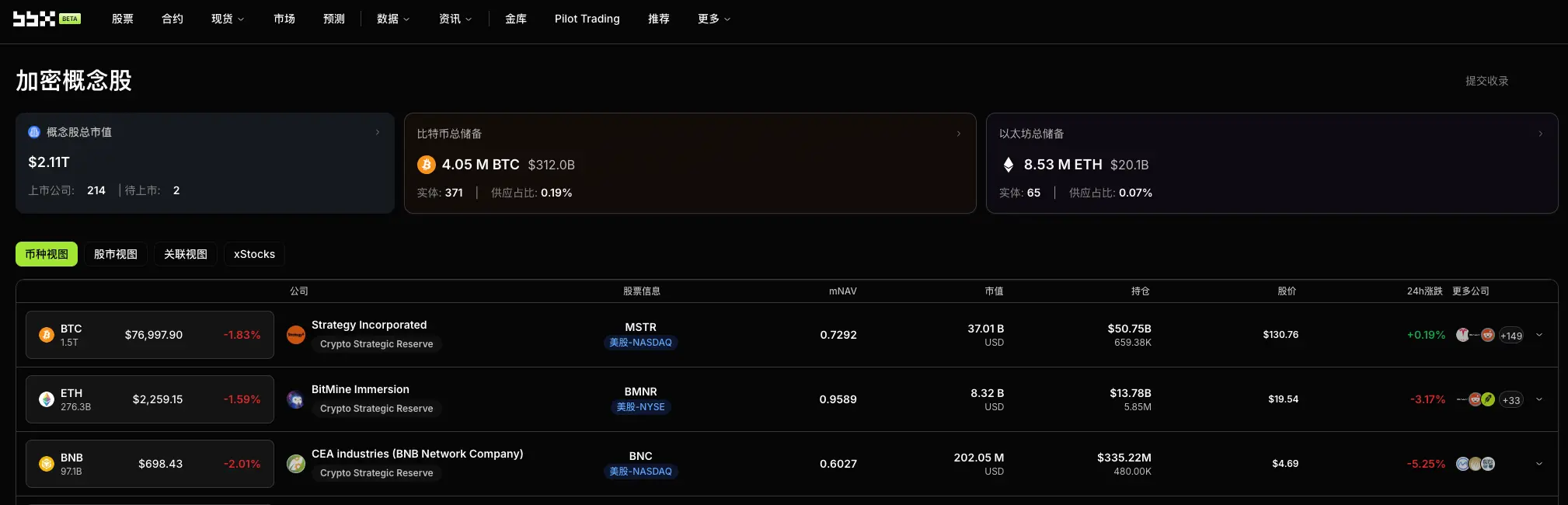
Data Source: https://bbx.com/ Cryptocurrency Concept Stock Information Database, compiled based on announcements from global listed companies and SEC/TSE disclosure documents from yesterday.
 Risk warning Risk warning