AMD conference call: Q4 AI chip revenue will surpass server CPU revenue for the first time, and next year the data center revenue proportion will exceed 80%
 Core Viewpoint


 Su Zifeng stated that Q4 data center AI chip revenue will historically surpass traditional server CPU revenue for the first time, and next year the revenue share from data centers will exceed 80%; AI agents are becoming the "next killer application" for cloud CPUs. However, the PC market is expected to see a double-digit decline next year.
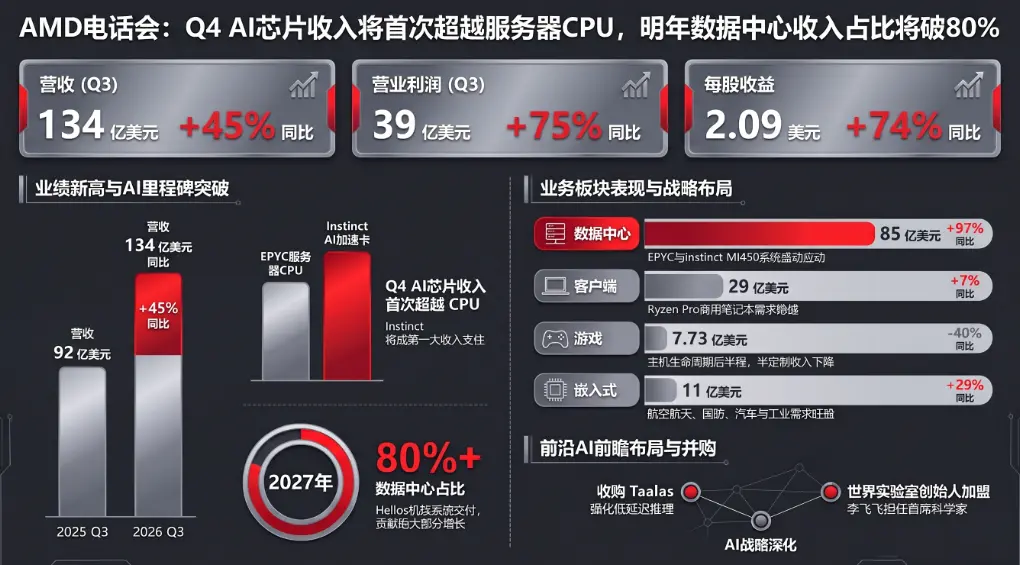
The explosive growth of the data center business has driven AMD's performance to exceed expectations across the board. The company has raised its outlook for next year, expecting server revenue to double and AI chip revenue to grow even faster.
Wall Street Journal mentioned that after the U.S. stock market closed on Tuesday, November 3, AMD announced that its revenue for the third quarter of 2026 increased by 45% year-on-year to $13.377 billion, setting a new quarterly record, which was about 2.3% higher than analysts' expectations. On a non-GAAP basis, earnings per share increased by 74% year-on-year to $2.09, exceeding analysts' expectations by more than 6%.
During the subsequent conference call, AMD CEO Lisa Su stated that demand for data centers is accelerating, and it is expected that data center revenue will exceed previous expectations by 2027, with server revenue potentially doubling and accounting for up to 80% of total revenue.
She expressed that the company "has strong confidence in its ability to maintain excellent revenue growth over the next few years, and that profit growth will exceed revenue growth." In response to analysts' questions, Su candidly admitted that current demand indeed exceeds supply, and the company is working closely with suppliers of wafers, substrates, advanced packaging, storage, and other key components to increase capacity, stating that the company "is confident" in further expanding supply through its deep partnerships within the ecosystem.
In terms of product strategy, AMD is simultaneously advancing the updates of its CPU and AI accelerator product lines. Su revealed that the EPYC Venice processors began shipping in the third quarter, with the first batch of OEM systems expected to officially launch in the fourth quarter.
In terms of AI accelerators, AMD has initiated mass shipments of the MI455X, with leading customers such as Anthropic, Meta, Microsoft, OpenAI, and Oracle completing the deployment of the first batch of Helios racks in the third quarter. Su stated that customers are running the latest models on Helios, and the overall performance is satisfactory, with a significant increase in the scale of Helios deployments expected in the fourth quarter.
Additionally, Su clearly warned that the PC market is expected to see a double-digit percentage decline in 2027.
Bloomberg cited Emarketer analyst Jacob Bourne's view that this performance result "will encourage investors, as they have been increasingly scrutinizing AI spending and its returns," especially against the backdrop of ongoing adjustments in tech stocks and the semiconductor sector.
Q3 Performance Sets Record, 2027 Total Revenue Expectation Surges Over 80%
AMD delivered a nearly perfect report for the third quarter of this year. Total revenue for the quarter reached $13.4 billion, a year-on-year increase of 45%; the non-GAAP earnings per share (EPS) growth was even more astonishing, soaring 74% year-on-year to $2.09. Gross margin also expanded to 56%, an increase of 190 basis points year-on-year.
What truly ignited market sentiment was the forward guidance provided by management. AMD expects fourth-quarter revenue to reach approximately $17 billion (a year-on-year increase of about 66%). More importantly, the company has given an extremely optimistic outlook for 2027.
Su stated at the meeting:
Based on the current visibility, we now expect revenue to grow by over 80% in 2027, which is more than double our long-term financial model expectations from last November's financial analyst day.
She pointed out that by 2027, the data center business will account for over 80% of the company's total revenue, becoming the absolute main driver of revenue and profit growth. Additionally, server revenue is expected to double year-on-year by 2027.
When discussing the supply-demand issue that the market is most concerned about, Su candidly stated:
Demand indeed exceeds supply, so we continue to work with supply chain partners to increase supply. Given the strong relationships we have across the entire ecosystem, I believe we have a good opportunity to achieve this.
Historical Intersection: Q4 AI Chip Revenue Will Exceed Server CPUs
The data center business is the core engine for AMD this quarter, with Q3 revenue soaring 97% year-on-year to a record $8.5 billion, increasing its share of total revenue from 47% a year ago to 64%.
This growth is backed by the comprehensive rollout of new generation products. The MI455X began mass shipments in the third quarter, and leading customers including Anthropic, Meta, Microsoft, OpenAI, and Oracle have quickly launched the first batch of Helios racks.
For the upcoming fourth quarter, CFO Jean Hu revealed a key milestone data point:
The data center business is expected to see a quarter-on-quarter increase of about 50% in the fourth quarter. In fact, this will be the first quarter where data center AI business (such as GPUs) revenue surpasses server business (CPUs). Compared to the server side, the data center AI business will see a very significant leap in Q4.
To further ramp up the AI arms race, AMD announced two key acquisitions (Taalas and World Labs) in the third quarter. Among them, Fei-Fei Li, co-founder and CEO of World Labs, will join AMD as Chief Scientist to lead model research and help shape the future software and hardware system roadmap.
"AI Agents Are Becoming the Next Killer Application for Cloud CPUs"
In a lengthy conference call, Su repeatedly mentioned a core term—Agentic Workloads (AI agent workloads)—and views it as a core force reshaping computing infrastructure.
Su pointed out during her industry insights:
Cloud providers added a significant amount of EPYC capacity this quarter for personal and enterprise agents, which are rapidly becoming the next killer application for cloud CPUs. These agents work continuously and in parallel within applications and enterprise systems, creating a sharp increase in demand for CPUs while also increasing the demand for accelerators. Adoption has just begun, and we expect demand to grow sharply as agents are more widely deployed and take on more complex tasks.
With advantages in performance and total cost of ownership (TCO), EPYC processors are rapidly capturing market share. Su specifically mentioned:
OpenAI chose the Turin EPYC processor as the host CPU for its first custom accelerator platform.
Additionally, AMD's recently launched Helion has seen unprecedented early demand, with OEM and ODM partners committing to provide 20% more Venice platforms than the previous generation.
Concerns and Countermeasures: PC Market Faces Double-Digit Decline Next Year
While the AI business is thriving, AMD's client and gaming businesses are facing headwinds from the macro environment.
In the third quarter, client revenue grew by 7% year-on-year to $290 million but fell by 4% quarter-on-quarter. Su issued a blunt warning about the PC market:
Sales of PC terminals slowed at the end of this quarter, as high memory and component costs put pressure on demand. Our planning assumption for 2027 is that unit shipments in the PC market will see a double-digit percentage decline.
In the face of the winter of the PC market, AMD has chosen to avoid price wars in the low-end market. Su stated:
We will focus on segments that can add the most value, such as enterprise-level, high-end consumer, and desktop channels. We recognize that there is a lot of volatility in the low-end market, and frankly, that is also the part where we have the smallest exposure.
However, the weakness in the PC market has not affected the overall logic of the company's profit expansion. CFO Jean Hu emphasized that as revenue surges over 80% in 2027, the company's operating expense growth will be less than half of the revenue growth, which will lead to "very significant operating margin expansion and profitability improvement."
Full Transcript of AMD Q3 Earnings Call (AI-Assisted Translation):
Host: Welcome to AMD's Q3 2026 earnings call. All participants are currently in listen-only mode, and there will be a Q&A session after the formal presentation. Please note that this meeting is being recorded.
Now, I will hand the call over to Matt Ramsey, Vice President of Financial Strategy and Investor Relations. Matt, please go ahead.
Matt Ramsay, Corporate Vice President, Financial Strategy and Investor Relations:
Thank you, host, and welcome to AMD's Q3 2026 financial earnings call.
I believe you have all had the opportunity to review our earnings press release and the accompanying slides. If you have not yet reviewed them, you can find the materials on the investor relations page of AMD.com.
In today's call, we will primarily reference non-GAAP financial metrics. A complete non-GAAP to GAAP reconciliation table has been included in today's press release and the slides published on our website.
Today's participants include: Dr. Lisa Su, Chair and CEO, and Jean Hu, Executive Vice President, Chief Financial Officer, and Finance Chief.
This is a live broadcast and will be replayed via webinar on our website. Before we officially begin, please allow me to mention that AMD will participate in the following financial events this quarter: the U.S. Technology and AI Conference on December 1 (Tuesday) and the Barclays 24th Global Technology Conference on December 9 (Wednesday).
The forward-looking statements included in today's discussion are based on our current beliefs, assumptions, and expectations, including forward-looking statements regarding financial forecasts, business, and industry trends, and represent our judgment as of today, involving risks and uncertainties that could cause actual results to differ materially from current expectations.
Please refer to the disclaimer in the press release for a discussion of factors that could cause actual results to differ materially.
Now, I will turn the floor over to Lisa.
Lisa Su, Chair and CEO:
Thank you, Matt, and greetings to everyone listening today. The third quarter was our largest and most profitable quarter ever, thanks to our progress in ramping up the production of next-generation data center products. Revenue grew by 45% year-on-year to $13.4 billion, setting a record, primarily driven by record sales of EPYC and Instinct as well as strong growth in embedded business. Earnings per share grew even faster, increasing by 74% to $2.09.
We executed exceptionally well this quarter: Helios production ramped up as planned, and the adoption of EPYC in cloud, enterprise, and super-intelligent workloads continues to expand. The quarter-on-quarter growth rate of data center business revenue has accelerated every quarter this year, contributing 64% of total revenue in Q3, compared to just 47% a year ago.
We expect this acceleration to continue into the fourth quarter, primarily driven by increased demand for inference and agent workloads, as well as the accelerated production of our latest products.
Data Center Business
Data center business revenue grew by 97% year-on-year to a record $8.5 billion. In the server sector, both cloud and enterprise sales more than doubled year-on-year. We significantly exceeded our previous performance expectation of "growth over 80%", achieving a notable increase in revenue share.
Customers are deploying EPYC in more application scenarios, and agent workloads contributed significantly to growth. In the cloud, hyperscale cloud providers deployed a large number of EPYC servers this quarter to run more internal services and expand their public cloud offerings. Turin is currently the most widely deployed EPYC generational product in public clouds, with over 500 instance types from major vendors available globally. Cloud providers also added a significant amount of EPYC capacity this quarter to support personal and enterprise agents—this is rapidly becoming the next "killer application" for cloud CPUs.
Meta's Muse and OpenAI's Dots showcase the rapid growth momentum of personal agents—over 10 million active users were activated within the first six weeks of Muse's launch. Enterprise clients are also moving quickly, actively deploying agents in areas such as software development, supply chain, and IT operations. These agents continue to run in parallel across various applications and enterprise systems, driving an increase in chip demand while significantly boosting CPU demand. Current deployments are still in the early stages, and as agents are more widely deployed and take on more complex tasks, we expect demand to grow substantially.
In the head node sector, we have won important deployment contracts from several top model developers and cloud service providers this quarter, which will be rolled out over the next few quarters. The leading performance of EPYC and its mature ecosystem have been fully validated in large-scale production environments, making it the preferred host CPU for custom acceleration platforms. For example, OpenAI selected the Turin EPYC processor as the host CPU for its first self-developed accelerator platform.
In the enterprise market, EPYC server channel sales have set a historical record, with strong demand from both new and existing customers. This quarter, we added dozens of new customers adopting EPYC for the first time, covering large financial services, telecommunications, retail, and healthcare enterprises. Existing customers are also establishing EPYC as their primary computing platform, expanding from specific workload deployments to a larger proportion of overall infrastructure coverage.
In the third quarter, we began shipping EPYC Venice processors to customers, with the first batch of OEM systems set to officially launch this quarter. From initial demand, Venice has seen the strongest response we have observed so far for the new generation of EPYC. OEM and ODM partners have confirmed over 240 Venice platforms, 20% more than Turin; cloud vendors have also begun deploying Venice this quarter, with related instances planned for official launch in early 2027.
We recently launched Helion—a Venice-based reference design that provides turnkey EPYC rack-level systems for agent infrastructure. Customers can customize Helion for their specific workloads: from providing full CPU racks for hyperscale cloud vendors to enterprise-level Venice and Instinct GPU mixed systems—the latter can run agents and models simultaneously. In a full CPU configuration, a single Helion rack can accommodate up to 144 Venice processors, boasting nearly 74,000 threads, achieving the industry's highest agent computing density. Major server OEMs and ODMs plan to offer Helion products, with the first systems shipping this quarter.
Looking at the broader market, server computing demand is accelerating across cloud, enterprise, agent, and superintelligent infrastructure sectors. EPYC covers all these markets, boasting the industry's widest product portfolio—leading single-socket performance for cloud and agents, leading single-core performance for enterprises and head nodes, and memory and IO configuration options optimized for different workloads.
On this basis, EPYC further leads all other x86 and ARM server CPUs with significantly better performance-to-power ratio, performance-to-core ratio, and performance-to-price ratio. With the total addressable market (TAM) expected to grow to approximately $220 billion by 2030, this will enable us to continue expanding market share and significantly grow our server business.
Data Center AI Business
Frontier labs, hyperscale cloud vendors, and cloud service providers have expanded the deployment of Instinct in inference and training, driving revenue to historic highs.
This quarter, we began shipping MI455X in large volumes, with core customers including Anthropic, Meta, Microsoft, OpenAI, and Oracle quickly completing the initial deployment of Helios racks. Customers are currently running their latest models and workloads on Helios, with initial deployments performing excellently.
As production capacity continues to increase, and OEM partners such as HPE, Dell, Lenovo, and Supermicro begin shipping systems, we expect the deployment of Helios to significantly increase in the fourth quarter. MI455X leads the industry in computing power, memory capacity, and horizontal scaling bandwidth, and after Helios launches, its advantages in memory bandwidth and vertical scaling bandwidth compared to competitors will further widen.
We are closely collaborating with manufacturing and OEM partners to expand capacity in tandem with customers' scaling deployment.
In the supercomputing field, EuroHPC has chosen the Instinct MI430X GPU and sixth-generation EPYC processors to provide computing power support for LUMI-AI—the next-generation flagship supercomputer set to launch in the second half of 2027 in Europe. The double-precision computing performance of MI430X is nearly nine times that of competing products, which is crucial for scientific simulations. MI430X has already been selected for several new supercomputing systems globally, and as governments and research institutions plan a new round of significant investments, we are well-positioned to win more orders.
In software, we released ROCm 10, which brings significant upgrades for large-scale production deployments, including accelerated startup for large GPU clusters and higher resilience for long-running workloads. ROCm 10 also introduces ROCm.ai agent performance tuning capabilities, which can analyze workloads, identify bottlenecks, and automatically apply and validate optimization solutions, compressing what previously took weeks of engineering optimization into just hours. Customers are also using their AI agents to optimize models on our open software stack. For example, Anthropic shared a case where an engineer used Claude to complete the deployment of the latest model on the Instinct MI355X rack in just one weekend, achieving excellent performance.
Our collaboration with frontier labs has enabled their models to assist in handling the complex software development and performance tuning work for Instinct, and as these capabilities continue to improve, the benefits will extend to all participants in the AMD ecosystem.
This quarter, we announced two acquisitions to strengthen our superintelligent product portfolio. Taalas has an experienced engineering team and dedicated chips designed for low-latency efficient inference, and we plan to integrate its technology into our solution portfolio to meet the growing demand for low-latency superintelligent applications. World Labs, led by co-founder and CEO Dr. Fei-Fei Li, has a world-class research team focused on spatial intelligence and cognitive modeling of the physical world, which will help us gain deeper insights into the evolution of frontier models and workloads. Dr. Li will join AMD as Chief Scientist, responsible for leading our model research efforts and shaping the future hardware, software, and systems roadmap. Both acquisitions are expected to be completed by the end of the year.
Outlook and Prospects
Looking ahead, our core mission is large-scale execution. The mass production of Venice, the MI450 series, and Helios is in the early stages, and all three product lines are expected to continue significant growth.
Currently, we expect the revenue growth rate of the data center business to accelerate further in the fourth quarter, with full-year revenue expected to more than double compared to 2025. Our outlook for 2027 is also continuously strengthening.
Last quarter, we indicated that we expected annual server revenue growth to exceed 70%, with the data center business achieving full-year revenue doubling. Since then, customers have expanded their deployment plans for EPYC and Instinct, and we have further secured more supply resources to support this growth. Currently, we expect server revenue in 2027 to double year-over-year, and the growth rate of data center AI revenue will also exceed our expectations from 90 days ago. Therefore, we anticipate that the data center business will account for over 80% of total revenue in 2027 and become the main driver of revenue and profit growth.
Looking further ahead, customer engagement for MI500 continues to progress smoothly, with significant market interest, as this represents another major leap in performance. We are collaborating deeply with several frontier labs to optimize MI500 for their workloads, and these customers are planning multi-gigawatt scale deployment solutions.
Client and Gaming Business
Client and gaming business revenue decreased by 8% year-over-year to $3.7 billion. Client business revenue grew by 7% year-over-year to $2.9 billion, primarily driven by strong sales of Ryzen mobile processors. Commercial PCs are becoming an increasingly important part of our client business, with large enterprises promoting the deployment of Ryzen Pro commercial PCs among all employees. Eight of the world's top ten banks and seven of the top ten healthcare and automotive companies have adopted Ryzen Pro commercial PCs. OEM manufacturers continue to expand their commercial product lines based on AMD chips, from everyday business PCs to high-end workstations. HP, Lenovo, and others have launched commercial laptops and small form-factor desktops powered by the latest Ryzen AI Max Pro 400 series processors, which can achieve workstation-level performance and run superintelligent models with up to 300 billion parameters locally.
From a market perspective, demand for PCs has slowed at the end of the quarter due to rising memory and component costs. We are adjusting our business pace accordingly to align inventory levels with sales, maintaining healthy levels for customer and channel inventories. In our planning for 2027, we expect PC market shipments to decline by double-digit percentages. In this environment, we will outperform the market through our continuously iterating product roadmap and expanding commercial market share.
Gaming business revenue decreased by 40% year-over-year to $773 million, primarily affected by a decline in semi-custom chip sales during the current phase of the console cycle, which is in line with expectations. Gaming graphics card revenue declined year-over-year, but Radeon GPU channel sales increased quarter-over-quarter. Outside of gaming, Radeon AI Pro revenue saw significant growth compared to the previous quarter, with more developers choosing to run and fine-tune models locally on AMD. Driven by the leading unit performance-to-price ratio and an open software stack optimized for the latest open-source models, we expect Radeon AI Pro to continue its strong growth momentum.
Embedded Business
Embedded business revenue grew by 29% year-over-year to $1.1 billion, achieving accelerated growth for the fourth consecutive quarter. Demand across end markets is very strong, with notable growth in aerospace and defense, automotive, communications, and industrial customers. The ongoing advancement of data center construction has also driven more demand for embedded CPUs and adaptive SoCs in control plane and optical network applications.
We continue to pursue our goal of exceeding $18 billion in design wins by 2026, which will mark our third consecutive record year. Since acquiring Xilinx, adaptive design wins have grown each year, with embedded x86 and semi-custom orders growing even faster. As these orders enter mass production over the next few years, we expect the embedded business to achieve strong double-digit annual growth and continue to outperform the market.
Summary and Outlook
In summary, we delivered an excellent third-quarter performance and expect a stronger fourth quarter as the growth of the data center and embedded businesses fully offsets the sluggish client CPU sales.
We enter 2027 with the strongest product portfolio ever and significant customer momentum. We have engaged the entire supply chain to secure the resources needed for higher growth next year, including wafers, substrates, advanced packaging, memory, and other key components.
Based on the current business visibility, we expect revenue growth to exceed 80% in 2027, which is more than double the long-term financial model target disclosed during our analyst day last November. The data center business will be the largest contributor, driven by the continued expansion of Helios deployments and the ongoing increase in EPYC market share. We also expect the embedded business to accelerate growth next year, benefiting from the widespread adoption of adaptive architecture and x86 solutions.
Looking beyond 2027, we are increasing our R&D investment in silicon, software, and systems roadmaps, and working closely with our largest customers to support their macro infrastructure planning for the next three to five years. We are also deepening our strategic collaboration with supply chain partners and co-investing with them to secure the capacity needed to support our long-term growth.
Overall, this gives us confidence in achieving excellent revenue growth and faster profit growth in the coming years.
Next, I will hand over the floor to Jean, who will provide a more detailed explanation of the third-quarter financial data.
Jean Hu, Executive Vice President, Chief Financial Officer, and Financial Officer:
Thank you, Lisa, and greetings to everyone.
I will first review the financial performance of this quarter and then provide an outlook for the fourth quarter of fiscal year 2026.
Third Quarter Financial Performance Review
The third quarter performance was outstanding, with revenue reaching a record $13.4 billion, exceeding the upper limit of the guidance range, primarily driven by the data center business segment, which nearly doubled year-over-year.
Revenue grew 16% quarter-over-quarter, mainly driven by strong growth in the data center and embedded business segments, although partially offset by declines in the client and gaming business segments. The data center business accounted for approximately 64% of total revenue, up from 58% in the previous quarter, highlighting the continued optimization of our business structure and its increasing contribution to AMD's growth.
Gross margin was 56%, up 190 basis points year-over-year, reflecting a more optimized product mix. Operating expenses were $3.6 billion, up 29% year-over-year, primarily due to our continued investment in R&D to expand data center silicon, systems, and software capabilities. Operating income grew 75% year-over-year to a record $3.9 billion, significantly outpacing revenue growth. The operating margin was 29%, up over 5 percentage points year-over-year, demonstrating the operational leverage effect from the expansion of our business scale.
In the third quarter, we began to recognize the accounting impact related to the warrants issued under previously announced customer agreements according to accounting rules—this impact arose when we began shipping the MI450 series GPUs. Our GAAP diluted earnings per share were $1.46, which included approximately $1.1 billion in non-cash expenses (included in other income and expenses), primarily reflecting the impact of the company's stock price increase and changes in the estimated probability of meeting the warrant trigger conditions.
In the future, as we and our customers continue to advance under this agreement, this quarterly non-cash fair value adjustment is expected to increase, with specific amounts varying each quarter based on AMD's stock price and other valuation assumptions. These non-cash adjustments do not affect non-GAAP performance and free cash flow.
Our non-GAAP diluted earnings per share were $2.09.
Business Segment Overview
Data Center Segment: Revenue reached a record $8.5 billion, up 97% year-over-year, primarily driven by strong demand for the fifth-generation EPYC processors, which drove record server revenue, and the launch of the AMD Instinct MI450 series GPUs, which drove record AI revenue in data centers. Quarter-over-quarter, data center revenue grew 27%, primarily driven by initial sales of the MI450 series and strong server revenue growth. The operating income for the data center segment was $2.9 billion, up 168% year-over-year, with the operating margin increasing from 25% a year ago to 34%, demonstrating the strong operational leverage effect of the data center business.
Client and Gaming Segment: Revenue was $3.7 billion, down 8% year-over-year, primarily due to declines in semi-custom and graphics card sales, partially offset by increased demand for the latest generation Ryzen mobile processors. Client business revenue was $2.9 billion, up 7% year-over-year, driven by increased sales of Ryzen mobile processors; quarter-over-quarter, client business revenue declined 4% due to rising memory costs impacting PC shipments, but improvements in the high-end processor product mix provided some offset. Gaming business revenue was $773 million, down 40% year-over-year, primarily due to declines in semi-custom revenue and weak graphics card demand; quarter-over-quarter, gaming revenue was essentially flat. The operating income for the client and gaming segment was $573 million, accounting for 15% of segment revenue; compared to $867 million a year ago, which accounted for 21%.
Embedded Segment: Revenue was $1.1 billion, up 29% year-over-year, and up 14% quarter-over-quarter, with demand strengthening across multiple end markets, particularly in aerospace and defense, automotive, communications, and industrial end markets. The operating income for the embedded segment was $453 million, accounting for 41% of segment revenue; compared to $283 million a year ago, which accounted for 33%.
Balance Sheet and Cash Flow
In this quarter, inventory increased by approximately $3 billion to $11.5 billion to meet strong data center demand. Cash flow from operating activities was $1.2 billion, and free cash flow was $554 million, reflecting increased working capital investments and ongoing capital expenditures to support rapid growth in the data center business, including backend capacity investments specifically serving data center demand. We expect to continue increasing inventory and capacity investments to support strong growth in 2027. At the end of the quarter, cash and cash equivalents and short-term investments totaled $15.8 billion, with total debt of $7.1 billion, including $4.75 billion in senior notes issued in August this year.
Fourth Quarter 2026 Performance Outlook
Revenue is expected to be approximately $17 billion, with a fluctuation of 3% up or down. The midpoint of the guidance represents a year-over-year revenue growth rate of approximately 66%, primarily driven by accelerated growth in the data center business segment. Quarter-over-quarter, revenue is expected to grow approximately 27%, with the data center business segment expected to achieve approximately 50% significant quarter-over-quarter growth, while the client and gaming business segment is expected to decline over 20% quarter-over-quarter, and the embedded business segment is expected to achieve double-digit growth.
Additionally, the fourth quarter non-GAAP gross margin is expected to be approximately 55%, non-GAAP operating expenses are expected to be approximately $3.75 billion, non-GAAP net interest and other expenses are expected to be approximately $4 million in net income, non-GAAP effective tax rate is expected to be 13%, and the number of diluted shares is expected to be approximately 1.67 billion shares (including the estimated impact of the acquisitions of Taalas and World Labs expected to be completed in the fourth quarter), with the fourth quarter share count expected to be unaffected by customer warrants.
Conclusion
The third quarter was an exceptional quarter for AMD, with record revenue, significantly improved operating margins, and substantial profit growth, demonstrating the company's overall rigorous execution. As the data center business continues to expand, our profitability and long-term shareholder value will be fully enhanced.
Now, I will hand the floor back to Matt for the Q&A session.
Host: Thank you all. We will now enter the Q&A session. Please feel free to ask your questions.
First question: Tom O'Malley (Barclays)
Tom O'Malley: Good evening, thank you for taking my question, and congratulations on the excellent results. Lisa, I want to start with your forward guidance for 2027. The revenue growth rate is 80%, but the data center business is growing even faster, with data centers expected to account for over 80% of total revenue next year. Can you explain the supply-side situation—including wafers, packaging, substrates, memory, etc.—and from the demand side, if more supply can be obtained, will demand exceed supply?
Lisa Su, Chair and CEO: Certainly, Tom, thank you for your question. As we enter the fourth quarter and 2027, we have strong growth momentum, with overall demand robust, covering both data center CPU and data center AI businesses. We have planned for this growth for several years. We have had extensive discussions with customers to fully understand their deployment needs and planning rhythms; at the same time, we are closely collaborating with supply chain partners to ensure that all key components such as wafers, substrates, advanced packaging, and memory are in place.
Demand is indeed exceeding supply, so we are continuing to push for expansion with our supply chain partners. Given the strong collaborative relationships we have within the entire ecosystem, I believe this is entirely achievable. From our current position, we can confidently state that the entire company will grow over 80%, especially with the server business expected to double from a high base in 2026, and the visibility and demand for data center AI business remain strong, which makes us very optimistic about the development of the data center business in 2027.
Tom O'Malley: Very helpful. I have a follow-up question regarding the client business: You mentioned that the fourth quarter is expected to decline over 20% quarter-over-quarter, which aligns with feedback from other vendors in the market. However, the situation in 2027 is worth noting—typically, the first quarter has a seasonal decline, and recovery often waits until the second or third quarter. How long do you expect this adjustment to last? Why has AMD been able to outperform previously? And how will you emerge from the trough in 2027?
Lisa Su, Chair and CEO: The PC market remains an important market for us. We have been indicating in our past few earnings calls that we expect a seasonal performance in the second half of the year, and that has indeed been the case. When component prices rise, the pricing of complete systems also increases, making the consumer market more sensitive, which slows down sales. We are managing the business prudently, aligning our purchase volumes with end sales to ensure that channel and customer inventories remain healthy.
Our planning assumption for 2027 is that PC market shipments will decline by double-digit percentages. We will focus on the segments that can deliver the most value—such as the enterprise market (where we still have room for improvement), high-end consumer, and desktop channels, which are our strongholds.
Fortunately, our supply chain has strong flexibility between the PC and data center businesses, allowing us to adjust supply based on market signals. Overall, we are still in a state where demand exceeds supply, so we will continue to work to increase supply in the coming quarters.
Second question: Vivek Arya (Bank of America Securities)
Vivek Arya: Thank you for taking my question. Lisa, there has been a lot of discussion in the market regarding data center financing, land, power, and campus supply. I want to ask two points: First, how confident are you that AMD's core customers have the financial and physical infrastructure to support AMD's planned deployment of approximately 3GW in 2027? Second, many competitors are claiming that their products have greater versatility through ecosystem investments and residual value guarantees; will this create competitive pressure?
Lisa Su, Chair and CEO: Vivek, thank you for your question. As mentioned earlier, we are seeing very strong demand from our core data center AI customers. From Venice, MI455 to Helios, we are very confident in our competitiveness and have been jointly planning this capacity ramp with customers. Regarding land, power, and campus data center infrastructure, we have good visibility and know where GPUs will be deployed and their specific locations.
In 2028 and beyond, my core view is that we are on a strong overall growth trajectory, with a solid business foundation and a robust balance sheet. On this basis, our top priority is to invest in growth, including research and development, supply chain, and capacity building, as well as collaborative investments with partners to ensure we have sufficient infrastructure support when launching new products. At the same time, we will selectively engage in forward-looking data center infrastructure layouts with core partners, identifying and locking in opportunities several years in advance. Our starting point is to strategically and selectively advance such collaborations under the guiding principle of investing in growth.
Vivek Arya: Okay. Additionally, a follow-up on the competitive landscape: Many of your cutting-edge lab customers are also developing their own accelerators. How do they make trade-offs when choosing between EPYC and AMD products? Are the key decision factors the cost per token, energy efficiency, software flexibility, or deployment cycles? Are there specific workloads where AMD GPUs outperform other alternatives?
Lisa Su, Chair and CEO: We are very satisfied with Helios's competitiveness in terms of performance and total cost of ownership, which are the core considerations in large-scale deployments. The third quarter marked our first delivery of MI455 and Helios racks to customers and confirmation of revenue, which is a significant milestone. In the fourth quarter, we expect substantial increases, continuing throughout 2027.
The key is to continuously demonstrate our TCO advantages across workloads. As a general-purpose GPU, we inherently possess strong versatility when handling various workloads. Meanwhile, collaborative design work is also progressing in depth—beyond the MI450 series, we are developing MI500 and MI600 to ensure that technology further aligns with the needs of cutting-edge labs. These are the core factors influencing deployment decisions.
Third question: Joshua Buchalter (TD Cowen)
Joshua Buchalter: Hello, thank you for taking my question, and congratulations on your progress. I would like to ask about the impact of HBM costs on the model— as the Instinct business scales, investors have been focused on revenue contribution per GW. Your forecast of $15.5 billion to $20 billion per GW over the past year has been quite stable; is this because early product procurement and pricing are locked in through long-term contracts? Looking ahead, does your company have the ability to pass on higher raw material costs to the three core customers?
Lisa Su, Chair and CEO: Josh, in short, during the capacity ramp-up process, we have signed long-term agreements with some suppliers and customers. Considering the inflationary pressures in the memory market and other component costs—due to increased capital expenditures across the supply chain, various costs have risen—we are also communicating with customers to share this cost increase.
Ultimately, it all points to total cost of ownership and revenue per dollar token; we need to ensure that AMD Instinct and Helios systems continue to provide strong value advantages to customers. Even in the face of some inflationary pressures, we remain confident that we can deliver industry-leading TCO for AI workloads.
Joshua Buchalter: Thank you, Lisa. A follow-up question for Jean: Both third and fourth quarter operating expenses have improved, which is a focus for investors. However, given the rapid revenue growth in 2027, we have limited visibility on operating expenses in a scenario where we exceed the target model by more than double. How should we view the growth rate of operating expenses in 2027? And regarding gross margins, can the lower limit of 55% be maintained as Helios continues to ramp up?
Jean Hu, Executive Vice President, Chief Financial Officer, and Finance Head: Josh, thank you for the question. Regarding operating expenses, as you mentioned, we have been actively investing. So far, these investments are translating into accelerated revenue growth. We are quite satisfied with the operating leverage performance in 2026—revenue growth significantly outpaced operating expense growth, driving an increase in operating margins. From the fourth quarter guidance, revenue growth is also significantly higher than operating expense growth, and we believe this trend will continue into 2027.
As Lisa mentioned, we expect the entire company to grow over 80%, with operating expense growth below revenue growth and not exceeding half of revenue growth, which will drive a significant increase in operating margins in 2027.
Regarding gross margins, we are quite satisfied with the overall situation. In the third quarter, we are ramping up MI450 capacity, and the performance of the data center AI business has actually exceeded our expectations entering the quarter. In the fourth quarter, the data center business is expected to grow by 50% quarter-over-quarter, which is the quarter when the data center AI business surpasses the server business—it's well-known that the AI business has a certain dilutive effect on the company's overall gross margin, but the total gross profit is significantly increasing.
Looking ahead to 2027, the data center business will account for over 80% of the company's total revenue, and the change in business structure will have a significant impact on the company's gross margin. The data center AI business will continue to ramp up throughout the year, and the server business is expected to double, with differences in business structure between quarters leading to some fluctuations in gross margins. The enhancement of the embedded business in 2027 will also help improve overall gross margins.
Overall, our goal is to achieve strong revenue growth and gross profit growth while significantly expanding operating margins and overall profitability, driven by operating expense growth below revenue growth.
Fourth question: Timothy Arcuri (UBS)
Timothy Arcuri: Thank you. Lisa, could you further break down the business structure for data centers next year? The expectation for server CPUs has been raised from 70% growth to over 100%, but no specific numbers have been given for data center AI. Is the correct understanding that the GPU business in dollar terms will still be greater than the server CPU business, but the gap is not large? Additionally, how should we grasp the rhythm for the year, will the GPU business be relatively evenly distributed throughout the year?
Lisa Su, Chair and CEO: Tim, let me break it down across several dimensions. First, we believe 2027 will be a year of strong momentum for both CPU and data center AI businesses. For the reference numbers we provided, please understand them as indicative metrics: the entire company is expected to grow over 80%; the data center CPU business is expected to roughly double; and the growth rate for the data center AI business will far exceed doubling. As Jean mentioned, in the fourth quarter, the scale of the data center AI business will for the first time exceed that of the CPU business, and both business segments are expected to achieve solid growth throughout 2027. I hope this provides a basic reference for the rhythm of the year.
Timothy Arcuri: Thank you. A question for Jean: regarding warrants, can you provide us with a reference framework for modeling throughout the year and into 2027?
Jean Hu, Executive Vice President, Chief Financial Officer, and Finance Head: Thank you for the question. In simple terms, warrants consist of three parts.
The first part is the impact on net revenue. The actual revenue we report for Q3, the guidance for Q4, and all subsequent revenues are already net revenues, having deducted the revenue reduction portion related to warrants based on the fair value on the grant date, so there is no need for separate handling.
The second part is share dilution. The shares from warrants will only be counted in the diluted share count once all vesting and exercise conditions are met by the customers—that is, they need to meet specified shipment volumes and satisfy several commercial conditions. Once we enter 2027, we will provide clear guidance on the expected timelines for meeting vesting and exercise conditions, at which point there will be full transparency.
The third part is quarterly non-cash fair value re-evaluation expenses, which do not affect non-GAAP performance or free cash flow. Regarding the number of shares, please wait for our clear guidance after we enter 2027.
Fifth question: CJ Muse (Cantor Fitzgerald)
CJ Muse: Good afternoon, thank you for taking my question. Regarding server CPUs, the outlook has been significantly raised, and I would like to understand the contributions of shipment increases, product structure (including higher core counts), and the ASP increase brought by Venice in the context of the 100% growth.
Lisa Su, Chair and CEO: CJ, the 100% growth in server CPUs is primarily driven by a significant increase in shipments, with some units transitioning to Venice bringing higher core counts. I want to emphasize that revenue growth mainly comes from increased shipments and core counts, while the contribution from ASP increases is relatively small—although there is indeed some ASP increase with higher core counts.
CJ Muse: Okay, thank you. One more question about Q1 seasonality: based on your statements tonight, my understanding is that Q1 will see normal seasonal declines in customer and gaming businesses, while data center will be roughly evenly distributed and above December levels. What are the expectations for embedded?
Jean Hu, Executive Vice President, Chief Financial Officer, and Finance Head: The embedded business typically has seasonal patterns, and there is indeed some seasonal decline in Q1. However, looking at the entire year of 2027, the embedded business will achieve significant growth and show a gradually strengthening trend throughout the year.
Sixth question: Stacy Rasgon (Bernstein Research)
Stacy Rasgon: Hello, thank you for taking my question. You mentioned that in the fourth quarter, GPUs will exceed CPUs under the guidance of 50%; how significant is this exceedance—does it slightly exceed or is it significantly ahead? I would like to have a basic judgment on the order of magnitude for next year.
Jean Hu, Executive Vice President, Chief Financial Officer, and Finance Head: Stacy, let me provide some reference. The ramp-up of MI450 production is a significant leap from Q3 to Q4, and the server business is also growing very strongly; however, the data center AI business exceeding the server business is a very significant step up. In the fourth quarter, the revenue from data center AI (in dollar terms) will be far higher than that of the server business.
Stacy Rasgon: Is that calculated in dollars?
Jean Hu, Executive Vice President, Chief Financial Officer, and Finance Head: Yes, it is calculated in dollars.
Stacy Rasgon: Okay. A follow-up question, Jean: regarding next year's gross margins, I'm not quite sure how to interpret your previous answer. Can you provide a rough directional guide for 2027 gross margins relative to Q4 levels—including reasonable reference ranges for the beginning and end of the year?
Jean Hu, Executive Vice President, Chief Financial Officer, and Finance Head: Stacy, we cannot provide quarterly guidance at this time, mainly because the trend of gross margins in 2027 will be dominated by the internal structure of the data center business—servers will double, and the AI business will grow even faster, with differences in business proportions leading to some fluctuations in gross margins between quarters.
Currently, Q4 is a good reference benchmark—at that time, data center AI revenue will be far higher than CPU revenue. As we enter 2027, the business structure may vary between different quarters. We are also limited by the current visibility of supply and are working hard with suppliers to secure more supply. Both business segments are expected to achieve excellent growth, which is certain, but the specific quarterly structure distribution is currently unclear.
Seventh question: Joseph Moore (Morgan Stanley)
Joseph Moore: Thank you. We have heard a lot of positive feedback about the Helion racks. How does this product differ from traditional racks in terms of intelligent agent workloads with a full CPU configuration? And what is your expectation for the additional deployment ratio of GPU blades?
Lisa Su, Chairwoman and CEO: Joe, the Helion rack has indeed sparked quite a positive response. The core starting point is that such intelligent racks need to be deeply optimized based on the environment they are in. In ultra-large-scale cloud scenarios, full CPU configurations and high-density deployments are mainstream. Venice, as the processor with the best single-socket performance, can achieve extremely high intelligent computing density when fully configured with all CPUs. In enterprise scenarios, there will be a demand for mixed deployment of CPUs and GPUs, allowing users to flexibly optimize configurations based on workloads. Helion has contributed a complete set of open specifications to the Open Compute Project (OCP), and the fully open rack design has received positive market feedback. Feedback from OEMs, ODMs, and end customers has been very positive.
Joseph Moore: Okay, thank you. One more question: In the case of 100% growth in servers, does your company believe it has basically met market demand, or will there continue to be a supply shortage throughout 2027?
Lisa Su, Chairwoman and CEO: Joe, achieving such growth itself means we have met a significant amount of demand. The server Total Addressable Market (TAM) is expected to grow at an annual rate of about 50% over the next three to four years, with growth coming from three areas: traditional cloud and enterprise, intelligent CPU workloads, and head nodes. We believe that within the given approximately 100% growth forecast, each segment is achieving market share gains.
I do believe there is still more demand in the market that remains to be met, and we are actively working with supply chain partners to address this issue, while also ensuring that components like chipsets and DDR5 are ready. The sources of demand are highly diversified, almost covering every customer that is expanding AMD's deployment scale, which is an exciting positive signal. We will continue to work hard to increase supply to meet these ongoing incremental demands.
Question Eight: Harsh Kumar (BMO Capital)
Harsh Kumar: Lisa, I want to ask a question about Helios. Your company is one of only two in the world that ships complete rack systems. What are your market share targets? You have performed excellently in competing for market share in the server market against strong competitors; what ambitions do you have in the data center GPU and complete rack space? Additionally, does your company intend to enter the enterprise market?
Lisa Su, Chairwoman and CEO: Harsh, we are very satisfied with the progress of Helios. The complete rack-level solution is a significant R&D investment, and the ramp-up of Helios's production capacity is going very smoothly: the third quarter was a good initial quarter, and the fourth quarter and 2027 will see continued volume growth. Our goal is to become one of the most important computing power suppliers for our largest customers—whether they are cutting-edge labs or ultra-large-scale cloud providers. We are highly focused on the ramp-up of MI450 production in the fourth quarter and throughout 2027; at the same time, we are also in deep discussions with our largest customers regarding MI500 and MI600, aiming to capture a larger share of their computing power needs. From everything we see, demand continues to rise.
Regarding the enterprise market, although the deployment pace of enterprise customers is indeed slower than that of large cutting-edge labs and ultra-large-scale cloud providers, we believe the enterprise market is very important. We have made significant progress in enterprise CPUs, and many enterprise customers are actively consulting us about AI deployment efficiency, including both on-premises and cloud deployment dimensions. We are expanding our product portfolio for enterprises, launching some enterprise-exclusive GPUs, and hope to continue to increase our share in this area, becoming a strategic core supplier for large enterprise customers.
Harsh Kumar: Okay, understood. One last question about customer business: Historically, your ability to manage this business in similar situations has been evident. If major competitors choose to cut prices, what is your company's response strategy? Will you follow suit, or will it depend on the situation?
Lisa Su, Chairwoman and CEO: Harsh, the PC market is an important market for us—I have always believed in the value of end-to-end AI deployment, from cloud to edge to client, and we have a unique complete product portfolio in this dimension. Based on this, our strategy in the PC business has always been highly focused on the highest value and highest profit segments—enterprise, high-end consumer, and desktop channels, all of which are our advantageous tracks. We are keenly aware that the low-end market is quite volatile, and frankly, that is also the part where we have the smallest exposure in the PC market.
Host Closing Remarks
Matt Ramsay, Vice President of Corporate Finance Strategy and Investor Relations: Thank you very much, John, for organizing this Q&A, and thanks to everyone for participating in our conference call, and for your questions and attention. I will hand it over to John to close the meeting. Thank you, everyone.
Host: Thank you all for participating. Today's conference call is now concluded; please hang up, and have a great day.
Risk Warning and Disclaimer
The market has risks, and investment requires caution. This article does not constitute personal investment advice and does not take into account individual users' specific investment goals, financial situations, or needs. Users should consider whether any opinions, views, or conclusions in this article align with their specific circumstances. Invest at your own risk.
 Risk warning Risk warning