BTC $64,971.08 +0.78%
ETH $1,930.92 +1.35%
BNB $587.25 +3.22%
XRP $1.08 +0.94%
SOL $74.53 +1.29%
TRX $0.3280 +0.43%
DOGE $0.0702 -0.54%
ADA $0.1674 +1.63%
BCH $212.70 +0.69%
LINK $8.48 +1.83%
HYPE $53.44 -3.43%
AAVE $99.27 +0.80%
SUI $0.6939 +0.79%
XLM $0.1729 -0.79%
ZEC $476.16 +2.04%
BTC $64,971.08 +0.78%
ETH $1,930.92 +1.35%
BNB $587.25 +3.22%
XRP $1.08 +0.94%
SOL $74.53 +1.29%
TRX $0.3280 +0.43%
DOGE $0.0702 -0.54%
ADA $0.1674 +1.63%
BCH $212.70 +0.69%
LINK $8.48 +1.83%
HYPE $53.44 -3.43%
AAVE $99.27 +0.80%
SUI $0.6939 +0.79%
XLM $0.1729 -0.79%
ZEC $476.16 +2.04%

bip

All
Article
Flash

The Bitcoin BIP-110 mandatory signaling window will open in less than two weeks, with a current support rate of about 2.64%

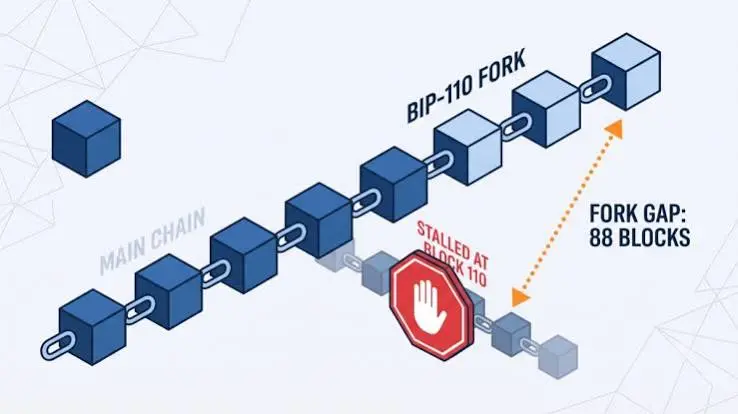
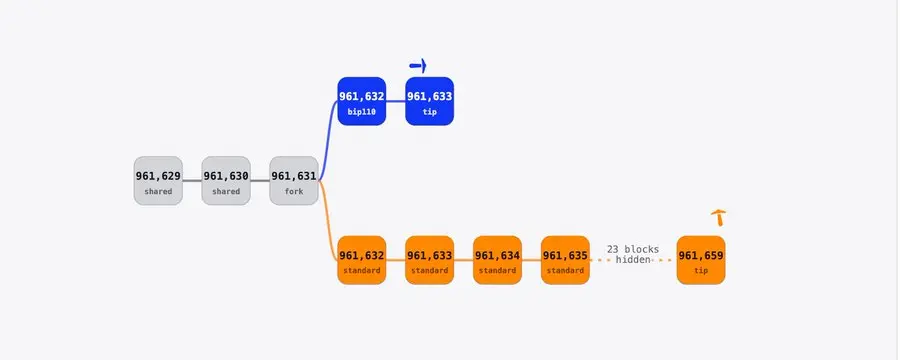
The Bitcoin BIP-110 mandatory signaling window will open at block 961632, expected around August 9, 2026. As of the on-chain height of 959842, there are about 1790 blocks remaining until that block, and the support rate for BIP-110 signaling is approximately 2.64%.BIP-110's formal name is Reduced Data Temporary Softfork, which proposes to limit the size of certain data fields in Bitcoin transactions, mainly targeting Ordinals type inscriptions, large OP_RETURN payloads, and similar high data volume uses. If activated, the restrictions will take effect at block 965664 and will automatically expire after 52416 blocks, approximately one year later.Current signaling support mainly comes from Ocean, independent miners, and small operators, while major mining pools such as Foundry, Antpool, ViaBTC, and F2pool have not yet shifted to support it. Foundry has requested clients to vote based on average hash power; only if "support" votes exceed 51% of the participating weighted hash power will the pool switch all blocks to support signaling. If the current signaling level persists until block 961632, nodes executing BIP-110 will reject blocks that do not emit version bit 4 signals and will follow the minority of blocks that do emit signals. Non-upgraded nodes will continue to accept both signaling and non-signaling blocks and will follow the chain with the highest accumulated proof of work.

SBI Holdings acquires Bitbank for $289 million, creating Japan's largest cryptocurrency exchange; bipartisan U.S. senators urge CFTC to investigate Polymarket's "deceptive marketing."

According to BBX data, last weekend Japan's largest financial group completed the most important cryptocurrency acquisition, and U.S. bipartisan senators launched a new regulatory offensive against prediction market platforms. The core developments are as follows:SBI Holdings, Inc. (Tokyo Stock Exchange: 8473) announced the acquisition of the Japanese cryptocurrency exchange Bitbank (privately held) for approximately $289 million. After the transaction is completed, SBI's cryptocurrency business will surpass all competitors, creating Japan's largest cryptocurrency exchange. SBI Holdings is one of Japan's largest independent financial services groups, already owning cryptocurrency-friendly network bank SBI Shinsei Bank, cryptocurrency asset custodian SBI Digital Asset Holdings, and multiple Bitcoin mining and cryptocurrency venture capital investments. Bitbank is one of Japan's largest spot BTC exchanges and holds an official cryptocurrency exchange license from the Financial Services Agency (FSA) of Japan. This acquisition marks a shift for traditional Japanese financial institutions from "strategic trial" in the cryptocurrency sector to "scale acquisition dominance," alongside the joint stablecoin plan of the three major banks: Mitsubishi UFJ ($MUFG), Sumitomo Mitsui ($SMFG), and Mizuho ($MFG) (targeting March 2027), forming the most intensive wave of cryptocurrency layout in Japan's financial industry by 2026.U.S. Senators John Curtis (Republican, Utah) and Adam Schiff (Democrat, California) reported on June 28 that they jointly sent a letter to the CFTC, urging it to conduct a formal investigation into the prediction market platform Polymarket (privately held), citing a "concerning" investigative report regarding Polymarket's "deceptive marketing" practices, which accused it of systematic misleading in user acquisition and risk disclosure. This is the third regulatory offensive against prediction market platforms initiated by Congress this year (previously, the House Oversight Committee launched an insider trading investigation on May 22); the two senators come from different parties, which is significant. For Robinhood Markets, Inc. (NASDAQ: $HOOD), this investigation poses indirect pressure—Robinhood's prediction market/event contract business (which achieved a record daily trading volume in June) faces the same regulatory qualitative disputes as Polymarket; however, Robinhood's defensive advantage lies in its ongoing application for a CFTC Designated Contract Market (DCM) license, providing a clearer compliance path compared to Polymarket.

Bipartisan senators urge the U.S. Treasury to maintain state-level stablecoin regulatory authority under the GENIUS Act

A bipartisan group of senators led by Cynthia Lummis has written to U.S. Treasury Secretary Scott Bessent, requesting that the Treasury maintain states' regulatory authority over certain stablecoin issuers when formulating implementation rules for the GENIUS stablecoin bill. The GENIUS Act was signed into law last year, establishing a federal regulatory framework for stablecoins in the United States, requiring that stablecoins be fully backed by U.S. dollars or similar high-liquidity assets, and mandating that issuers with a market capitalization exceeding $50 billion undergo annual audits, while also setting rules for offshore issuance.The bill allows stablecoin issuers with a market capitalization of no more than $10 billion to be regulated at the state level, as long as the relevant state regulatory systems are "substantially similar" to federal requirements. The senators believe that the rules previously proposed by the Treasury do not clearly outline the timeline and standards for state regulatory system applications, reviews, and certifications, creating uncertainty for the states. The letter points out that there are significant differences in legislative cycles across states, with some states even adopting a biennial legislative cycle, thus requiring a flexible and continuously open certification mechanism to ensure that states can apply for certification when demand arises, rather than being constrained by timing mismatches that limit innovation and competition.

The U.S. Congress will advance a bipartisan cryptocurrency tax bill, which may become the next significant legislation following the CLARITY Act

Jason Smith, the chairman of the U.S. House of Representatives' fundraising committee, stated that digital asset tax legislation must receive bipartisan support; otherwise, the related bill process will not advance. Subsequently, U.S. Representatives Steven Horsford, Max Miller, Suzan DelBene, and Mike Carey jointly proposed the "Digital Asset Protection, Accountability, Regulation, Innovation, Taxation, and Revenue Act" (PARITY Act). The bill aims to update digital asset tax rules, provide a clearer regulatory framework for the market, while enhancing investor protection and preventing market manipulation.Representative Steven Horsford stated that the bill will help ordinary investors participate more safely in the digital asset market and promote wealth accumulation opportunities. Max Miller believes that the current U.S. tax laws are unable to adapt to the rapid development of digital assets and modern financial technology. Currently, the PARITY Act and the advancing CLARITY Act are seen as important components of establishing a comprehensive regulatory system for crypto assets in the United States.The U.S. Congress released a tax policy discussion draft in March this year and held a bipartisan roundtable in May to discuss the tax framework for crypto assets. The market is closely watching whether the CLARITY Act can be passed by 2026. Analysts believe that if both the CLARITY Act and the PARITY Act are ultimately legislated and combined with the subsequent rule-making of the GENIUS Act, the U.S. crypto industry will welcome a clearer regulatory environment, further promoting Web3 and DeFi into the mainstream financial system.
app_icon
ChainCatcher Building the Web3 world with innovations.