BTC $79,840.32 -1.99%
ETH $2,312.46 -2.56%
BNB $751.71 +0.13%
XRP $1.29 -3.23%
SOL $99.90 -2.70%
TRX $0.3311 -0.06%
DOGE $0.0777 -2.95%
ADA $0.1980 -4.45%
BCH $278.89 -6.57%
LINK $11.43 -3.18%
HYPE $78.94 -3.17%
AAVE $130.27 -3.78%
SUI $0.9087 -3.53%
XLM $0.1676 -2.43%
ZEC $1,242.10 -5.43%
AAPL $347.68 +0.22%
AMZN $252.37 -0.70%
GOOGL $292.25 -9.98%
MSFT $549.73 +3.69%
META $620.73 -0.54%
NVDA $213.45 -2.81%
TSLA $400.19 -2.22%
SNDK $1,349.67 -0.97%
INTC $91.56 -4.04%
SPCX $143.47 -4.30%
MU $945.48 -2.05%
AMD $558.08 -1.86%

senate

All
Article
Flash

first_img The U.S. Senate investigates Tether's payment to Bo Hines Company

The chief Democratic member of the U.S. Senate Permanent Subcommittee on Investigations, Richard Blumenthal, sent a letter on Thursday to Tether and its U.S. subsidiary CEO Bo Hines regarding the consulting firm Nxum Group, which Hines co-founded, requesting clarification on the arrangements related to Tether's payments to Nxum. According to The Wall Street Journal, Nxum received substantial payments for providing consulting services to Tether while Bo Hines was still serving as a White House crypto advisor and involved in shaping crypto policies, including those concerning stablecoin issuers.In his letter to Tether CEO Paolo Ardoino, Blumenthal stated that the unusual terms and nature of the business relationship between Tether, Nxum, and Bo Hines raised serious ethical and legal concerns, implying that Tether likely knew that making payments to a current White House official directly involved in shaping critical legislation for its business was illegal and improper. A Tether spokesperson did not immediately respond to a request for comment. CoinDesk previously reported that Nxum, as a major campaign advertising supplier for a political action committee associated with Tether, received millions of dollars in revenue, despite having little prior political experience, and recently hired another White House crypto advisor, Harry Jung.Blumenthal has recently focused on the crypto space, including Trump's meme coin, World Liberty Financial, and activities involving Binance, particularly Tether. He has released reports on Tether's financial connections with Iran and questioned its relationship with U.S. financial partner Cantor Fitzgerald. Ardoino criticized Blumenthal this week for ignoring important information and sharing the report with the media before giving the company a chance to respond. The prediction market Kalshi shows a 69% probability that Democrats will regain control of the Senate, and if Blumenthal leads the subcommittee, he will gain greater subpoena and agenda control.

first_img Fairshake affiliated PAC invested over 52 million dollars in the Ohio Senate election, opposing Sherrod Brown

According to documents submitted by the Federal Election Commission (FEC) on October 15, the political action committee Fairshake, primarily funded by Coinbase and Ripple Labs, has invested $46.6 million through its affiliated organization Defend American Jobs in the Ohio Senate election for media advertising opposing former Congressman Sherrod Brown's return to the Senate and supporting Republican incumbent Jon Husted. This expenditure is over 50% more than Fairshake's initial plan of $30 million announced in September.In an interview aired on Pod Save America on October 16, Brown responded that he has spent his entire career battling Wall Street, big pharmaceutical companies, and oil giants, achieving success in many cases, while Husted is a spokesperson for these forces, which is why they have invested tens of millions of dollars. In addition to Fairshake, the super PAC Digital Freedom Fund, established by Gemini co-founders Tyler and Cameron Winklevoss, reported approximately $3 million in advertising expenditures this week to oppose Brown and support Husted, bringing the total media spending in the Ohio campaign to over $5.9 million. With less than three weeks until the U.S. elections, early voting in Ohio has been underway for 10 days.Fairshake's spending this round has exceeded $41 million for 2024, when the PAC supported Republican Bernie Moreno and opposed the incumbent Brown. Brown, who previously served as chairman of the Senate Banking Committee, is one of the lawmakers in Congress openly questioning the laws and policies supported by the cryptocurrency industry. Defend American Jobs also reported spending over $6.7 million in the Nebraska Senate election opposing independent candidate Dan Osborn, whose opponent, Republican Pete Ricketts, voted in favor of the Digital Asset Market Structure Act and legislation related to stablecoins. Fairshake stated in January of this year that it held $193 million in cash before the election.

U.S. Senate Investigation: USDT is a key liquidity channel for Iran's shadow banking, Gulf VASP faces higher sanction risks

A report from the U.S. Senate Permanent Subcommittee on Investigations (PSI) identifies stablecoins, particularly USDT, as a key liquidity channel supporting Iran's shadow banking system. Licensed virtual asset service providers (VASP) in the Gulf Cooperation Council (GCC) region face heightened sanctions compliance pressure and need to enhance wallet ownership identification and counterparty assessment.Soham Jethani, a partner at the law firm Septten, stated that merchants settling crypto assets into local fiat currency do not necessarily avoid sanctions risks. Liability may involve designated entities, the provision of funds or economic resources, and asset handling within the transaction chain, potentially arising before the final settlement by banks. Jethani pointed out that the name of the stablecoin or the currency in which it is priced does not determine legal ownership; specific rights depend on contractual arrangements and actual payment processes.Globally circulating stablecoins may also pose secondary sanctions risks, as indirect or historical wallet associations do not automatically constitute violations and must be assessed in conjunction with applicable regulations, transaction participants, and specific facts. In regulated markets like the UAE, licensed exchange wallets are continuously monitored, and related funds can be frozen before consumption settlements, with merchants also required to complete KYC. Regulated VASPs handling deposits and withdrawals bear the responsibility for counterparty and sanctions risk assessment and corresponding controls.

first_img The cryptocurrency advocacy organization Stand With Crypto announced its first round of endorsements for Senate candidates

According to The Block, the crypto advocacy organization supported by Coinbase, Stand With Crypto, has announced its first round of Senate candidate endorsements.The organization stated that it will endorse Ohio Republican Senator Jon Husted, whose opponent is the crypto-skeptical former Senate Banking Committee Chairman Sherrod Brown. Additionally, it will endorse Ashley Hinson from Iowa and Chris Pappas from New Hampshire.This endorsement comes after the Senate's procedural vote on September 15 failed to pass the Clarity Act, which aims to establish a federal regulatory framework for the industry.Senate Democrats stated that they could not vote for a bill that would allow President Trump to profit personally from the crypto industry. Stand With Crypto's Executive Director Mason Lynaugh mentioned that after the Senate's recent failure to advance the Clarity Act, the organization’s more than 3 million advocates are fully shifting their focus to ensuring the election of candidates who support crypto.In addition to the Senate endorsements, Stand With Crypto also stated that it will increase advertising spending in six House campaigns, including those of Democratic Congressman Don Davis and Republican Congressman Bryan Steil.These newly endorsed House candidates all voted in favor of the Clarity Act when it passed the House last year. The organization has also endorsed more House candidates, including Congressmen Shomari Figures and Mariannette Miller-Meeks.

first_img Democratic members of the U.S. Senate Banking Committee call for a public hearing on prediction markets

Democratic members of the U.S. Senate Banking Committee sent a letter to the committee's chairman, Republican Senator Tim Scott, calling for a congressional hearing on prediction markets. The Democrats stated in the letter that the committee has a "critical oversight responsibility" in regulating prediction markets and emphasized that Congress should examine prediction markets through public hearings on a bipartisan basis, rather than in closed-door roundtable meetings limited to Republicans and industry-friendly discussions. Senators including Elizabeth Warren signed the letter.On the same day, Republican members of the Senate Banking Committee met with Tarek Mansour, CEO of the prediction market platform Kalshi. Scott stated in a statement to The Block that he convened Republican lawmakers to meet with Kalshi to better understand the opportunities and challenges presented by securities-linked products. The two sides discussed keeping innovation within the United States, how investors use these products, protecting retail investors, and regulatory issues that Congress should address. Kalshi did not immediately respond to a request for comment.Currently, the U.S. Commodity Futures Trading Commission (CFTC) advocates for a leading role in the regulation of prediction markets but faces opposition from various states, which claim jurisdiction over sports event contracts. The Senate Banking Committee, on the other hand, has jurisdiction over the SEC and is responsible for regulating "securities-linked products" related to prediction markets. Democrats pointed out that the bets offered by such products, which are linked to company performance metrics, may fall under the SEC's regulatory scope. It has been reported that Cboe Global Markets is seeking SEC approval for its listing of "all-or-nothing options" linked to company earnings results.

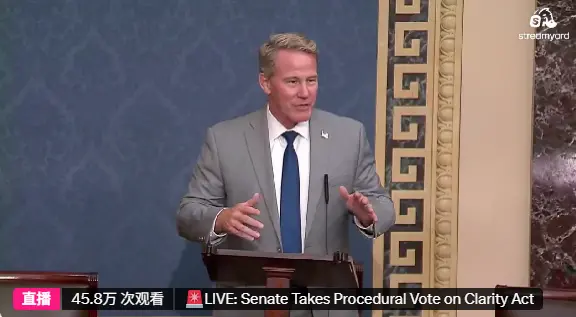
The U.S. Senate is about to conduct a procedural vote on the CLARITY Act, with a threshold of 60 votes

The U.S. Senate will conduct a procedural vote on the Digital Asset Market Clarity Act (referred to as the CLARITY Act). At 2:15 AM Beijing time on September 16, senators will decide whether to end the debate on the motion to enter the bill's review process, with a threshold of 60 votes. If the vote passes, the bill will then enter full Senate debate, amendments, and subsequent final voting, which does not equate to the bill being passed directly that night, nor does it mean it will take effect immediately.To garner bipartisan support, Senate Republicans accepted 126 substantive amendments proposed by Democrats in the final draft. The new text includes stricter ethical provisions, granting state attorneys general a clearer enforcement role; it also gives the Secretary of the Treasury the authority to intervene against potential deposit outflows triggered by payment stablecoins, and revises developer-related provisions to reduce the risk of decentralized infrastructure developers being classified as money transmission entities. Democrats are concerned that the Trump family's cryptocurrency business may create conflicts of interest, with some lawmakers hoping to add constraints such as asset divestiture or blind trusts; moderate senators like Warner and Gallego still hope to push for more amendments. Some Republican lawmakers are also under pressure from the banking industry, fearing that accounts with yield attributes linked to stablecoins could siphon off deposits from community banks.

first_img U.S. Senators Discuss Requirement for AI Companies to Fulfill Duty of Care

According to a report by Reuters, U.S. Senate negotiators are discussing legislation that would require artificial intelligence companies to demonstrate that they are taking reasonable precautions to prevent their tools from causing harm. The proposal aims to grant the U.S. Secretary of Commerce the authority to require developers to provide proof of reasonable steps taken to prevent harm, referred to as "duty of care," and to authorize the dispatch of government auditors to test relevant products. Reuters was unable to immediately determine what constitutes "reasonable," and the related legislation is still under discussion.Even if Congress passes the measure, its prospects of becoming law still face significant resistance. U.S. President Donald Trump stated on Monday that existing authorities are sufficient to regulate and prosecute technology companies, suggesting that he would not sign a bill that sets new rules for artificial intelligence. Senate Majority Leader John Thune, Senate Commerce Committee Chairman Ted Cruz, and Democratic Senator Amy Klobuchar, who is involved in the negotiations, are discussing the proposal. Thune told reporters on Monday that Congress could set safeguards against more significant threats without compromising the U.S.'s leading position in the artificial intelligence race.Klobuchar stated in a statement that she is continuing to push for bipartisan legislation to oversee the greatest risks posed by artificial intelligence models, including requiring developers to work with government experts to validate and test models to ensure safety. Senior Democratic member of the Commerce Committee Maria Cantwell is also involved in the discussions. Reuters reported on Friday that negotiators are also discussing the possibility that if the government determines that certain artificial intelligence models are unsafe and wishes to prevent their release, it could be brought to federal court, where companies could challenge that decision. The portion of the measure involving federal courts would also prevent states from enforcing their own laws regarding specific risks associated with artificial intelligence models.
app_icon
ChainCatcher Building the Web3 world with innovations.