Cryptocurrency CEXs are flocking to sell US stocks, and traditional brokerages are facing "unexpected guests."
 Core Viewpoint

 The big reshuffle has just begun.
Author: momo, ChainCatcher
Selling U.S. stocks has surprisingly become a top priority for crypto CEX.
On one hand, the overflow demand for U.S. stocks is incredibly tempting. Over the past few years, U.S. stocks have remained hot, and investors from non-U.S. regions have shown high demand for star assets like Nvidia and the soon-to-IPO SpaceX, OpenAI, etc. Traditional brokerages, constrained by regulatory uncertainties and compliance costs, find it difficult to efficiently capture this flow of global investors. However, with the SEC approving Nasdaq to pilot tokenized stock trading, Wall Street's experimentation with tokenization has made it possible for crypto CEX to enter the U.S. stock market.
On the other hand, this trend has also exposed the traffic dilemma faced by crypto CEX themselves. The hotter U.S. stocks become, the colder the crypto market gets, and there is unlikely to be a strong catalyst to reverse this situation in the short term.
However, the crypto industry has never determined winners and losers during favorable times; it always reshuffles during crises and turning points. The worst of times often become the best of times for crypto CEX. The regulatory purge in '94 established Binance's dominant position, and today, U.S. stock business may be becoming a new watershed for crypto CEX.
Looking at the recent accelerated layout of U.S. stocks, there are mainly two paths: "direct connection to traditional brokerages" and adherence to "tokenization of U.S. stocks." This article uses Binance and Bitget as representatives of these two paths, comparing their similarities and differences across several sub-dimensions, and exploring whether this move by crypto CEX into U.S. stocks can eat into the traditional brokerage pie.
1. Why were crypto CEX's previous U.S. stock products lukewarm?
Before making a formal comparison, let's briefly discuss why, after most mainstream exchanges laid out U.S. stock products last year, recent CEX have concentrated on proposing new U.S. stock products.
The previous round of U.S. stock products mostly took two forms: one is contracts for difference, where users trade on stock price fluctuations without actually touching the underlying stocks; the other is integrating platforms like Ondo and other RWA/tokenization issuance platforms to package U.S. stock exposure as on-chain assets and then place them in the exchange's entry.
These two methods addressed the question of "whether there are products," but did not fully resolve the question of "how usable they are."
Contracts for difference are more like trading tools, suitable for short-term directional bets, but they are still far from real stock assets; early experiences with tokenized stocks also revealed many pain points for users.
Firstly, the authenticity of the underlying U.S. stocks and their liquidity is a major concern for everyone. Additionally, there are many issues with the user experience. Bitget CEO Gracy Chen mentioned several pain points that users concentrated on in the previous round of products when discussing the new generation of U.S. stock tokenization products. For example, slippage is too large when placing large orders, and the trading experience does not feel like buying blue-chip stocks but rather resembles trading on-chain assets with insufficient liquidity; dividend processing is not smooth enough, for instance, after the underlying stock pays dividends, the synchronization on the token side is not strong; when encountering corporate actions like stock splits or consolidations, price and position mapping can easily confuse users.
Another issue is the utilization of funds. Early tokenized U.S. stocks were more like "tradable assets," and after purchase, they mostly just sat in the account waiting for price fluctuations, making it difficult to participate as margin in contracts or unified accounts, and also hard to integrate into financial management, lending, and other exchange ecosystems; for crypto users, this weakened the combinatorial and capital efficiency that tokenization should possess.
In the recent CEX U.S. stock proposals, improvements have been made around these pain points. The new moves by Binance and Bitget represent two different paths: the former leans towards direct connections with brokerages and real stock trading, while the latter attempts to integrate real U.S. stock liquidity, tokenized mapping, and exchange ecosystems through Reality/rToken.
Next, we will compare the details of the two proposals based on several dimensions where users have pain points.
2. Two new paths for U.S. stocks: Direct connection to brokerages vs. adherence to tokenization
1. Product Underlying: What exactly are users buying?
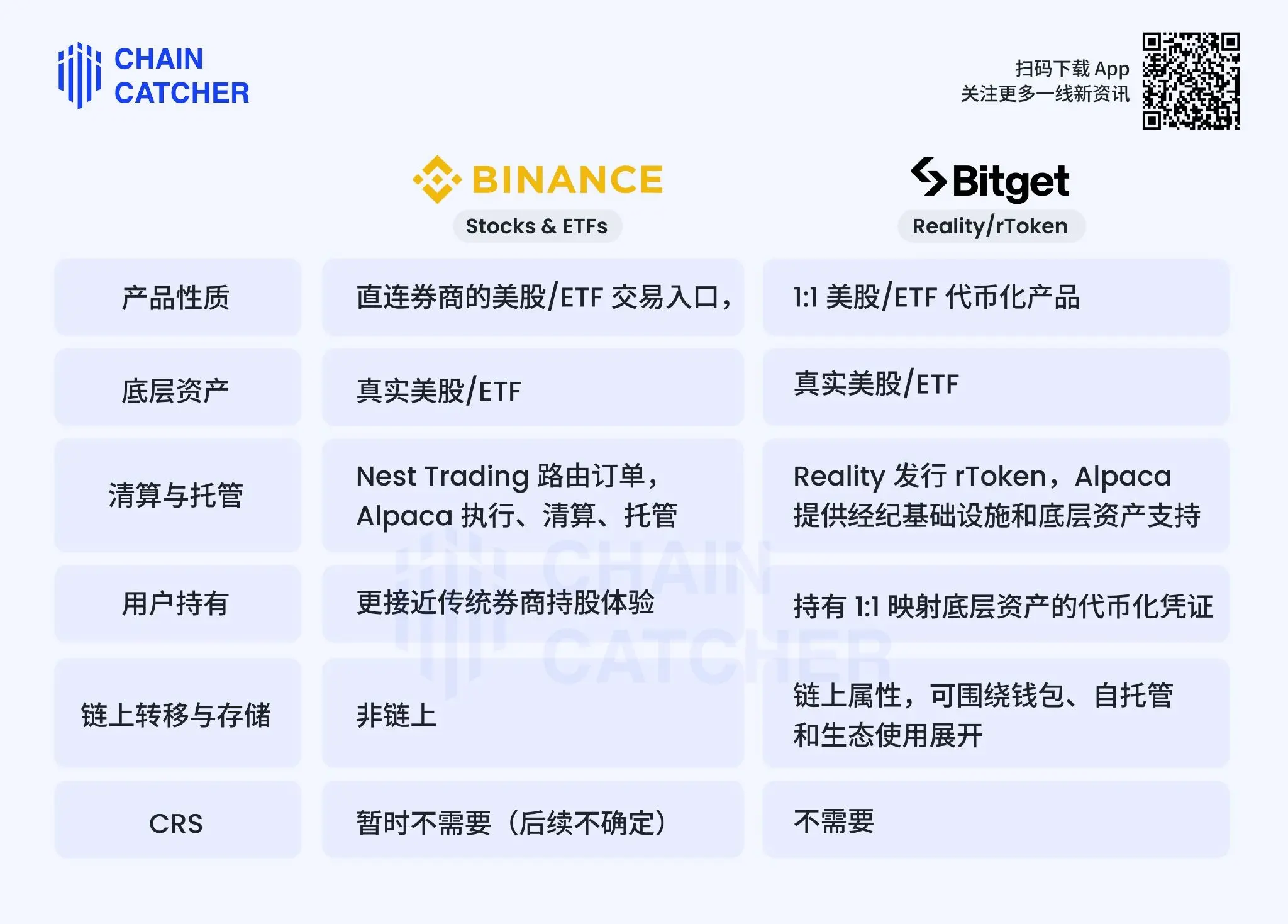
Both Binance and Bitget have addressed the fundamental issue of directly connecting to U.S. stock liquidity in their products, using the underlying custodian Alpaca to achieve this. Alpaca is a compliant U.S. brokerage infrastructure, and currently, other core players in tokenization like Ondo Finance, Dinari, and xStocks are also supported by it.
Specifically, Binance follows the "brokerage entry" route, with U.S. stock business orders handled by introducing broker Nest Trading, and the backend connected to Alpaca for execution, clearing, and custody.
On the other hand, Bitget follows the "tokenization" route, where users hold rToken, but orders are executed directly in the U.S. stock market through Reality's on-chain counter, with the underlying stocks held by Alpaca, and rToken serves as a 1:1 on-chain certificate. Therefore, the price and depth of rToken are not matched internally by the platform but are connected to real U.S. stock liquidity.
However, rToken is not directly held as stocks in a traditional brokerage account. Where does the security guarantee for this tokenized certificate come from? Currently, Bitget's official answer is that it is composed of three layers of protection: custody by licensed brokers, independent asset isolation, and real-time reserve proof.
In terms of CRS, Bitget's rToken currently does not involve traditional brokerage account-level CRS; the Binance path is closer to a brokerage and may be affected by regulations in the future.
In summary, both have resolved the question of "whether it is real U.S. stock assets." Binance resembles a brokerage entry, while Bitget tokenizes real assets into the on-chain ecosystem, emphasizing on-chain attributes and capital efficiency.
2. Asset Rights: What else do users enjoy besides price fluctuations?
For users, buying U.S. stocks is not just about price fluctuations; it also involves dividends, dividend taxes, stock splits, consolidations, mergers, delistings, voting rights, and a series of rights and corporate actions. The closer it is to real stocks, the more these details cannot be vague.
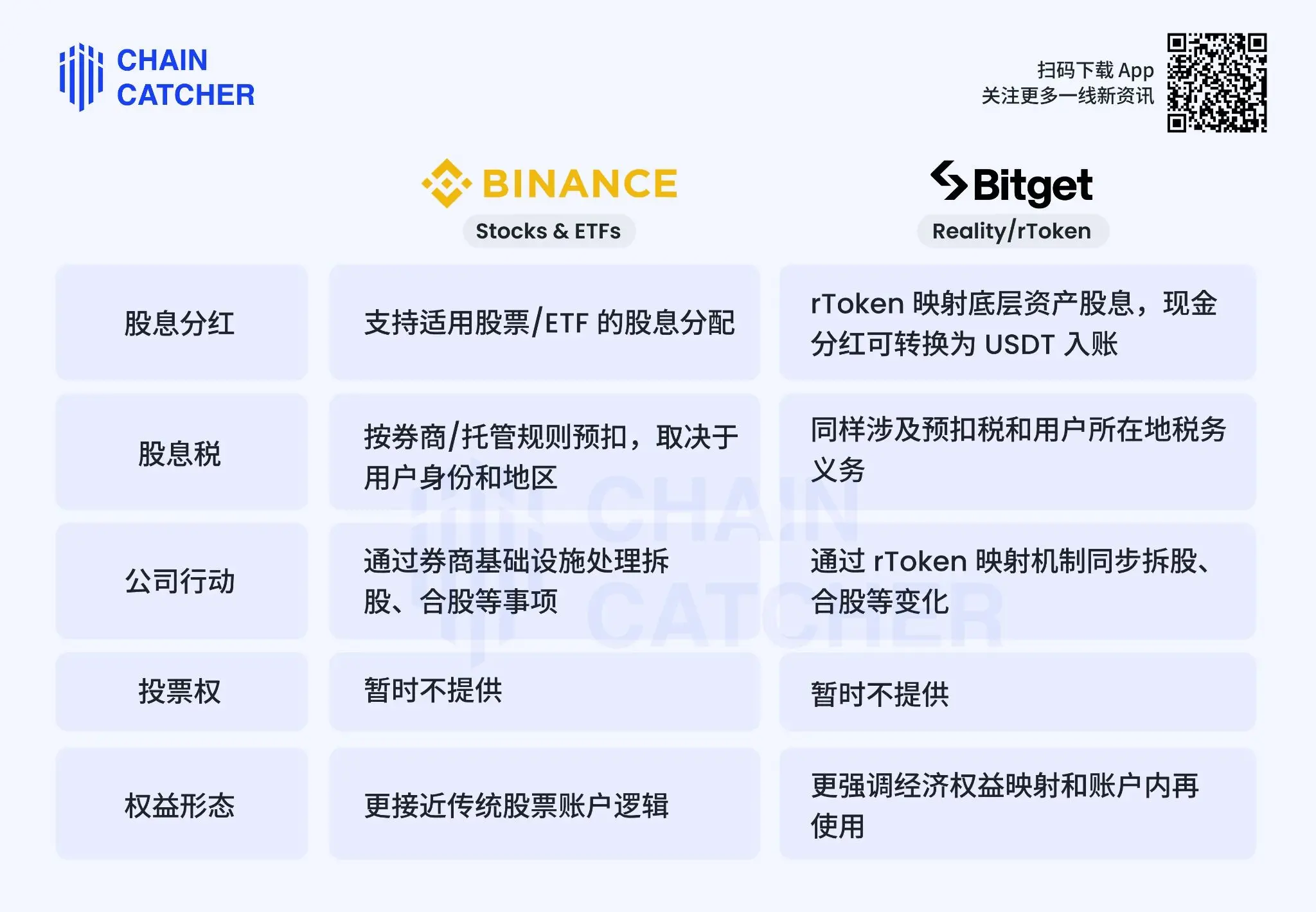
From publicly available information, both Binance and Bitget in this round of proposals are no longer just allowing users to trade a U.S. stock price symbol but are also addressing the basic economic rights related to real U.S. stocks.
Dividends, dividend taxes, stock splits, consolidations, and other corporate actions essentially rely on underlying brokerage infrastructures like Alpaca to handle them. Therefore, in terms of these basic rights, both are aligned; as long as the underlying U.S. stocks undergo dividends or corporate actions, the platform needs to synchronize the corresponding results to the users' accounts.
The difference lies only in the method of realization. Binance reflects this in the U.S. stock account, while Bitget maps it to the token side through Reality/rToken, with stock dividends being issued in token form 1:1 in real-time to accounts, and cash dividends automatically converted to USDT directly into accounts.
Voting rights are not a major difference either. Whether in the brokerage entry model or the rToken model, under non-U.S. users, fragmented holdings, and platform-held structures, users typically do not directly enjoy voting rights as shareholders of listed companies, and voting rights are not the core selling point of such products.
The advantage of Bitget's tokenization approach is that it can achieve some stock rights that the direct connection to brokerages can also accomplish, and it further enables stock rights to become more efficient circulating assets once they enter the CEX.
3. Trading Experience and Capital Efficiency
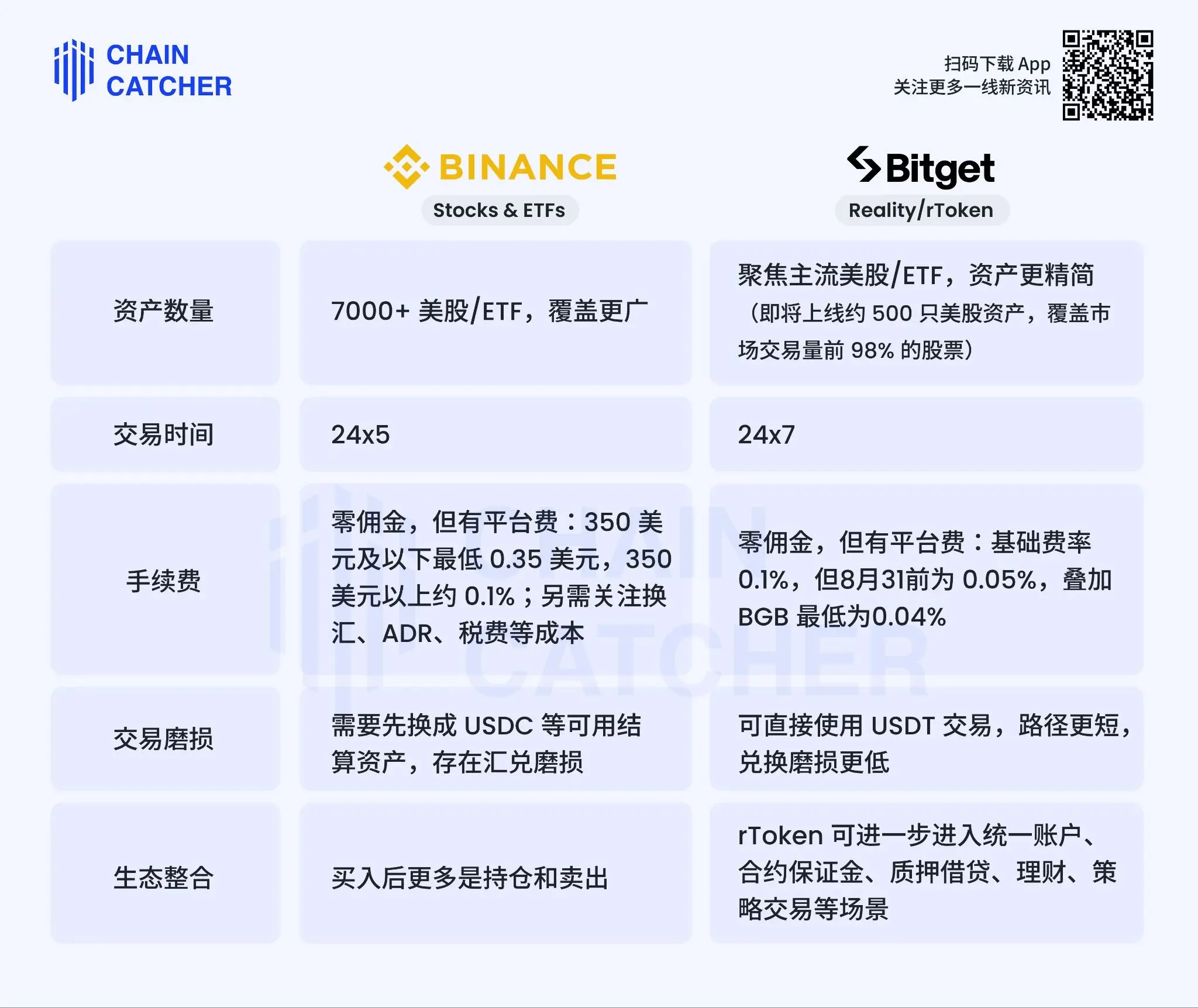
Now let's look at the overall trading experience and asset efficiency.
In terms of asset coverage, Binance has a broader range; Bitget focuses on mainstream stocks and is about to launch coverage of 500 stocks that account for 98% of market trading volume, emphasizing selection and liquidity coverage.
In terms of trading hours, Binance is generally close to traditional U.S. stock trading hours; Bitget can achieve 24/7 trading through tokenization, which aligns better with crypto users' habits.
Some may ask where the liquidity comes from after U.S. stock market hours. Bitget CEO responded on Twitter that it is provided by third-party market makers, who hold spot inventories to meet buy and sell demands. This means that liquidity during non-U.S. stock hours is not unlimited, and one-sided buying during weekends or extreme market conditions may push prices up, leading to significant fluctuations when the market opens on Monday.
In terms of fees, Bitget currently has relatively lower fees, with zero commissions but a platform fee, with a base rate of 0.1%, which is 0.05% before August 31, and with BGB, it can go as low as 0.04%, making it more user-friendly for high-frequency users.
In terms of trading friction, when Binance settles with USDC, users holding USDT need to exchange it additionally; Bitget uses USDT directly, resulting in a shorter path.
The difference in ecosystem integration is most evident. Binance's U.S. stock products have not deeply integrated with the ecosystem, while Bitget's rToken can enter a unified account system, serving as margin for contracts, staking, lending, etc., improving capital efficiency. It currently supports 15 stocks, including Nvidia and Micron, as collateral for contracts.
Finally, let's summarize the pros and cons of the two paths.
The biggest advantage of Binance's direct connection to brokerages model is that users are closer to traditional U.S. stock trading because the underlying assets are real U.S. stocks, and liquidity comes from the real U.S. stock market, with broader asset coverage, providing a stronger sense of trust for users without crypto trading experience. However, the downside is that it is relatively simple, and users' capital efficiency has not been fully realized.
The advantage of Bitget's tokenization model lies in achieving the core advantages of direct connections to brokerages, namely liquidity and dividend distribution. On this basis, Bitget has also improved capital efficiency, allowing users to trade 24/7. Tokenized stock assets can be used as contract margins and in more trading scenarios, all while offering lower fees. However, for some more cautious users, directly holding stocks may feel safer than tokens. It is expected that as the tokenized U.S. stock experience provided by Bitget continues to improve, users' concerns will gradually diminish.
III. Can cryptocurrency exchanges eat into the traditional brokerage market?
Trading U.S. stocks has never been a competition among cryptocurrency CEX. In the long run, cryptocurrency CEX still has to face competition from brokerages.
1. Selling U.S. stocks through crypto CEX: specific advantages and challenges
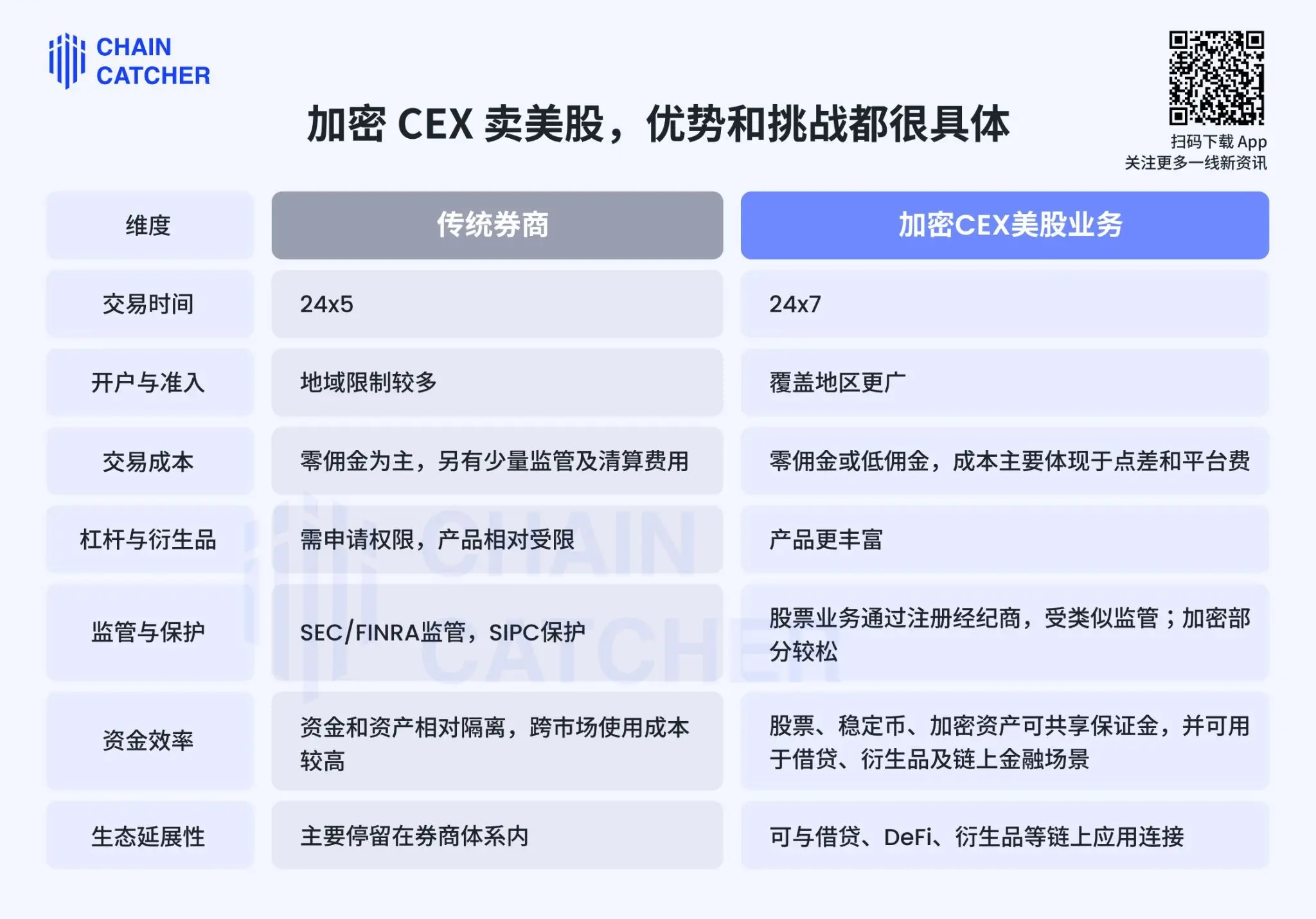
From several key dimensions, the advantages of cryptocurrency CEX compared to traditional brokerages are as follows: in terms of trading hours, cryptocurrency CEX can achieve 24/7 trading through tokenization, which better meets investors' trading needs. Regarding account opening and access, traditional brokerages have more geographical restrictions, while cryptocurrency CEX has a broader coverage.
However, the core advantage lies in capital efficiency and ecological extensibility. In traditional brokerage accounts, stock funds are relatively isolated from other assets, and the cost of cross-market usage is high; cryptocurrency CEX allows stocks, stablecoins, and crypto assets to share margins, which can be used for lending, derivatives, and on-chain financial scenarios. This may be why Bitget insists on the tokenization path, bringing U.S. stocks onto the blockchain, making them 24/7 tradable, collateralizable, and reusable assets, which currently distinguishes it from the core competitiveness of traditional brokerages.
Of course, the challenges are also very specific. The closer it gets to the real stock market, the more users' requirements for CEX approach those of traditional financial products. The platform must prove the underlying stocks truly exist, ensure custody and reserves are transparent, and manage details such as dividends, stock splits, taxes, and liquidity well. Especially for tokenized products, whether prices are stable and liquidity is sufficient during non-trading hours or extreme market conditions will directly determine user trust.
2. The outcome may not be one replacing the other, but both moving towards panoramic exchanges
Currently, the larger trend is that traditional finance and crypto finance are moving towards each other.
On one side, cryptocurrency CEX is no longer satisfied with just cryptocurrency trading. Binance has already connected directly with brokerages to trade U.S. stocks, while Bitget has clearly defined its strategy as Universal Exchange ( UEX ), aiming to integrate stocks, gold, foreign exchange, and crypto assets into a single account. On the other side, traditional platforms are also embracing tokenization; brokerages like Robinhood have launched stock tokens, and the NYSE is promoting 24/7 tokenized stock trading.
This indicates that the tokenization of U.S. stocks is not just about product competition, but a change in the form of financial accounts. In the future, the boundaries between brokerage accounts, crypto accounts, and bank accounts will become increasingly blurred.
In the short term, whether CEX can eat into the traditional brokerage market depends on product experience and compliance boundaries; in the long term, the real competition is about who becomes a more efficient multi-asset financial platform first.
This is also the most noteworthy aspect of the U.S. stock strategy of cryptocurrency CEX, as Bitget CEO Gracy stated, this is not simply about adding a trading category, but about integrating traditional assets into the crypto ecosystem through blockchain technology, and positioning cryptocurrency CEX on a larger financial platform, beginning to compete with traditional institutions for the pricing power of global mainstream assets.
 Risk warning




Popular articles