








The "Meme Factory" has emerged; how does the harvesting assembly line of Robinhood Chain operate?
 Core Viewpoint

 The methods of continuous token issuance and centralized control of opening prices are not uncommon on various platforms; they have just been dressed up in the guise of stocks and real estate here.
Author: Zhou, ChainCatcher
On September 22, the token DEED opened on the issuance platform Pons of Robinhood Chain, and within a day, its market value evaporated by more than 90%.
Since its launch in July, Robinhood Chain has become one of the most active token issuance platforms. According to independent statistics from pons ledger, Pons alone has issued nearly 900,000 tokens. With such a high density of token issuance, the collapse of a new coin is not surprising.
However, on-chain analysts traced the funds of DEED and discovered that the same group had orchestrated dozens of token issuances over about two months, extracting approximately $18.43 million in total. Let's take a look at how they operated.
1. Profits from the previous round fund the next round's opening
DEED claims to be a real estate vault on Robinhood Chain, stating that holders can share rental income from a portfolio of apartments after costs are deducted. On September 22, DEED opened on Pons, with its market value briefly reaching $4.23 million.
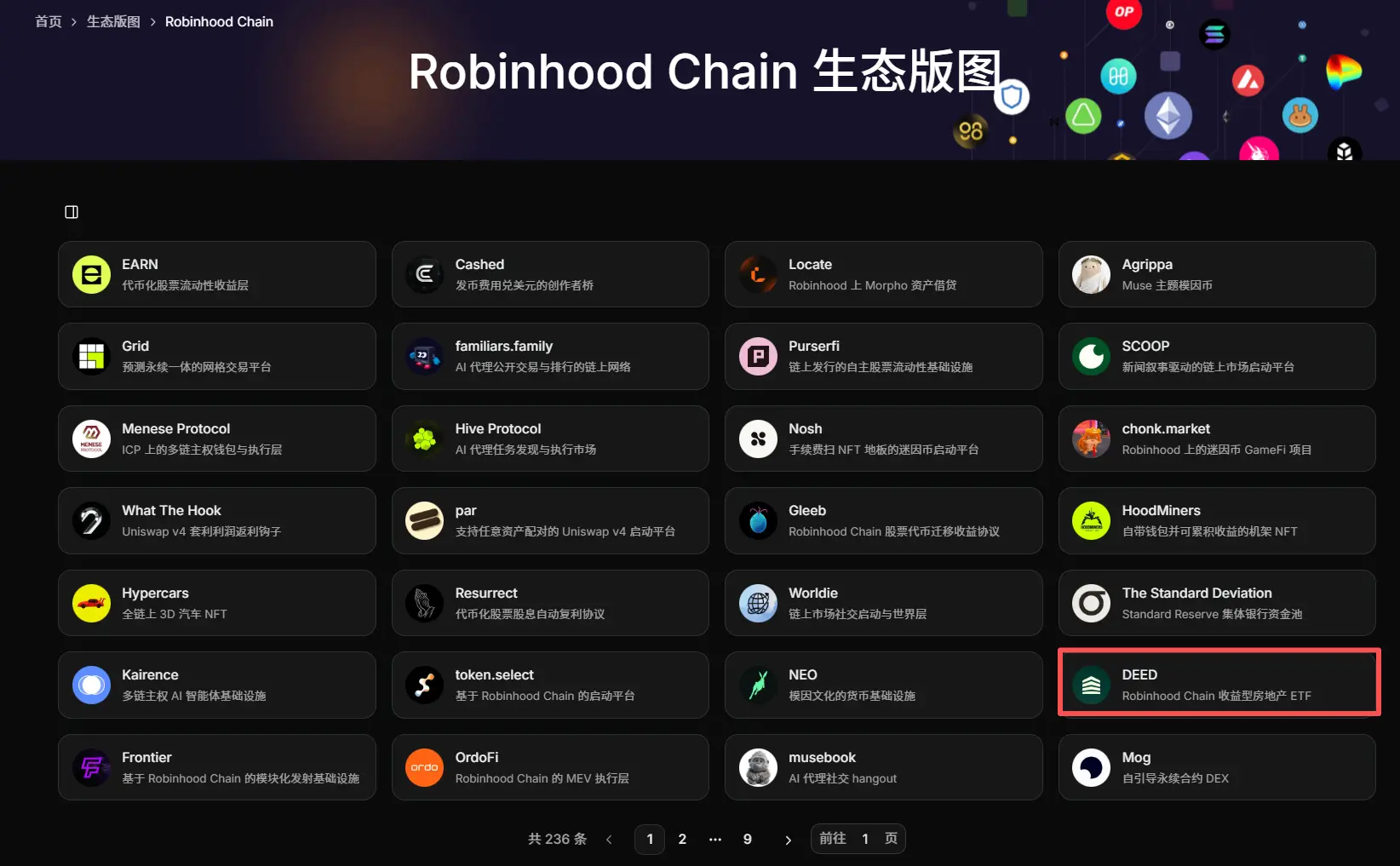
However, the hype lasted less than a day. On September 23, Onchain Lens detected that DEED was suspected of a Rug Pull. 110 associated wallets controlled about 86% of the token supply at one point and extracted approximately $700,000 in funds, while the creators also received 68.5 ETH in creator fees, worth about $188,900. At this point, DEED's market value had dropped to about $55,000, a decline of approximately 98.7% from its peak.
According to on-chain analyst Wazz, DEED is not an isolated incident. The funds behind it came from another token previously issued by the same group.
The story begins with DRAFT from a week ago. On the evening of September 14, 98 wallets holding DRAFT transferred 179.88 ETH to the same address within three seconds, and this money was subsequently transferred to a wallet starting with 0x9d06, where it stayed for a week.
On the morning of September 22, this money began preparing for the opening of DEED. 0x9d06 first transferred out 50 ETH, and two minutes later, 20 ETH arrived at DEED's funding wallet. Sixteen seconds later, this funding wallet distributed 15.98 ETH to 50 addresses through a bulk transfer, including the creator of DEED and 25 wallets that were pre-set to be exempt from the platform's anti-sniping tax.
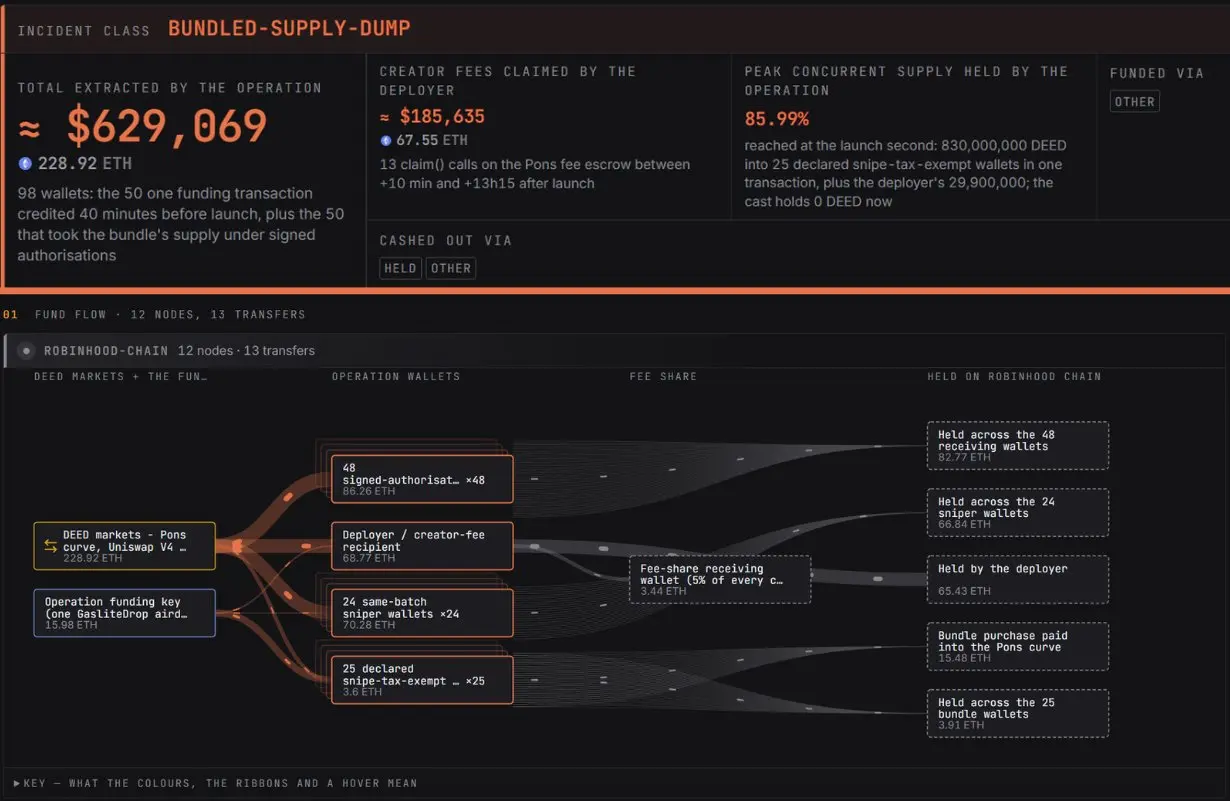
Forty minutes later, DEED opened. The first buy after the opening concentrated the holdings for these 25 tax-exempt wallets. By the time the buying was completed, the creator and this batch of wallets held about 86% of the supply.
One second later, they began selling, and the chips were subsequently dispersed to more wallets for gradual offloading. By the time Onchain Lens issued a warning, this round of harvesting had already been completed.
The connection between DRAFT and DEED is just a microcosm. Wazz found that the same rhythm repeated itself repeatedly over the course of two months.
Before each token issuance, the group prepared dozens of wallets and listed them as tax-exempt. Once the token was launched, these wallets would take most of the chips within one or two blocks. When external buyers entered the market, they would gradually sell off, with the proceeds collected into a few addresses to fund the next token.
Wazz traced 45 issuances along this funding chain. Additionally, four issuances had their startup funds issued by the same private key, and another four had their sale proceeds funneled into the same collection address. Ultimately, he attributed 53 issuances from July 10 to September 21 to the same group, most of which were issued through Pons V2.
To amplify profits, the group also repeatedly used the same name. On the same day that 0x9d06 funded DEED, it also funded another token also called DEED. PINK, CRUMBS, and DEED were each issued three times within about a day. Wazz believes that the group first uses tokens with the same name to harvest the traffic generated by the pre-heating, then announces the real contract address.
According to Wazz's estimates, these 53 issuances extracted approximately $18.43 million in total, but this figure only accounts for the funds taken from the market by the group, with counterparties including both retail investors and other traders and bots, which does not equate to the total losses of retail investors.
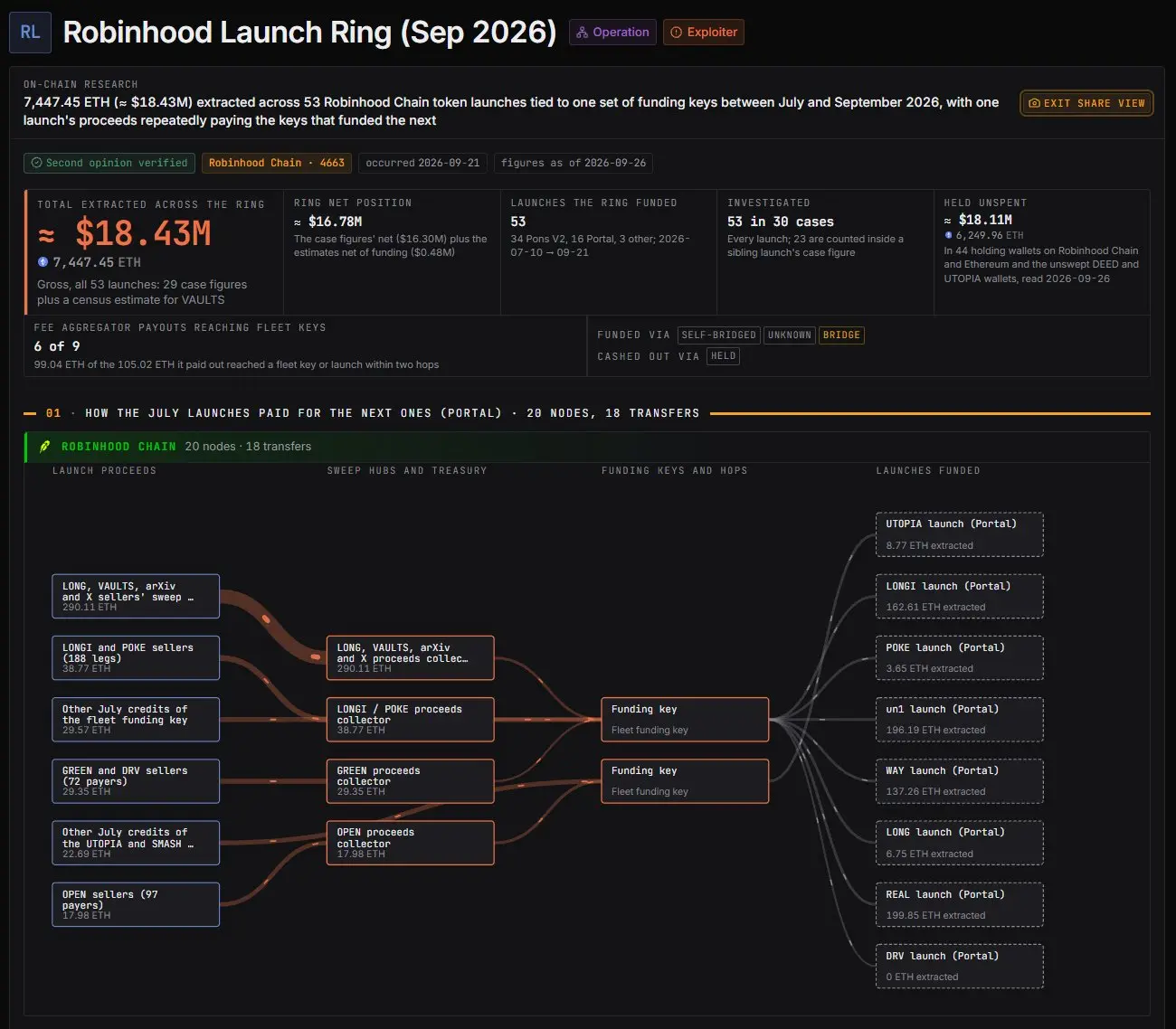
As a clue, DEED's single scale is not large. The highest extraction amounts were CRUMBS and LEGS, at approximately $3.12 million and $2.90 million, respectively. Wazz stated that most of the funds remain on-chain in the form of ETH and cannot be frozen.
2. Anti-sniping tax blocked bots but not those who got exemptions early
The aforementioned tax-exempt list is key to the repeated harvesting. It comes from a set of rules designed by Pons to prevent bots from front-running.
After a new token is launched on Pons V2, it first trades on a joint curve, where the more people buy, the higher the price goes. Once the curve is sold out, the token automatically graduates to the Uniswap v4 pool, with liquidity permanently locked. Pons documentation indicates that graduated tokens do not have the function to withdraw liquidity.
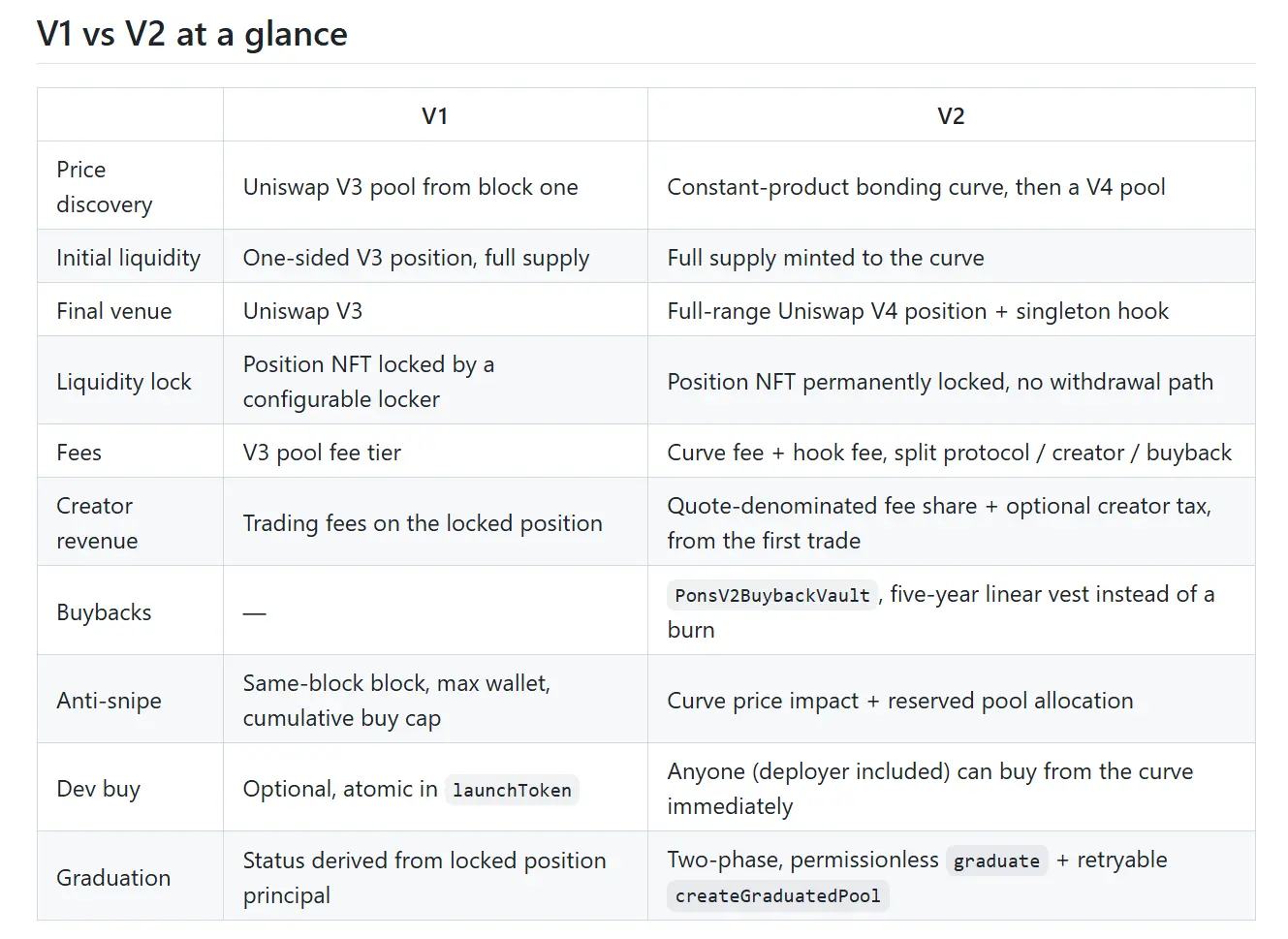
This design blocks the old route for project teams to withdraw liquidity and run away, but it does not control who can buy chips at the opening.
In the first few seconds after a new token is launched, it is easiest for bots that are monitoring to buy in first. To address this, Pons V2 has set an anti-sniping tax. Buyers after the opening must pay a tax of up to 99%, which decays to zero in about five seconds, with the rate being about 25% at one second and about 3% at two seconds.
This tax is enough to make it unprofitable for bots, but the rules also leave a loophole. The token issuance address and the creator's fee address are automatically tax-exempt, and the issuer can additionally designate up to 32 tax-exempt addresses when creating the token. Pons provides the reason in its documentation as facilitating the team to distribute the opening purchases across multiple wallets.
In other words, as long as the issuer writes their own wallet into the list in advance, they can build their position tax-free during those few seconds when everyone else has to pay high taxes.
In the issuances listed by Wazz, nine since the end of August have shown the same pattern. The creator exempted 15 to 25 wallets from the anti-sniping tax, and then a single transaction concentrated the buying for them, directly buying out the curve and pushing the token into the Uniswap pool. After the opening, the holding ratio of the creator and tax-exempt wallets ranged from 82% to 86%.
These nine opening purchases also share a common point, all passing through the same unverified contract created on August 28. Wazz stated that this contract belongs to a commercial bundling tool with many unrelated users, and it has been used in 25 of the 53 issuances.
Additionally, he discovered at least two consecutive token issuance groups that could not be directly linked to this case.
On September 28, the security agency GoPlus disclosed the discovery of a high-risk fraudulent Meme factory on Robinhood Chain, with a transaction volume exceeding $9 million in the past 30 days, involving hundreds of fraudulent Memes.
This Meme factory follows a different route, distributing tokens to a large number of new addresses with only 4 to 11 transactions each, and then selling them in segments through Pons V2's auxiliary contracts and Uniswap routing, creating the illusion of multiple independent traders.
In the 10 samples listed by GoPlus, each token only utilized 3 to 8 new wallets, with a single token extracting 2 to 13 ETH. The individual scale is not large, and the proceeds from sales are similarly funneled into a collection address for funding the next round.
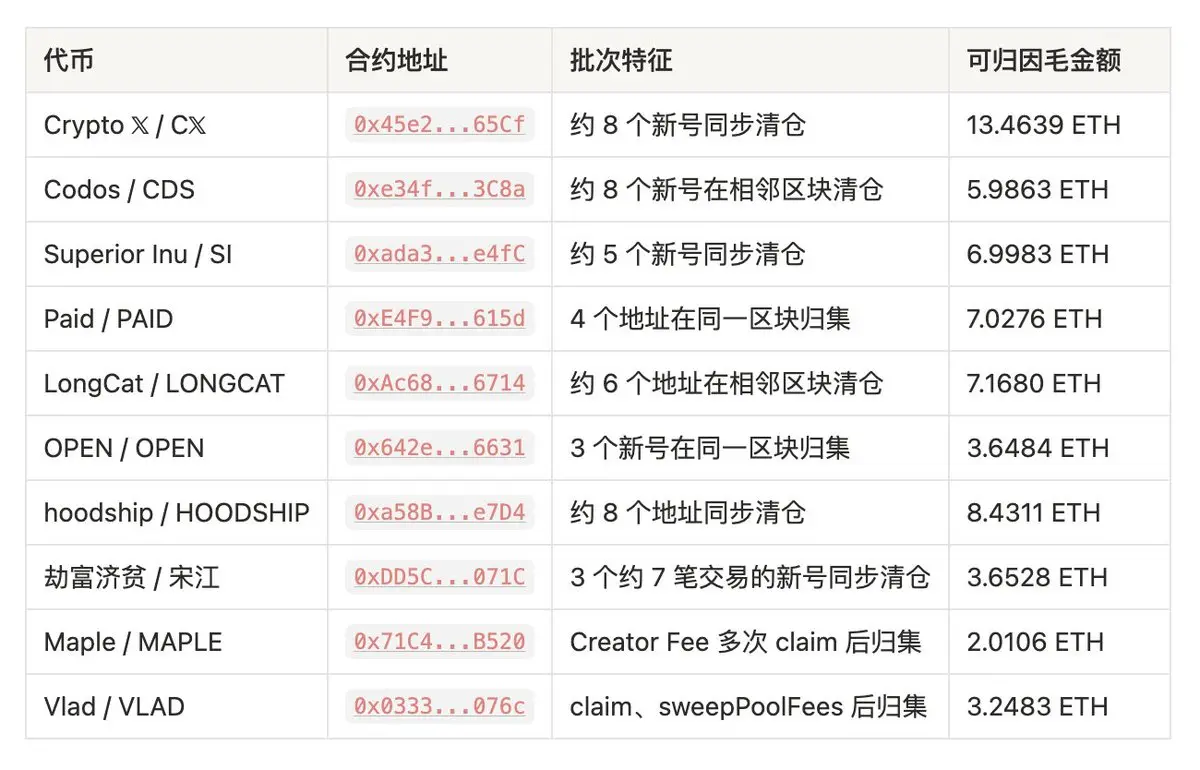
GoPlus statistics show that the collection address's recent 400 transactions had a total inflow and outflow of about 3,589 ETH, approximately $9.49 million, which represents a two-way flow and does not indicate net profit. GoPlus pointed out that both cases used a large number of wallets to hide the true concentration of holdings and did not rely on withdrawing liquidity or prohibiting sales. Currently, there is no evidence to suggest that the two are the same group.
The reason why a large number of new wallets are not conspicuous is related to the token issuance ecosystem of Robinhood Chain. According to pons ledger, from July 13 to September 27, Pons alone issued about 899,000 tokens from approximately 453,000 addresses. Only about 1.5% of V2 tokens sold out the curve and graduated successfully.
On the peak issuance day of September 8, among about 27,000 addresses participating in token issuance, around 90% had never issued a token before. In the daily influx of tens of thousands of new tokens and new addresses, dozens of one-time wallets are difficult for ordinary buyers to identify.
3. Stock disguise and creator revenue sharing make token issuance a business
Looking back at DEED's apartment vault, this type of packaging is not uncommon among the group's tokens.
In the tokens listed by Wazz, there are names like Pink Sheets, Stock Miner, Openbell, EQUITY BROKERS, etc., with Pink Sheets being the old name for the U.S. OTC market; the highest extraction amount, CRUMBS, claims to convert shopping receipts into stock token rewards.
This layer of disguise is inseparable from Robinhood Chain's own positioning, which uses tokenized stocks as a selling point, and Pons V2 also allows issuers to directly price new tokens with stock tokens.
GoPlus previously scanned the issuance records of Pons V2 and found that in about 324,000 issuances within 11 days, 32% were directly priced with official stock tokens. In summary, the combination of Meme coins with stock tokens has become a common practice.
JINQIAN has pushed this layer of outerwear to the extreme. In early September, this meme coin was launched on the Robinhood Chain through a private token issuance factory, with a trading pair being a FAMI token using the Farmmi stock code. Farmmi is a mushroom supplier listed on NASDAQ, and the name JINQIAN is derived from the money mushroom mentioned in its annual report.
According to Nansen, this FAMI is not an official stock token and is not associated with Farmmi's shares. However, the name is enough to evoke associations in the market. On September 2, during U.S. stock trading, Farmmi's stock price surged by about 350% at one point.
Previously, GoPlus published a Robinhood Chain Risk Report showing that the entire supply of this FAMI token is held by the operator. JINQIAN can only be traded in pairs with FAMI, and retail investors must first buy FAMI from the operator each time they purchase JINQIAN. After the hype subsided, the operator withdrew about $2.06 million in stablecoin.
The packaging is responsible for bringing buyers in, while the creator's share allows this business to continue in rounds.
On Pons, most of the transaction fees for each trade are distributed to the token creators. According to pons ledger, as of September 27, Pons has accumulated transaction fees of about $180 million, of which about $147 million flowed to the creators.
For groups that continuously issue tokens, this is another source of income beyond selling chips. In the samples listed by GoPlus, there are two tokens whose earnings come from collecting creator fees multiple times. The cost of issuing a token is very low, and once a token becomes popular, the proceeds from sales and creator fees are enough to cover the costs of many previous attempts.
Conclusion
Data shows that the token issuance craze is waning. According to pons ledger, the daily token issuance volume on Pons dropped from about 36,000 on September 8 to about 5,400 on September 27. Revenue and expenses are also clearly declining.
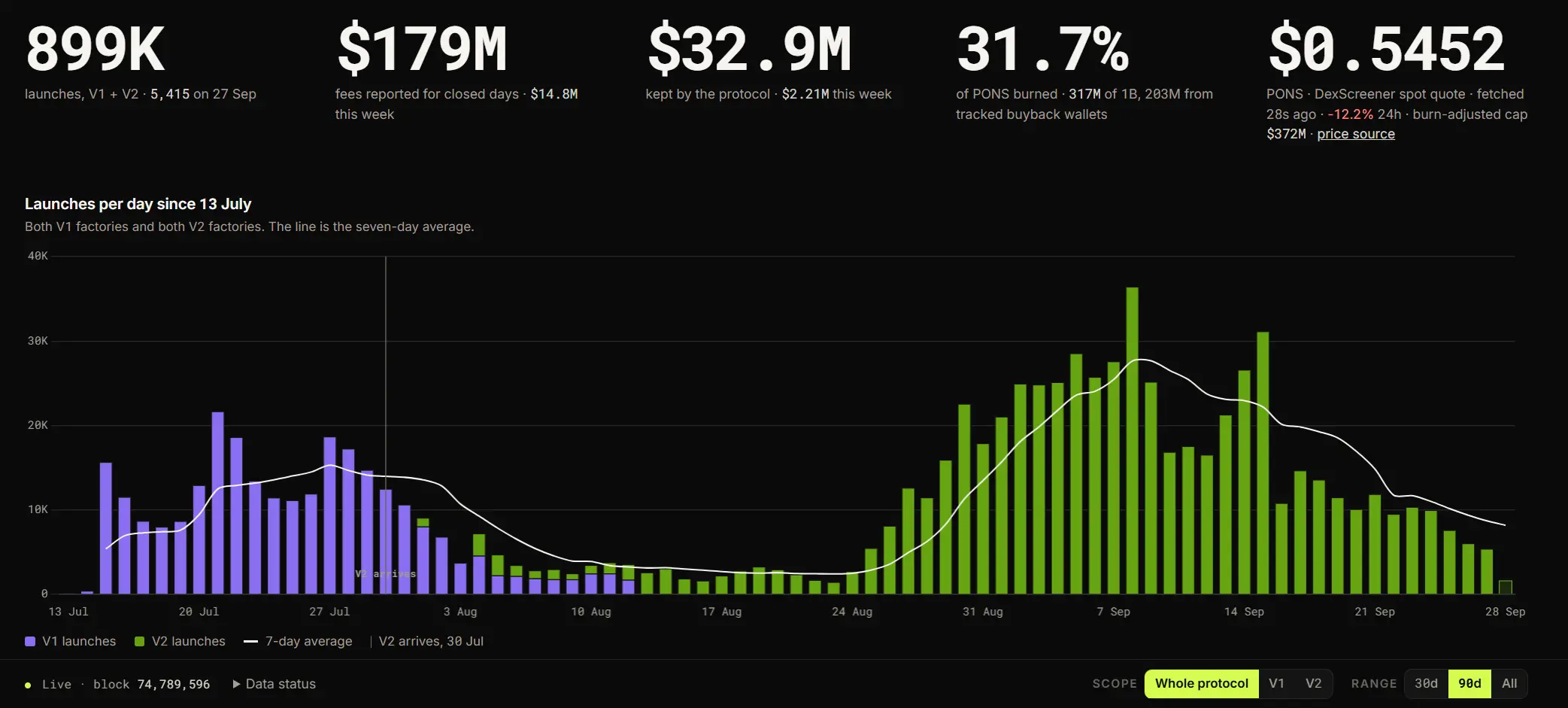
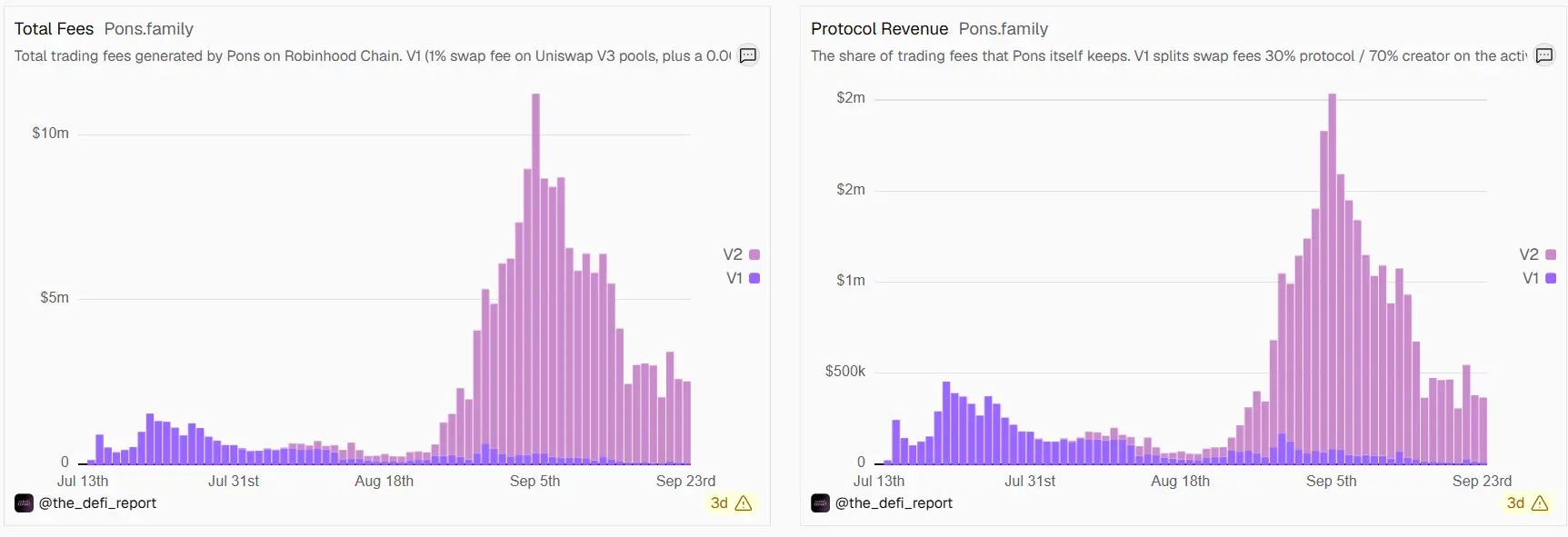
In the coming days, the Robinhood Chain may enter a testing period. On September 29, the gas subsidy provided by Robinhood Wallet for on-chain exchanges will expire. If it can retain users and trading volume after the subsidy ends, these data will truly be meaningful.
On September 30, Robinhood's annual conference HOOD Summit will launch new products aimed at active traders. As for Pons, the market is also waiting for the rollout of its next-generation version. The market expects that the new version will likely adjust the token issuance mechanism, fees, and graduation rules based on V2.
Overall, the original intention of the Robinhood Chain is to move stocks onto the chain. The methods of continuous token issuance and concentrated control of opening positions are not uncommon across various chains; here, they are dressed in the guise of stocks and real estate. As more ordinary investors follow stock tokens to this chain, it may still face those old problems.
 Risk warning



Popular articles





