








Circle is responsible for issuance, Coinbase controls the users: who actually profits from stablecoins?
 Core Viewpoint

 Everyone is watching who issues stablecoins, but from a business model perspective, the real focus should be on who controls the distribution channels.
Author: Darko, IOSG
Everyone is watching who issues stablecoins, but from a business model perspective, the real focus should be on who controls the distribution channels.
The crypto industry has spent a decade searching for a product that even outsiders would use. Stablecoins are the answer. Over the past year, mainstream financial institutions have finally understood it.
The key change is not in technology, but in institutional attitudes. The "GENIUS Act," which took effect on July 18, 2025, established a federal regulatory framework for payment stablecoins in the United States for the first time. Subsequently, the OCC has promoted or approved national trust bank licenses for Circle, Ripple, and Paxos. In June 2026, Visa, Mastercard, and others joined the Open Standard, which consists of more than 140 companies, and launched Open USD. Dollar tokens have been functioning normally since 2014; there has been no sudden technological breakthrough. The real "Aha!" moment is that banks and card organizations finally understand what stablecoins can do.
As of September 28, 2026, DefiLlama shows that the total market capitalization of stablecoins is approximately $306.6B, with USDT at about $183.7B and USDC at about $75.4B. Compared to the mid-July 2026 data used in the original text, the total has slightly increased, and USDC has also seen some growth. Citi's baseline forecast remains at $1.9T by 2030.
Beyond enthusiasm, two things must be clearly understood.
First, the trading volume in the title seriously overestimates real usage. BCG and Allium estimate that the total transfer amount of stablecoins will be about $62T in 2025; after excluding bot trading, routing, and internal transfers, only $4.2T remains, of which the amount actually used for purchasing goods and services is about $350B-$550B. The real payment scale is one to two orders of magnitude lower than the headline figure.
Second, supply contraction and usage innovation can occur simultaneously. In June 2026, the supply of stablecoins decreased by $7.7B, marking the largest single-month decline since 2022, but the decline was only 2.4%, and there was no decoupling. In the same month, the adjusted transfer volume reached $1.79T, a year-on-year increase of 63%. The number of dollar tokens has decreased, but their circulation has become faster.
There are three reasons behind this: Crypto market risk reduction. BTC and ETH fell, with over $4B flowing out of spot Bitcoin ETFs. When traders deleverage, they redeem trading collateral, but corporate wages and operating capital do not disappear simultaneously. The market is preemptively responding to the interest-bearing restrictions of the "GENIUS Act." The relevant restrictions will take effect on January 18, 2027, and some funds have shifted to tokenized government bonds that can still directly provide yields. As of September 24, 2026, the scale of tokenized U.S. government bonds is about $14.9B, down from about $16B at the end of July. Therefore, the direction of "funds continuously flowing from stablecoins to tokenized government bonds" is worth noting, but recent data is not showing unilateral growth. Increased velocity of money circulation. Standard Chartered estimates that stablecoins are turned over about 6 times on average per month, double that of two years ago. The same payment volume now does not require as much stablecoin balance to be held. Only the first point indicates that the demand for stablecoins is still influenced by the crypto cycle, and it may not be the most important factor.
The third point is the most noteworthy because it does not completely align with the interests of the issuers. Issuer revenue is roughly equal to "held funds × yield." The more widespread payments are, the faster the funds circulate; the stablecoin balance required for each dollar of payment actually decreases.
Trading collateral remains there, continuously earning money for the issuer; operating capital flows constantly, contributing less to held earnings. If the payment thesis holds, issuers will see more usage, but they may not earn more from each unit of usage.
The question is no longer whether stablecoins will grow, but:
If stablecoins become the default transmission method for internet dollars, which layer can retain the profits?
Issuance creates a revenue pool, and distribution determines how it is divided.
1. Where does the money for a stablecoin come from, and who takes it?
There are five layers of participants making money in the stablecoin ecosystem, corresponding to three business models: reserve interest is an interest rate business, fund flow fees are a trading volume business, and infrastructure is a SaaS business.
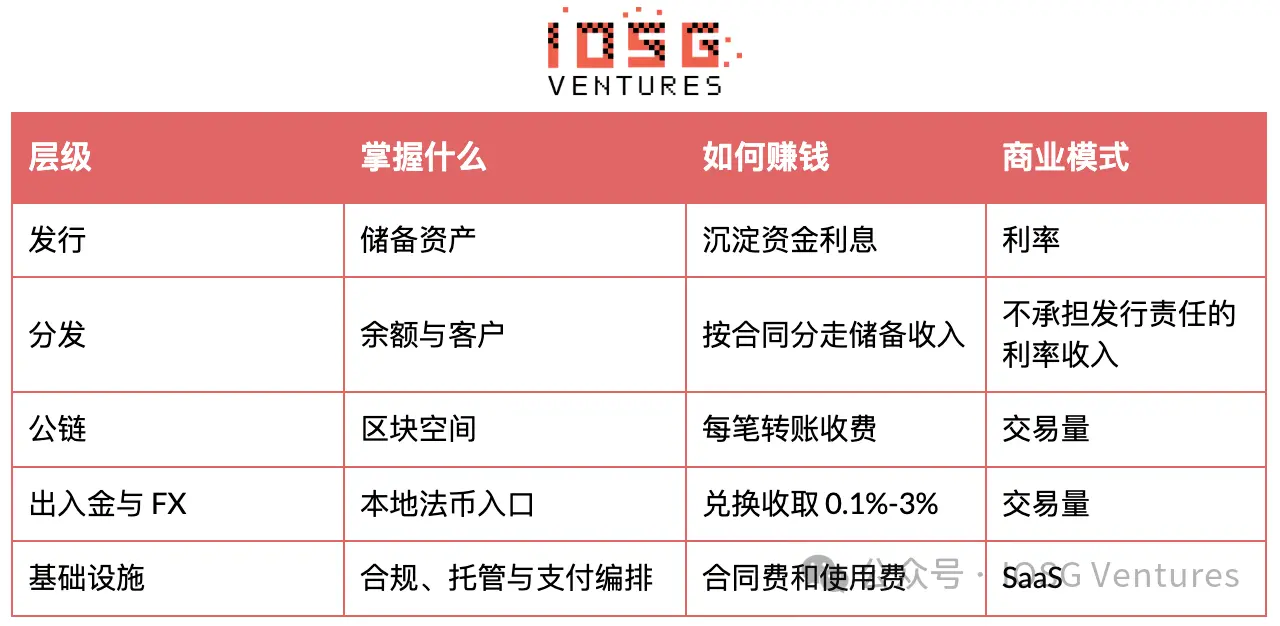
This is the most asymmetric part. The issuance side creates the largest profit pool, while the distribution side decides where the funds stay, but the public chain responsible for the transfers is actually the cheapest layer in the value stack.
2. Issuers earn interest but cannot retain all profits
Circle has gone public and has the most complete disclosures, making it suitable for analysis.
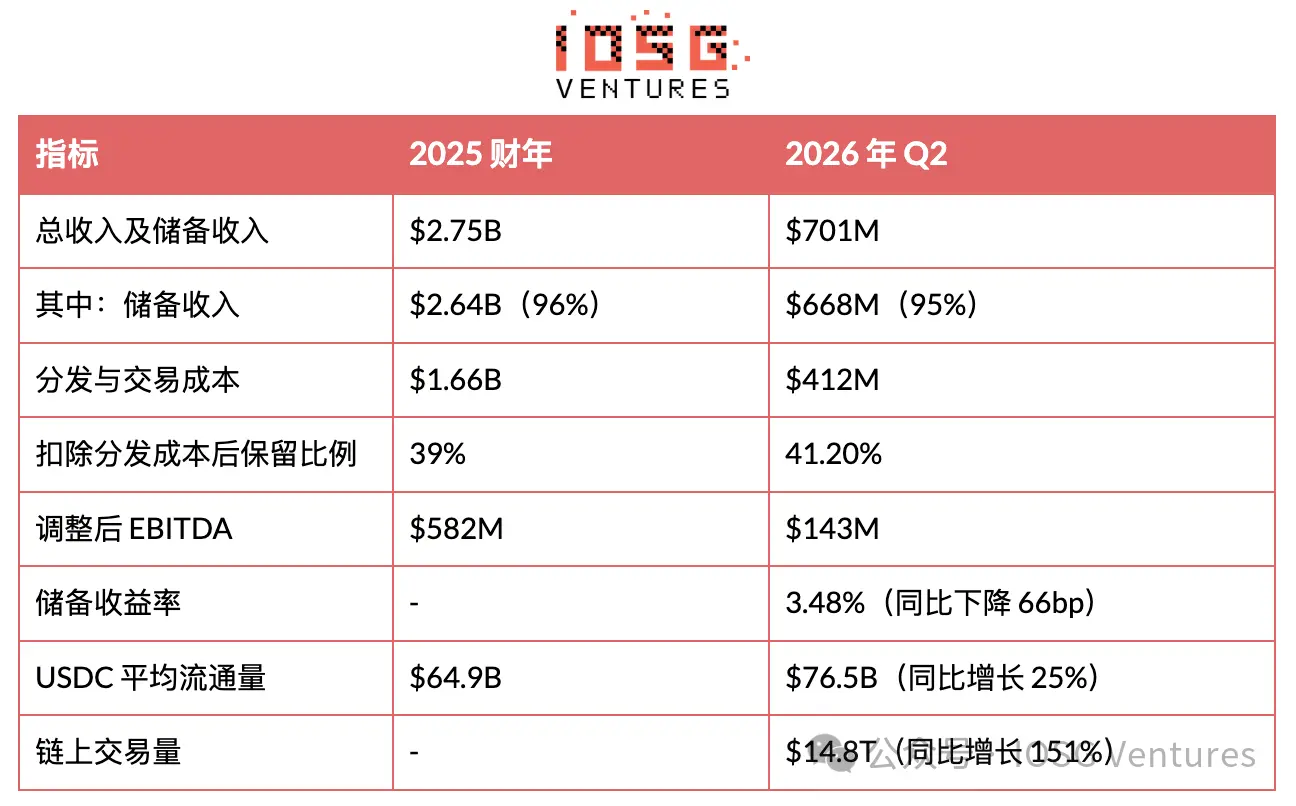 These numbers indicate three things.
Revenue follows held funds, not payment volume.
Circle earns interest during the time balances are held, not fees when dollars move. In Q2 2026, USDC on-chain transaction volume grew by 151%, but it did not directly increase reserve income.
What truly constrains revenue is interest rates, not competition.
USDC's average circulation increased by 25%, but reserve income only grew by 5%. The reserve yield fell by 66 basis points, eating up most of the incremental growth brought by the balance increase. This is more like the impact caused by the decline in SOFR rather than USDC losing market share to competitors.
Less than half is retained by the issuer.
Circle retained 39% after deducting distribution costs in 2025, which rose to 41.2% in Q2 2026. The proportion taken by distributors did not continue to rise, but the revenue pool they share is shrinking as interest rates decline.
These numbers indicate three things.
Revenue follows held funds, not payment volume.
Circle earns interest during the time balances are held, not fees when dollars move. In Q2 2026, USDC on-chain transaction volume grew by 151%, but it did not directly increase reserve income.
What truly constrains revenue is interest rates, not competition.
USDC's average circulation increased by 25%, but reserve income only grew by 5%. The reserve yield fell by 66 basis points, eating up most of the incremental growth brought by the balance increase. This is more like the impact caused by the decline in SOFR rather than USDC losing market share to competitors.
Less than half is retained by the issuer.
Circle retained 39% after deducting distribution costs in 2025, which rose to 41.2% in Q2 2026. The proportion taken by distributors did not continue to rise, but the revenue pool they share is shrinking as interest rates decline.
3. Whoever controls the users controls the revenue share
The following four sets of data become increasingly concerning for issuers. Circle obtained the license, but Coinbase still took a significant share According to the 2023 agreement, Coinbase can receive most of the reserve income generated by USDC on its platform and a portion of the reserve income from USDC outside the platform. In Q2 2026, Circle paid Coinbase $324.6M in related distribution costs; the total cost paid to major distributors in 2025 was about $1.66B.
This three-year agreement entered the renewal window in August 2026. Circle confirmed during the earnings call on August 5 that the agreement would be renewed under the original terms until 2029.
This is the strongest evidence in the entire text. Circle had already obtained a federal trust bank license, the payment network was growing, and there were multiple distribution partnership cases in the market that gave 90%-100% of reserve income to the channels. Two months ago, Coinbase joined the Open USD alliance, which competes with USDC, and Circle's stock price fell about 17% that day. But none of this changed the renewal terms.
The reason is simple: customers are in the hands of the distributors. Whether the contract can be renewed mainly depends on performance thresholds and does not equate to the issuer having the initiative to reprice.
In Q2 2026, the average USDC balance in Coinbase's products reached a historical high of $20B, accounting for over 30% of the quarter-end USDC circulation. Nearly one-third of Circle's revenue base is concentrated on a single competitor's platform, and the next complete renewal window will not come until 2029. Hyperliquid: Trying to issue its own token to capture interest, ultimately returns to USDC In September 2025, Hyperliquid launched USDH, hoping to retain the reserve income corresponding to billions of USDC on the platform for itself. USDH peaked at only about $21M and ceased operations on June 20, 2026.
The subsequent arrangements are more interesting. There is about $6B USDC on Hyperliquid. Coinbase counts it as part of its platform balance, earns corresponding reserve income, and then returns about 90% to Hyperliquid. Why is Coinbase in the middle instead of Circle doing it directly? Because Coinbase has transferable channel profits. By recognizing the balance as platform funds, Coinbase first obtains a higher proportion of income and still has room to return to Hyperliquid. Circle's economic interests remain basically fixed in both scenarios, and the renewal locks in another three years. USDG does not make money from issuance but gives profits to the channels Paxos is responsible for issuing the Global Dollar, with a partner network that includes Robinhood, Kraken, Galaxy, and Mastercard. Partners can retain the vast majority of reserve income; if the balance stays on their own platform, the proportion can reach up to 100%. The issuer here acts more like a service provider rather than a profit center.
This model will self-reinforce. Robinhood Chain launched on July 1, 2026, making USDG the only native stablecoin, issuing $178M in the first week and supporting a 7% Earn product. Since the channel can retain profits, it will naturally direct its own chain, brokerage business, and 27 million accounts toward the stablecoin that is most willing to pay. Open USD: More than 140 companies band together to turn stablecoins into a channel business Open USD was launched in June 2026, backed by more than 140 participants, including Visa, Mastercard, and Coinbase. After deducting management fees, it distributes reserve income to distribution channels. USDG proves that channels can take away income through contracts; Open USD directly incorporates this arrangement into product design and involves large card organizations.
Coinbase, while completing the renewal as the largest distributor of USDC, also joined Open USD. Its disclosures show that in the first half of 2026, the combined stablecoin trading volume of USDC and Coinbase accounted for 79% of stablecoin trading volume, up from 55% in 2025. Distribution channels can remain neutral regarding the currency, which issuers cannot do.
4. Interest rates fell by 300 basis points, and issuance profits evaporated by nearly 80%
Issuer income can be simplified to: held funds × yield, minus the channel share specified in the contract, minus relatively fixed operating costs.
Assuming an issuer has $100B in held funds, with 50% of the yield shared with the channel, and annual operating costs of $600M:
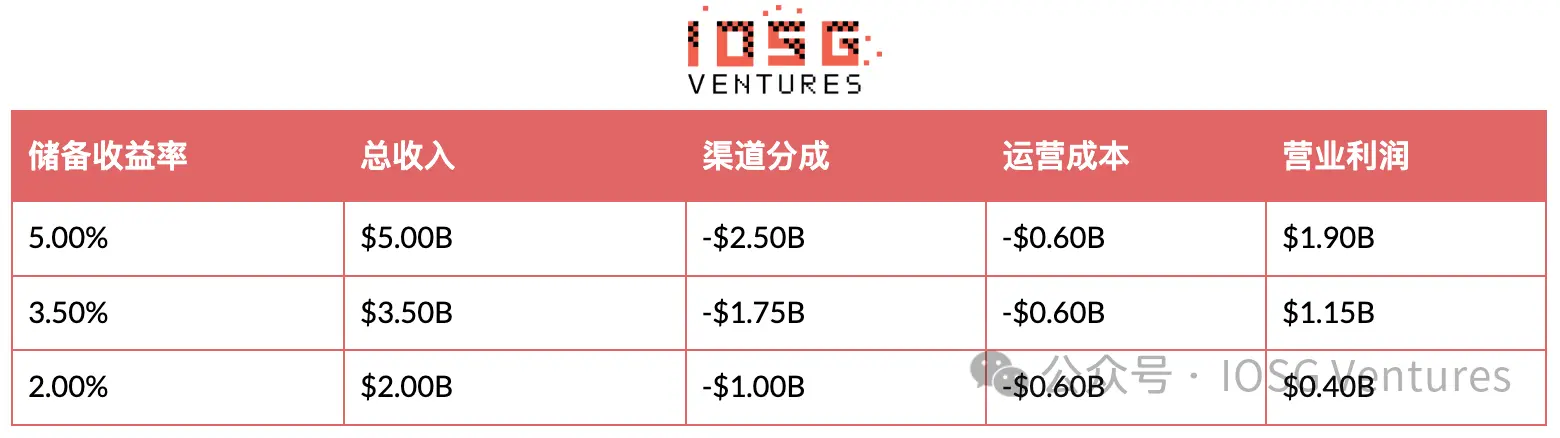
If the deposited funds remain unchanged and the yield decreases by 300 basis points, it will erase about 79% of the operating profit. To continue earning $1.9 billion at a 2% yield, the deposited funds must increase to about $250 billion. In other words, the scale must grow by 150% for profits to just return to the starting point.
This is no longer a hypothesis. Circle's actual reserve yield for Q2 2026 was 3.48%, which is right around the second line. The assumption of a 50% channel share is even conservative: total revenue for the quarter was $701 million, with distribution, transaction, and other costs amounting to $412 million.
Of course, Circle has not been idle.
By the end of the quarter, the annualized transaction volume of the Circle Payments Network reached $14.7 billion, a quarter-over-quarter increase of 76%; as of July 31, it had risen to $23 billion. The company raised its full-year non-reserve revenue guidance to $310 million-$330 million. However, $242 million of that came from a one-time token presale, not sustainable revenue. The payment network had not yet started charging fees at that time, so the real focus should be on the fee rates, not the transaction volume.
Circle is also expanding downstream. At the time of writing, Arc was planning to launch on September 16; as of the date of this update, the Arc public mainnet has launched as scheduled, with over 100 institutions and ecosystem builders participating on the first day, including BlackRock, DTCC, ICE, Mastercard, Standard Chartered, and Visa serving or participating in verification and integration. Circle is using its still ample deposited funds to purchase positions in the settlement layer.
Tether appears to be an exception, but the data from Q2 2026 indicates that direct comparisons can be misleading. Tether reported an operating profit of about $1.5 billion for the quarter, with a USDT issuance of about $184.6 billion, holding about $115 billion in U.S. Treasury bonds, and lacking the massive channel share like Circle. However, the operating profit emphasized by the company does not include the market value fluctuations of its held gold and Bitcoin, both of which saw significant declines during the quarter. Excess reserves dropped from $8.23 billion to $4.11 billion. Supply increased, but the buffer was halved due to asset price fluctuations.
The same accounting standards also magnified the often-cited 2024 profits. Of the reported $13 billion profit at that time, about $5 billion came from unrealized gains. Excluding the market value fluctuations on both sides, Tether resembles a business that earns $1 billion-$1.5 billion per quarter from Treasury bond spreads: it is large in scale, sensitive to interest rates, and takes on balance sheet risks that regulated issuers typically cannot.
The real dividing line is not "regulated" versus "offshore," but between self-distribution and rented distribution. Circle rents channels, with terms locked in until 2029; Tether had already built its network before the arrival of regulation. Banks and payment companies that directly control customers can usually retain profits far exceeding 41%.
V. No matter how fast public chains run, they usually only earn a fraction
Transferring on Solana or Base often costs less than a cent. Compared to the interest generated from storing one dollar in reserves for a year, transfer fees are almost negligible. Public chains only charge when funds move, while issuers earn money every day the balance exists.
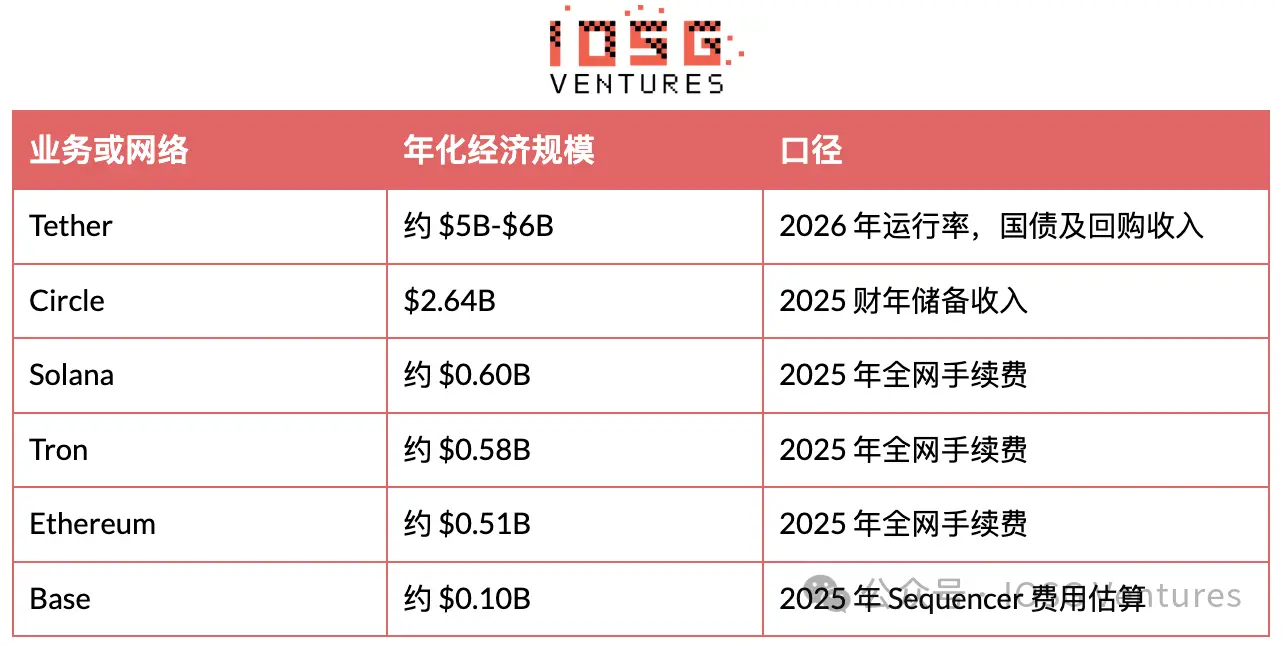 These figures can only be used for directional comparisons, as the metrics from different data providers are not consistent, and Tron is particularly susceptible to statistical methods.
Tron is the most enlightening exception. BCG estimates that in 2025, Tron processed about $235 billion-$375 billion in real economic stablecoin payments, surpassing other public chains. The reason is not throughput, but that certain cross-border channels have already formed standards around Tron: exchange support, wallet integration, deep USDT liquidity, and long-established user habits.
Even so, Tron does not own customers. Cash withdrawal services bring users in, wallets provide interfaces, and Tether provides dollars. Tron is the settlement track of this channel, not the distributor.
Neutral blockchain space finds it hard to achieve high profits because public chains are always competing on who is cheaper. Only when liquidity and user habits make it difficult for users to leave does the track have pricing power. The biggest winner is hidden off-chain: the U.S. Treasury According to a 2023 agreement, Coinbase can earn most of the reserve income generated by USDC on its platform and share some reserve income from USDC outside the platform. The distribution cost paid by Circle to Coinbase in Q2 2026 was $324.6 million; the total cost paid to major distributors for the entire year of 2025 was about $1.66 billion.
This three-year agreement entered the renewal window in August 2026. Circle confirmed on the August 5 earnings call that the agreement would be renewed under the original terms until 2029.
This is the strongest evidence in the entire text. At that time, Circle had already obtained a federal trust bank license, the payment network was growing, and there were multiple distribution partnership cases in the market that allocated 90%-100% of reserve income to channels. Two months prior, Coinbase joined the Open USD alliance, which competes with USDC, causing Circle's stock price to drop about 17% that day. However, none of this changed the renewal terms.
The reason is simple: customers are in the hands of the distributors. Whether the contract can be renewed mainly depends on performance thresholds, and it does not mean that the issuer has the initiative to reprice.
In Q2 2026, the average USDC balance in Coinbase products reached a historic high of $20 billion, accounting for over 30% of the circulating USDC at the end of the quarter. Nearly one-third of Circle's revenue base is concentrated on a single counterparty's platform, and the next complete renewal window will not come until 2029. All the participants mentioned earlier are actually competing for the same pool of income: the interest on reserve assets. Where does the interest come from? The answer usually does not appear in the stablecoin value chain diagram.
The GENIUS Act requires issuers to hold cash or U.S. Treasury bonds with a maturity of no more than 93 days. It not only regulates stablecoins but also legally creates demand for short-term U.S. Treasury bonds.
As of the end of Q2 2026, Tether held about $115 billion in U.S. Treasury bonds, claiming to be the largest non-sovereign holder. Circle's approximately $79 billion in reserves is mostly held in funds managed by BlackRock. The IMF pointed out that the combined U.S. Treasury bonds held by the two companies have exceeded those of Saudi Arabia.
About 99.8% of the stablecoin supply is denominated in U.S. dollars, so regardless of which layer ultimately takes the value, the growth of stablecoins will drive T-bill demand. Standard Chartered envisions the scale of stablecoins reaching $2 trillion by 2028, corresponding to up to about $1 trillion in new U.S. Treasury bond purchases. Such buyers barely existed five years ago and do not demand maturity premiums.
However, two restrictions must be added. First, stablecoins are still small relative to the approximately $7 trillion money market fund industry, being marginal buyers that are continuously growing, and cannot be said to dominate. Second, the impact of fund inflows and outflows on yields is asymmetrical. BIS research found that an inflow of $3.5 billion could reduce the yield on 3-month Treasury bonds by about 2-2.5 basis points; an equivalent outflow would push it up by 6-8 basis points. The impact of redemptions on risk-free rates is about three times that of subscriptions. Therefore, the $7.7 billion supply contraction in June is not just a sentiment indicator.
VI. The truly stable business lies in cash deposits, FX, and compliance
Cash deposits and FX. On-chain transfers are cheap, but entering and leaving the on-chain world is not. BCG estimates that exchange deposit and withdrawal fees are around 0.1%-1%, professional service providers charge 1%-3%, and crypto ATMs can go as high as 7%. Emerging market cross-border channels also face higher FX spreads. These represent the widest trading profits in the entire value chain and are concentrated in the areas with the most rigid demand: acquiring dollars. Compliance, custody, and payment orchestration. Regulated entities cannot simply access a wallet to launch business. List screening, transaction monitoring, key management, custody, reserve services, and auditable reports mostly need to be outsourced. While it may not be as eye-catching as reserve income, it is more stable: long contract cycles, high switching costs, and it does not rely on interest rates staying at 5%, nor on whether a particular channel is renewed.
This layer may not capture the largest profit pool, but regardless of which stablecoin ultimately prevails, it can still charge fees.
VII. After issuers can no longer pay interest, channels become more valuable
The GENIUS Act prohibits issuers from directly paying interest solely because users hold coins, but it does not clearly prohibit independent exchanges or wallets from using their share of reserve income to subsidize rewards.
The legislative intent is to keep stablecoins as payment tools rather than turning them into deposit substitutes. However, the actual market effect is different: when issuers cannot use income to compete for balances, competition shifts to channel sharing with those who control users. Issuers pay distributors, who then decide whether to give part of that to users.
Thus, the ban on interest payments for holding coins actually protects channel profits. USDG and Open USD were designed to take advantage of this space.
This advantage is also controversial. Banking groups want to expand the restrictions to third-party rewards, and some market structure bills in 2026 also attempt to more broadly limit passive income. The boundaries are yet to be determined.
Banks also face choices: issue their own and bear costs, provide custody and reserve services for others' stablecoins, join alliances, or watch deposits flow out. My baseline judgment is that most of the announced bank stablecoins will ultimately become alliance products or infrastructure collaborations. Issuance has clear scale effects, and few banks have large enough distribution networks to independently establish liquidity.
VIII. Conclusion: Stablecoins will commoditize, but the entry points will not
Visa does not issue cards, lend, or directly charge interchange; these tasks are completed by banks. Visa earns money from the network.
Creating payment tools does not equate to controlling profits. Value will ultimately flow to the party that controls the scarce control points: acceptance networks, distribution channels, liquidity, or customer relationships.
Stablecoins are rapidly reconstructing this framework. Three conclusions can be drawn from this.
Issuance will gradually standardize.
The GENIUS Act has not made issuance easier; approval, liquidity, redemption infrastructure, and trust remain barriers, and Circle's federal license is indeed valuable. However, regulatory requirements will compel issuers to hold similar reserve assets, and disclosure rules will converge, with every regulated dollar stablecoin promising the same thing. Differentiation will shift to the tokens themselves. Circle obtained its license before the renewal window, but it did not change the terms for Coinbase.
Declining interest rates will compress the profits from idle funds, and this has already begun.
The reserve yield has dropped by 66 basis points, resulting in only a 5% increase in reserve income for a 25% average circulation growth. Any issuer model calculated at a 5% interest rate should be recalculated at 2%. Circulation growth can offset interest rate cuts, but it must occur before channel sharing and fixed costs erode profits. More challenging is that the payment scenarios that drive adoption require the least balance to support each dollar of transaction volume.
Distribution channels have bargaining power.
Coinbase's renewal is the most informative stablecoin contract event of 2026, and the information comes from "nothing has changed." Circle enters the renewal window with a federal license, a growing payment network, and publicly comparable cases where 90%-100% of the revenue is transferred to the channels; Coinbase holds over 30% of the USDC balance and has joined a competitive alliance, with no obligation to renegotiate. Ultimately, the agreement extends under the original terms until 2029.
For asset allocators, the following criteria can be used:
Conduct stress tests on pure issuance models using both lower yields and higher channel sharing.
Treat the renewal date as an information event rather than merely a risk event. Automatic renewal mechanisms are usually more favorable to channels.
Separate one-time income from sustainable income. Token sales and launch incentives can beautify performance during the transition period; what truly matters is the fee rate corresponding to transaction volume.
Focus on companies that control the entry points for deposits and withdrawals and specific payment channels, especially in emerging markets where dollars are scarce and FX spreads are wider.
Compliance, custody, and trading infrastructure are least sensitive to interest rates, but regulatory risk and cyclical risk must still be accounted for.
Do not treat transaction volume as income. USDC processed $14.8 trillion in one quarter but still primarily earns from idle balances.
If this is indeed the "Aha!" moment for currency, the insight gained from the AI industry is not that foundational models will necessarily commoditize, but that capabilities diffuse quickly, prices will be driven down, and bargaining power will ultimately flow to scarce distribution capabilities and customer relationships.
Stablecoins themselves may become increasingly interchangeable, but the paths for users to acquire, hold, and spend stablecoins will not.
Data Updates and Source Notes
Circle Q2 2026 Financial and Operational Data: https://www.circle.com/pressroom/circle-reports-second-quarter-2026-results
Circle Arc Mainnet Launch: https://www.circle.com/pressroom/circle-launches-arc-mainnet-an-economic-operating-system-for-the-internet
Circle Q2 2026 10-Q: https://www.sec.gov/Archives/edgar/data/1876042/000187604226000248/crcl-20260630.htm
Coinbase Q2 2026 10-Q: https://www.sec.gov/Archives/edgar/data/1679788/000167978826000088/coin-20260630.htm
Circle-Coinbase Collaboration Agreement: https://www.sec.gov/Archives/edgar/data/1876042/000187604226000062/coinbasecollaborationagree.htm
OCC License and Condition Approval Records: https://www.occ.gov/topics/charters-and-licensing/interpretations-and-decisions/2026/interpretations-and-actions-jan-2026.html
Open USD Announcement: https://www.fireblocks.com/blog/open-usd-stablecoin-infrastructure-partner
Tether Q2 2026 Reserve Verification: https://tether.io/news/tether-posts-strong-q2-performance-generates-1-5b-net-operating-profit-maintains-4-11b-reserve-buffer-and-expands-gold-holdings-to-more-than-146-tons/
Stablecoin Market Capitalization and Supply: DefiLlama, September 28, 2026 snapshot, https://defillama.com/stablecoins
Tokenized U.S. Treasuries: RWA.xyz, September 24, 2026 snapshot, https://app.rwa.xyz/treasuries
Note: Different data platforms have slightly different statistical criteria for stablecoin supply, on-chain transaction volume, and public chain fees. Tether data comes from BDO's verification report and is not a U.S. GAAP audit. Data from Citi and Standard Chartered are forecasts and should not be viewed as definitive results.

 Risk warning



Popular articles





