Five months ago, a16z was heavily invested in Crypto; why has it now switched to Frontier?
 Core Viewpoint


 As cryptocurrency shifts from being the protagonist of the story to becoming infrastructure, can it continue to play a defining role in a broader technological landscape?
Author: Zhou, ChainCatcher
In the early hours of October 23, Beijing time, a16z crypto founder Chris Dixon announced that the investment scope of the new fund will be expanded from crypto startups to a broader range of frontier startups, and a16z crypto will be renamed a16z Frontier.
Dixon emphasized that this is an expansion, and a16z will continue to invest in crypto and related fields while advocating for reasonable crypto regulation.
According to The Information, it was revealed yesterday that Ali Yahya, the first full-time member of a16z crypto's crypto team and a general partner, will leave a16z to start a new venture, marking a symbolic shift for the leading crypto investment firm.
Just five months ago, a16z crypto had completed fundraising for its fifth fund of $2.2 billion, promising that this fund would be 100% directed towards crypto entrepreneurs.
In a year where leading crypto VCs are turning to AI, why has it also taken this step?
Five Months Ago, It Was Still Committing 100% to Crypto
On May 5 of this year, a16z crypto announced the completion of fundraising for Fund 5, totaling $2.2 billion. Including the previous four funds, a16z crypto has raised approximately $9.8 billion in total.
The background for this fundraising was not easy. The crypto primary market continued to cool in 2025, with the number of financing events hitting a nearly five-year low, prompting many leading firms to seek opportunities outside of crypto.
In February of this year, Paradigm was reported to be raising up to $1.5 billion for a new fund, expanding its investment scope to AI and robotics. Just a day before a16z crypto announced its fundraising, former a16z crypto general partner Katie Haun's Haun Ventures also completed a $1 billion new fund, similarly including AI in its investment direction.
When asked if it would follow suit with AI, a16z crypto's spokesperson told Fortune that Fund 5 would be 100% directed towards crypto entrepreneurs. In the market environment at that time, this statement made a16z crypto the most clearly defined conservative player among leading crypto VCs.
a16z invested in Coinbase back in 2013 and subsequently backed projects like Solana and Uniswap. According to SEC filing data obtained by Fortune, a16z crypto chose to distribute profits to LPs at the market peak in 2025, with the net DPI of the first fund reaching 5.4 times.
However, the size of a16z crypto's single fund has also dropped from $4.5 billion in 2022 to $2.2 billion for Fund 5, with the total management scale of its four funds declining nearly 40% in 2025 to about $9.5 billion.
a16z crypto stated that it intends to return to a smaller fund size and shorten the fundraising cycle to keep up with the rapid changes in the crypto industry.
Unexpectedly, five months later, it is the changes outside of crypto that it is keeping up with.
It is worth mentioning that according to Dixon's statement, the expansion refers to the investment scope of the new fund ("our new fund"), but it does not distinguish whether this fund is Fund 5, which is committed to 100% crypto, or another new fund beyond Fund 5. The market generally believes it to be the former.
The Investment List Has Long Exited Crypto Natives
In fact, shortly after the commitment to 100% crypto was made, a16z crypto crossed the boundaries of crypto.
According to RootData, after Fund 5 was announced, a16z crypto participated in 11 rounds of financing. Based on business attributes, these projects can roughly be divided into three categories.
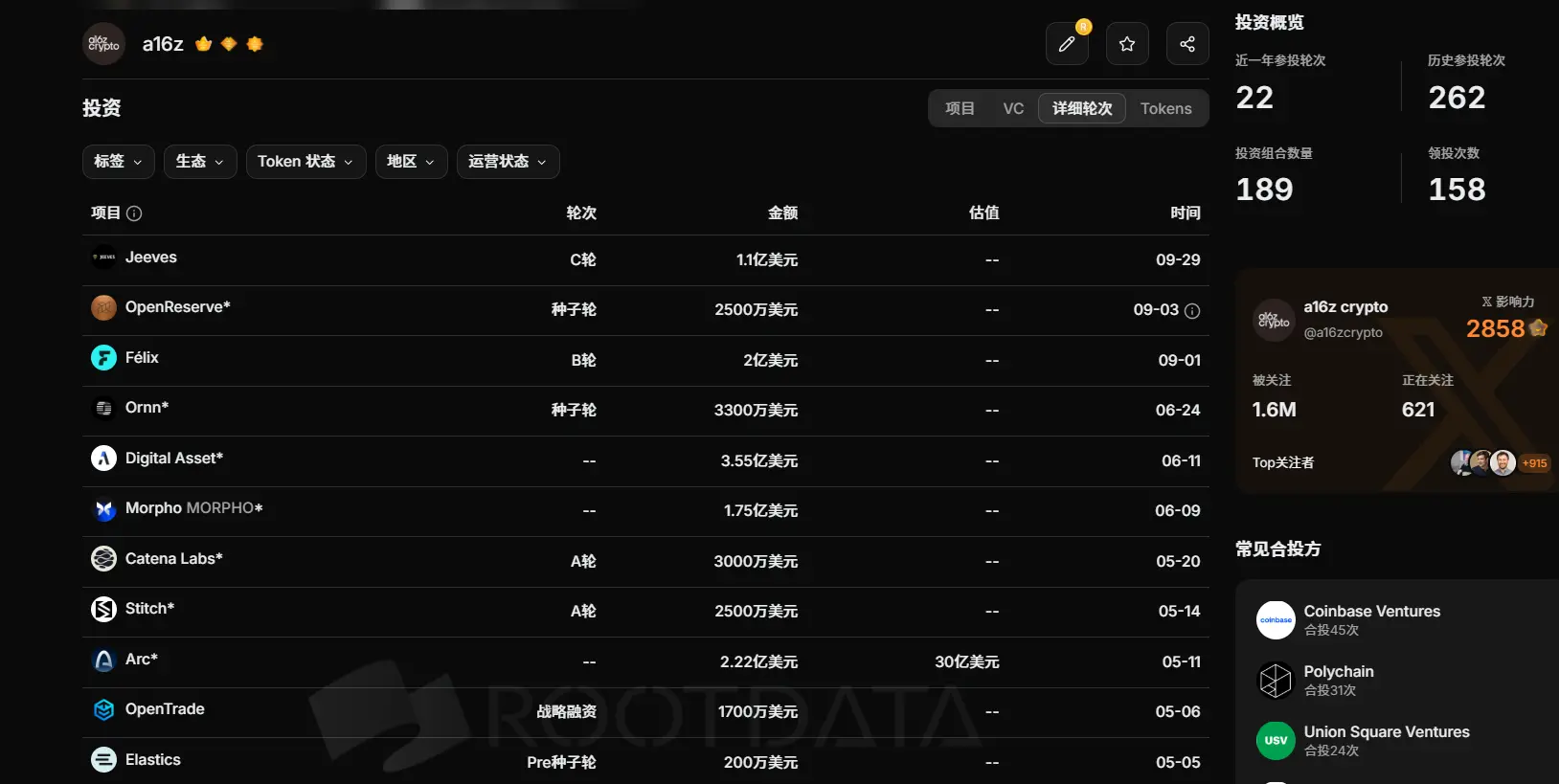
The first category includes crypto-native projects, such as the public chain Arc launched by Circle, the lending protocol Morpho, and the developers of Canton Network, Digital Asset.
The second category consists of fintech companies that have begun to adopt stablecoins. For example, the corporate payment platform Jeeves was founded in 2019 and was led by Tencent in a funding round in 2022, with a valuation of $2.1 billion. Félix, OpenReserve, and Catena Labs also belong to this category, with businesses involving cross-border remittances, blockchain-based banking, and financial services aimed at AI agents.
The third category includes companies like Ornn that are unrelated to blockchain. Additionally, Ornn, Catena Labs, and the AI trading terminal Elastics aimed at prediction markets are all directly related to AI, indicating that AI has already entered a16z crypto's investment list.
On September 29, a16z crypto stated that one of the core values of blockchain is to create entirely new markets and predicted that on-chain markets would expand to commodities, foreign exchange, stocks, as well as risk assets like computing power, music, and sports that previously lacked financial expression.
On October 20, Dixon had a conversation with Circle CEO Jeremy Allaire, with the topic also revolving around the AI agent economy.
Dixon pointed out that as blockchain is used more widely, the boundaries become blurred, infrastructure gradually retreats to the background, and Wall Street and fintech companies frequently launch blockchain-based products, making labels less important; it is more reasonable to define them by what companies do.
Early Core Members Depart
In January of this year, Arianna Simpson, a general partner who had worked at a16z crypto for six years, announced her departure to independently establish a new fund covering multiple verticals.
Now leaving is Ali Yahya. According to Dixon's announcement in 2021 when he was promoted to general partner, Yahya graduated from Stanford University with a degree in computer science and previously worked on robotics research at GoogleX and as a core developer for TensorFlow at Google Brain. He joined a16z in 2017, becoming the first full-time member of the crypto team and participating in early investments in Compound, Avalanche, Near, and others.
Now, as the fund expands into AI and autonomous machines, this partner, known as the soul of the crypto team with a background in both AI and robotics, has chosen to leave.
The new leadership team is jointly led by Dixon and a16z's two founders, Marc Andreessen and Ben Horowitz, along with general partners Eddy Lazzarin and Guy Wuollet, with Lazzarin being promoted from CTO to general partner in May.
In a16z's New Narrative, Crypto Has Shifted from Destination to Infrastructure
In the article, Dixon reflected on the two long-term themes he focused on after joining a16z. One is new computing devices, representing investments including Oculus and drone company Skydio, Zipline; the other is crypto.
Over the past decade, a16z crypto has consistently described crypto as the next generation of the internet. Now, in Dixon's narrative, crypto is placed within the larger framework of betting on future technologies, becoming one of the cases.
Looking ahead, he extensively discusses the native applications brought by AI, autonomous machines, biomedicine, and machine-oriented networks, with only a brief discussion on blockchain, which is placed after AI.
In this segment, he positions blockchain as providing a fast, low-cost, global, and programmable financial channel for the internet, helping new networks gain native economic capabilities and enabling transactions between machines.
In a16z's new narrative, crypto has transformed from a destination into the infrastructure serving the AI wave. Whether this shift should be seen as maturity or a devaluation of the label is a matter of differing opinions in the market.
Some believe this is a natural result of technology becoming mainstream. Terms like Web, mobile, and SaaS were once hot keywords in fund names, and as technology became ubiquitous, these terms gradually disappeared from fund names.
Mike Dudas, founder of 6th Man Ventures, stated that almost every crypto VC has done this privately, even if not publicly; crypto has become deeply intertwined with other frontier technologies, and this term is always associated with those who were not serious in the past.
If the past a16z crypto represented the most steadfast long-term belief in the crypto industry, then a16z Frontier needs to answer whether, as crypto shifts from being the protagonist of the story to infrastructure, it can continue to play a defining role in a broader technological landscape.
 Risk warning
 Risk warning