Why hasn't SGOV dropped much with the Federal Reserve raising interest rates? The yield logic of short-term U.S. Treasury bond ETFs

1. What are you actually buying when you invest in SGOV, BIL, and SHV?
SGOV, BIL, and SHV are all ETFs primarily investing in U.S. Treasury securities, but their holding periods differ. SGOV mainly holds U.S. Treasury securities with remaining maturities of 0 to 3 months, BIL mainly holds U.S. Treasury bills with maturities of 1 to 3 months, and SHV covers short-term U.S. Treasury securities with maturities of 0 to 1 year. The commonality among the three is their short duration, with interest rate changes typically having a far lesser impact on net asset value than long-term Treasury bond ETFs; the main differences lie in holding periods, portfolio durations, and management fees.
|---------|-------------|--------|--------------| | ETF | Main Holding Period | Fee Rate | Main Positioning | | SGOV | 0--3 months U.S. Treasury securities | About 0.09% | Ultra-short-term cash management | | BIL | 1--3 months U.S. Treasury bills | About 0.14% | Short-end products similar to SGOV | | SHV | 0--1 year U.S. Treasury securities | About 0.15% | Short-term Treasury bond products with slightly longer maturities |
To understand these products, one must first grasp how U.S. Treasury bills generate returns. Unlike regular coupon-bearing bonds, Treasury bills typically do not pay periodic interest but are issued at a discount to face value and redeemed at face value upon maturity. The difference between the purchase price and the maturity amount is the interest income for the investor. For example, if an investor buys a three-month Treasury bill with a face value of $100 for $99.50, they will receive $100 at maturity, and the $0.50 difference is the yield on this investment, translating to an annualized yield of about 2% (not accounting for transaction costs and other factors).
After the fund purchases a basket of Treasury bills, it will gradually earn the corresponding returns during the holding period. As the maturity date approaches, the bond prices will gradually converge towards face value, and the related returns will be reflected in the fund's assets, which are then distributed to holders through the fund's allocation mechanism. Therefore, the goal of holding SGOV is to earn interest income from a basket of short-term Treasury bills during the holding period, rather than waiting for a significant price increase in any specific bond, which is not a source of income for this type of product.
SGOV and BIL focus on short-term Treasury bills, allowing the fund to quickly recover principal after bonds mature and reinvest in new securities. SHV covers a slightly longer duration, making it generally more sensitive to interest rate changes. It is also essential to distinguish between two concepts. The holding period range indicated for the product does not represent the actual remaining maturity of each bond in the portfolio, nor does it equal the fund's effective duration. The effective duration and other metrics are what truly measure the fund's sensitivity to interest rate changes.
Taking SGOV as an example, as of October 30, it has total assets of approximately $116.8 billion, making it one of the larger ultra-short-term U.S. Treasury ETFs, distributing returns monthly. When investors buy it, they effectively hold a basket of short-term U.S. Treasury securities through the ETF, earning interest income from these bonds. For temporarily idle U.S. dollar funds, SGOV provides a way to participate in the short-term Treasury market's returns, and pursuing price appreciation of bonds is not its primary investment goal.
Compared to other common U.S. dollar cash instruments, SGOV's characteristics are also quite clear. Directly purchasing Treasury bills allows one to hold a single bond until maturity, knowing its maturity amount in advance, but requires trading through auctions or the secondary market and arranging reinvestment of matured funds independently. Bank deposit rates are quoted by banks, and time deposits usually lock in rates for the agreed period, but the flexibility of funds is relatively low. Money market funds may have similar underlying assets and return mechanisms as short-term Treasury funds, but the specific holdings, redemption rules, and risks are not entirely the same. SGOV, on the other hand, is traded on the exchange through an ETF, allowing investors to buy and sell by shares without needing to manage the maturity and turnover of Treasury bills individually, at the cost of the fund's net asset value still fluctuating with market changes, and returns are not guaranteed to be fixed. Choosing this type of ETF essentially trades market-based floating returns for convenience in trading and holding management.
2. Why does SGOV's net asset value not drop significantly when the Federal Reserve raises interest rates?
SGOV's net asset value remains relatively stable primarily because of its very short duration. The shorter the duration, the less impact existing bond prices typically experience when market interest rates rise. Bond prices generally move inversely to market interest rates, but how much they drop depends not only on how much rates rise but also on the duration of the bonds. Long-term bonds have cash flows distributed over a more extended period, making them more sensitive to interest rate changes. Short-term Treasury bills mature quickly, resulting in much smaller price reactions to interest rate changes.
For example, the long-term Treasury bond ETF TLT has an effective duration of about 16 to 17 years. According to Yahoo Finance's analysis in September 2026, under unchanged conditions, if long-term Treasury yields rise by 1 percentage point, TLT's price could drop by about 16%. In contrast, SGOV's effective duration is about 0.09 years. Assuming the market yield rises by 1 percentage point, the estimated price impact on SGOV would be only about 0.09%. This is merely an approximate estimate of interest rate sensitivity and does not mean the fund's actual net asset value will change by this magnitude.
The role of duration can be understood through bond cash flows. The principal of long-term bonds is often not returned until many years later, and investors must continue to wait for coupon income during that time. When market interest rates rise, these future cash flows need to be recalculated at a higher discount rate, and cash flows further away from the present are typically more affected by discounting, leading to a significant drop in long-term bond prices. The Treasury bills held by SGOV will mature within a few months, allowing the fund to quickly recover principal and reinvest in new securities at the current market rates. Although the existing holdings will still be affected by interest rate changes, the impact is limited, and the fund can quickly update its holdings. In contrast, long-term Treasury bond ETFs hold bonds with longer maturities, and existing low-yield bonds cannot quickly mature and be replaced, forcing the market to adjust their yields through price declines.
The market performance in 2022 can illustrate the differences between the two more intuitively. That year, the Federal Reserve rapidly raised the policy rate from near zero to over 4%, resulting in a total return of -31.41% for the long-term Treasury bond ETF TLT. In contrast, SGOV, BIL, and SHV had total returns of 1.58%, 1.38%, and 0.94%, respectively, all positive.
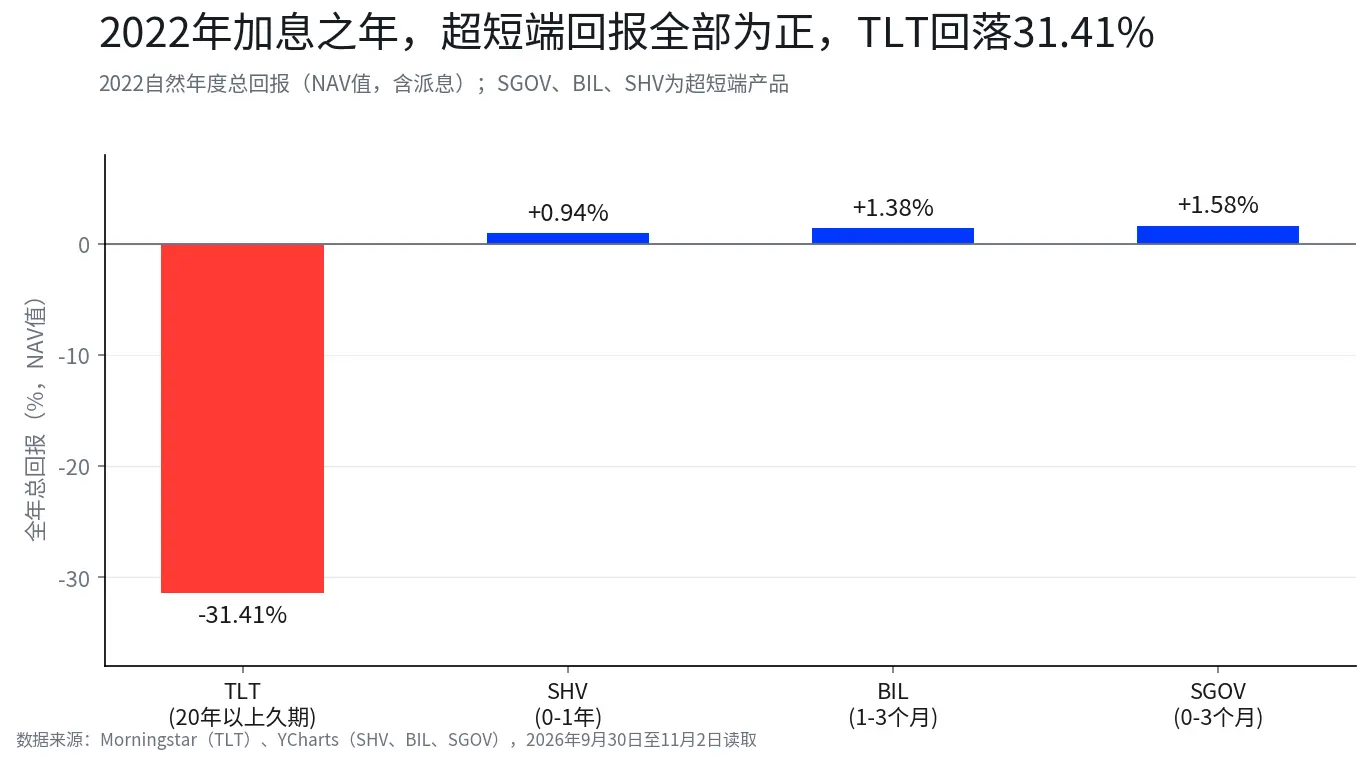
The data represents total returns for the calendar year 2022 (NAV value, including distributions). SGOV, BIL, and SHV are short-term Treasury products, while TLT is a long-term Treasury bond ETF with maturities of over 20 years.
However, a short duration does not mean there is no fluctuation in net asset value. SHV recorded a total return of -0.10% in 2021, indicating that in years when interest rates are near zero and yields change, short-term Treasury ETFs may also experience returns close to zero or even slightly negative. Net asset value fluctuations depend on the speed and magnitude of yield changes, but due to the short duration, the price impact is usually limited. For SGOV, with an effective duration of about 0.09 years, under unchanged conditions, a 1 percentage point rise in yield corresponds to a price impact of about 0.09%. This is the primary distinction between short-term Treasury ETFs and long-term Treasury ETFs. The former typically has lower price risk, but it does not mean there is no price risk.
The data from 2022 should not be interpreted to mean that short-term Treasury ETFs can achieve positive returns in any interest rate hike environment. It indicates that a short duration significantly reduces the price losses caused by rising interest rates. That year, short-term Treasury yields gradually increased as the Federal Reserve continued to raise rates, allowing the fund to reinvest matured funds into new securities with higher yields, and the additional interest income helped offset limited price fluctuations. Subsequently, SGOV's annual total returns for 2023 and 2024 were approximately 5.12% and 5.27%, respectively, further illustrating that the returns of such products primarily come from continuously accumulating interest income, with limited contributions from net asset value appreciation.
3. Where does SGOV's income come from? The answer is reinvestment after maturity.
SGOV's income primarily comes from the interest generated by the underlying Treasury bills and the returns obtained after the fund reinvests the matured principal into new securities. Due to the very short holding periods of the bonds, the fund continuously recovers matured principal and reinvests in new short-term Treasury securities at the current market rates. The U.S. Treasury regularly auctions Treasury bills with maturities ranging from a few weeks to six months, and the fund can participate in primary market auctions or buy them in the secondary market at current market prices and yields. Short-term Treasury yields are determined by market supply and demand and interest rate expectations; adjustments in the Federal Reserve's policy rates will affect the short end of the market, but market yields do not necessarily wait for the Federal Reserve to act formally before changing.
Assuming short-term Treasury yields rise from 3% to 4%, as existing bonds mature, the fund will have the opportunity to reinvest the recovered principal into new securities with higher yields, and the overall yield level of the portfolio will gradually align with the new market rates. This process will not be completed in a single day but will occur gradually as holdings mature and the fund continuously buys new securities. SGOV primarily holds Treasury bills with maturities of 0 to 3 months, so the portfolio updates quickly, and changes in market interest rates can typically be reflected in the holding returns within a relatively short time.
This process can be understood through a simplified example. Suppose the fund's original portfolio yield is 3%, and after market interest rates rise, the yield on newly purchased Treasury bills reaches 4%. As existing holdings mature, the fund will reinvest in new securities, and the portfolio yield will gradually approach 4%. The specific speed of this increase depends on the maturity distribution of the original bonds, the actual turnover ratio, and changes in market yields; it is not the case that every fixed proportion of turnover will result in a corresponding increase in portfolio yield.
This differs from the income mechanism of long-term fixed coupon bonds. The coupon of long-term bonds is essentially determined at the time of purchase; even if market interest rates rise later, existing bonds do not automatically receive higher coupons. If investors want to switch to new bonds with higher yields, they need to sell the existing bonds, but when market interest rates rise, the prices of old bonds often decline. SGOV's short holding periods and rapid capital turnover allow it to adjust portfolio yields through continuous purchases of new securities, making it easier to follow changes in short-end market interest rates.
Looking at SGOV's returns over several years, one can see the impact of different interest rate environments on yield levels. In 2022, during the initial phase of rate hikes, short-term Treasury yields gradually increased from low levels, resulting in a total return of 1.58% for SGOV. From 2023 to 2024, the policy rate remained at a high plateau, with short-term Treasury yields sustained at high levels, leading to annual total returns of approximately 5.12% and 5.27% for SGOV. After the rate hikes resumed in September 2026, short-term rates rose again, and SGOV's return for the year was 3.04% (as of October 29). These data reflect that SGOV's return levels are closely related to short-term Treasury market interest rates. In the early stages of rate hikes, yields need time to gradually transmit to the fund's holdings. When interest rates remain high, the fund can continuously earn higher interest income. When market interest rates change again, the fund's income will also adjust with the updates to its holdings. 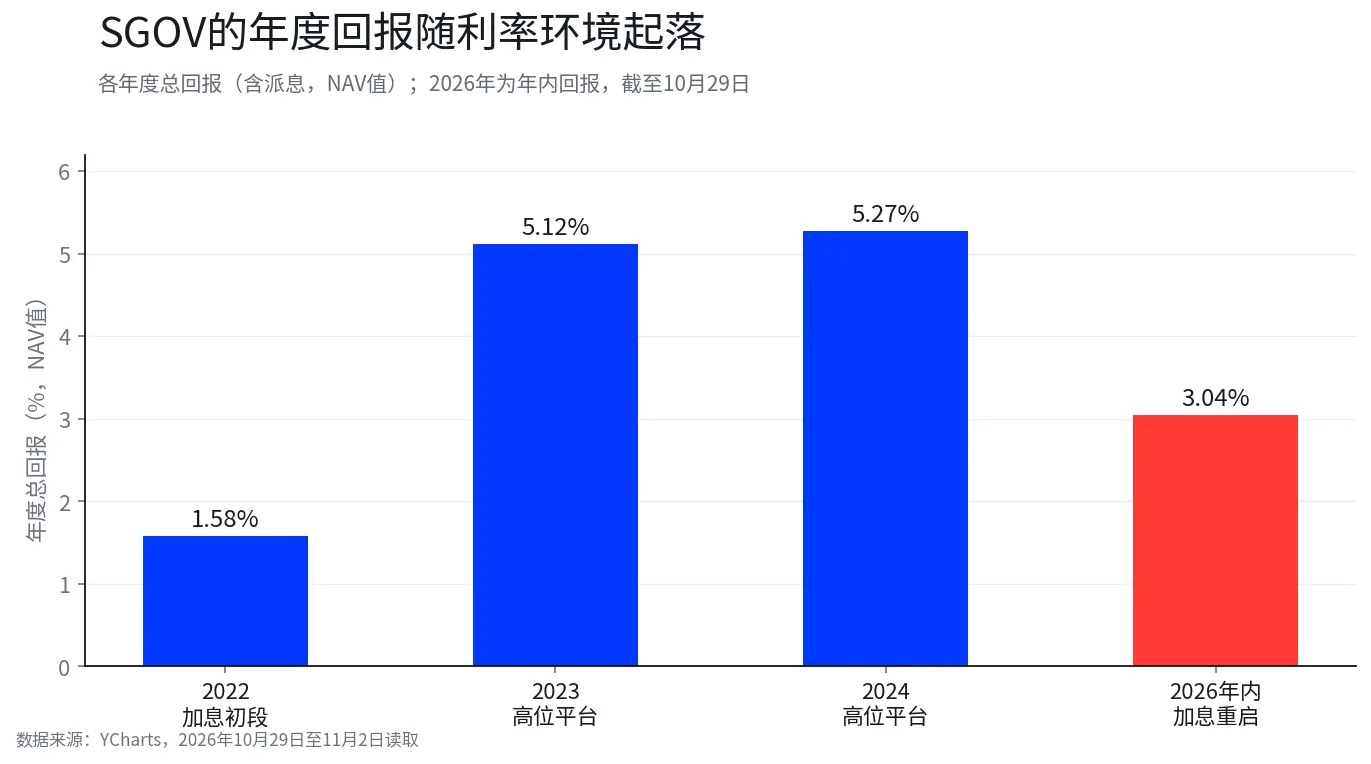
The data represents SGOV's annual total returns (including distributions, NAV value), with 2026 being the return for the year as of October 29. 2022 was a year of rate hikes, while 2023 to 2024 saw the policy rate at a high plateau, and rate hikes resumed in September 2026.
However, the dividend of SGOV will not increase immediately and proportionally with each rate hike by the Federal Reserve. The yield on short-term government bonds will also be influenced by market supply and demand, future interest rate expectations, and funding conditions. Sometimes, the market will adjust the yield on short-term government bonds in advance of an official rate hike by the Federal Reserve. The speed of the fund's portfolio updates and management fees will also affect the final yield. Therefore, to assess SGOV's current and future yield levels, one must not only look at whether the Federal Reserve raises rates but also observe the yield in the short-term government bond market and the fund's subsequent actual dividends.
As of October 29, 2026, SGOV's 30-day SEC yield is 3.79%, and the rolling dividend yield over the past 12 months is 3.64%, with a difference of about 0.15 percentage points between the two. These two indicators are calculated differently and cannot be directly compared as the same yield. The 30-day SEC yield is calculated based on recent portfolio income and annualized, mainly reflecting the fund's recent yield level. The rolling dividend yield over the past 12 months is calculated based on the actual income distributed in the past year, which includes dividends from different interest rate environments. Since the past year may include distributions from periods of lower interest rates, if current short-term rates remain high, as the lower dividends from earlier months gradually exit the rolling statistical range, the rolling dividend yield over the past 12 months may approach recent yield levels. However, this does not mean that the two indicators will ultimately be equal, as their calculation methods and statistical scopes are different.
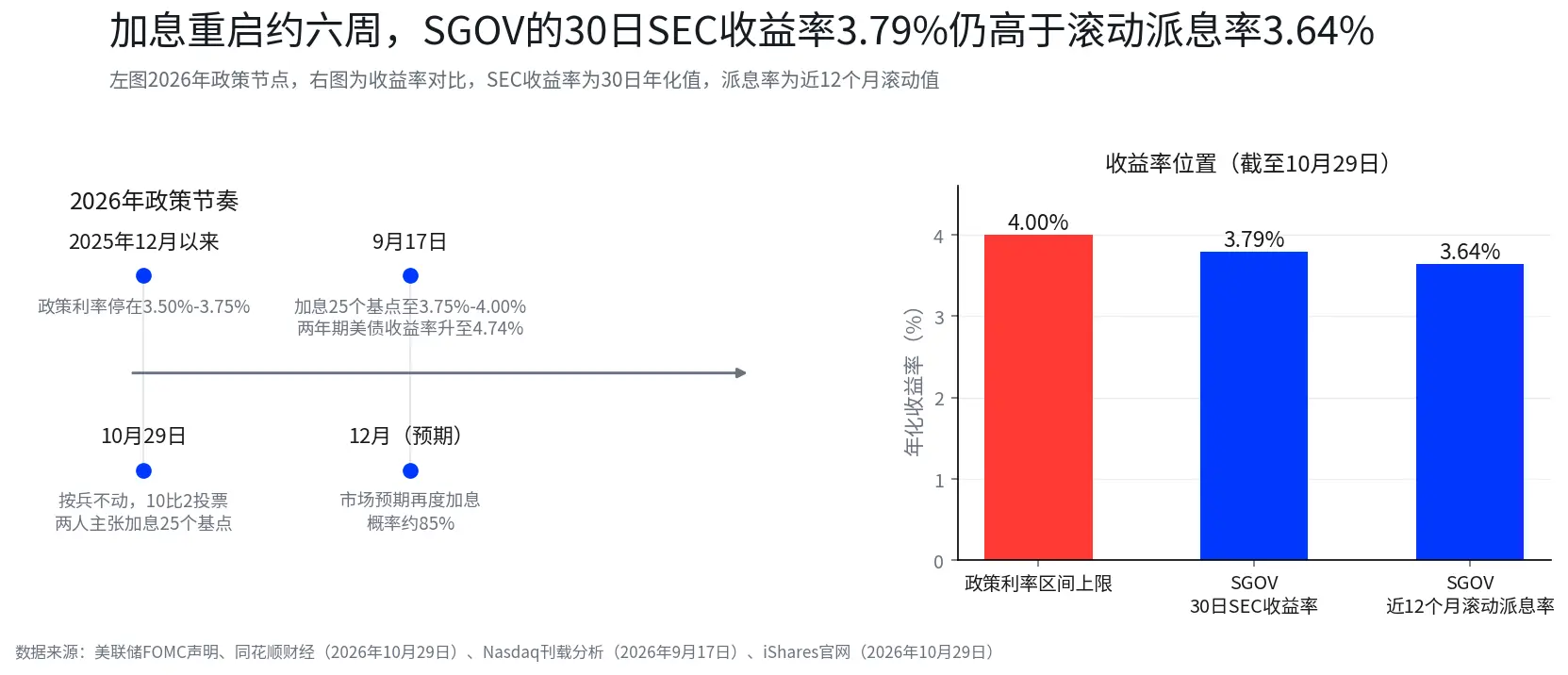
The left chart shows the changes in policy interest rates in 2026. The right chart shows SGOV yield data as of October 29, 2026. The 30-day SEC yield is an annualized indicator, while the rolling dividend yield over the past 12 months is calculated based on the distributions over the past 12 months, and the two calculation standards are different and cannot be directly viewed as the same yield.
For investors, the most important thing to track is whether there are changes in the yield of short-term government bonds and whether these changes are gradually reflected in SGOV's subsequent monthly dividends. The change in net asset value on the day the Federal Reserve announces a rate hike does not directly indicate how much yield the fund can achieve in the future. The yield in the short-end market and actual dividends are more valuable reference indicators.
4. Is a drop in net asset value after monthly dividends a loss?
No. The adjustment in net asset value after dividends is a normal ex-dividend change that occurs when the fund distributes accumulated earnings to holders. During the dividend cycle, the income generated by the underlying bonds is gradually included in the fund's assets. On the distribution date, the fund will distribute the accumulated portion of income in cash to holders, and the fund's net asset value will also be adjusted accordingly. The cash received by investors corresponds to the decrease in net asset value, so if one only looks at the price curve, it is easy to misinterpret the normal ex-dividend as an investment loss.
Taking an annualized yield level of 3.79% as an example, simply dividing by 12 gives a monthly corresponding yield of about 0.32%. This means that if one holds $10,000 in SGOV, roughly calculated at this yield level, the pre-tax monthly yield is about $31.6. After the dividend is credited, the fund's net asset value will be adjusted accordingly, and the value of the fund assets held by the investor will decrease by the same amount as the cash distribution received in the account. It should be noted that this is just a simple calculation to help understand the scale of earnings; the actual dividend amount is determined by the fund based on current portfolio income and distribution arrangements and is not guaranteed to be the same every month.
When evaluating SGOV, BIL, and SHV, one should look at the total return that includes dividends; simply comparing the purchase price and current net asset value can lead to misunderstandings. Total return consists of net asset value changes and dividends, and if one chooses to reinvest dividends, the income generated from reinvestment also needs to be included in the calculation. For products that distribute income monthly, investors can decide whether to continue buying after the dividends are credited. If reinvestment is chosen, subsequent yields will also be affected by market interest rates and purchase prices at the time of reinvestment. The periodic sawtooth changes in the net asset value chart do not indicate that the fund has incurred actual losses every month.
Tax considerations are also a factor to consider before holding. For U.S. tax residents, distributions from short-term government bond ETFs typically need to be reported according to the relevant tax rules, and the specific tax classification and treatment of state and local taxes depend on the fund's annual distribution composition and the investor's location. Non-U.S. tax residents need to assess their own tax status and applicable rules. Therefore, the yield displayed on the product page is a pre-tax indicator, and the actual net yield may vary depending on the investor's tax status.
5. Is it suitable to pay attention to SGOV now? Focus on funding purposes and short-end interest rates
SGOV is suitable for temporarily parking dollars and earning short-term government bond interest, but it is not suitable for locking in interest rates or betting on bond price differences brought by rate cuts.
First, clarify two things: when the money will be used and how high the current yield is. As of October 29, 2026, SGOV's 30-day SEC yield is 3.79%, and the rolling dividend yield over the past 12 months is 3.64%. The 3.79% can be used to observe recent yield levels but is not a fixed return locked in after purchase. Roughly calculated at this annualized rate, $10,000 would yield about $379 pre-tax per year, which will actually vary with short-end interest rates, portfolio income, and fees. If short-end rates remain at current levels, subsequent dividends may stay at similar levels; if rates continue to rise, yields may gradually increase after old bonds mature and are replaced with new ones; if the Federal Reserve shifts to rate cuts, the yield on newly purchased bonds may decrease, and monthly dividends may also gradually decrease.
Compared to common dollar cash instruments, SGOV occupies a different position. Bank time deposits can lock in interest rates for a specified period, but early withdrawals may be restricted, and the interest rates are quoted by banks, which may not keep pace with the short-end market. Money market funds may include short-term government bonds, repurchase agreements, etc., and their yield mechanisms are similar to those of short-term government bond ETFs, but the asset composition, subscription and redemption methods, and risks depend on specific products. Directly holding treasury bills allows one to clearly know the maturity payment amount of a single bond at the time of purchase, and holding until maturity can yield corresponding returns, but one must participate in auctions or secondary market transactions and arrange for reinvestment upon maturity. SGOV entrusts the holding and turnover of a basket of short-term government bonds to fund management, allowing investors to buy and sell in real-time on the exchange without managing each maturity individually; the trade-off is that the net asset value fluctuates with the market, and dividends are not fixed. It provides short-term government bond yields and trading convenience, not a deposit with a locked term and fixed interest rate.
Therefore, from the product characteristics, SGOV's net asset value fluctuations are small, yields fluctuate with short-end interest rates, and it can be traded on the exchange, making it commonly used for dollar cash management. If funds may be used in the next few months or if one wishes to retain higher flexibility, this type of product can be considered as one of the cash management options. However, if funds can be parked long-term and one wants to lock in the current high yield and gain capital appreciation from rising bond prices in the future when rates are cut, longer-duration bond tools need to be considered. SGOV has a very short holding period, and after a rate cut, the principal maturing quickly gets reinvested into lower-yielding new bonds, leading to a decrease in dividends; with a short duration, it is also difficult to achieve significant price increases during a rate-cutting cycle like long-term government bonds.
Three indicators affect the yields of such products. The 30-day SEC yield indicates whether recent portfolio income has started to decline; the actual monthly dividend amount shows whether yield changes have been transmitted to cash distributions; and the yield on 1 to 3-month U.S. treasury bills indicates the direction of short-end market interest rates. If short-end yields continue to decline, the SEC yield and monthly dividends will also fall, necessitating a re-evaluation of SGOV's after-tax yield compared to other cash management tools, as simply looking at the yield on the product page is insufficient.
When should one reassess? If short-end market yields continue to decline and have been reflected in the SEC yield and monthly dividends, it indicates that future cash income may decrease; if the purpose of the funds changes, for example, initially just temporarily parking and later deciding to invest long-term, one must reconsider the duration and yield structure; if SGOV's after-tax yield is significantly less advantageous compared to bank deposits, money market funds, or other cash tools, it is also worth re-evaluating. Regularly checking these indicators is more useful than guessing how the Federal Reserve will decide at each meeting.
Risks must also be clearly stated: if inflation continues to exceed the product's yield, the real return after accounting for inflation may be negative; during certain points of market liquidity stress, the ETF trading price may temporarily fall below net asset value, which may incur additional costs when selling; SGOV is not a bank deposit and does not guarantee principal or fixed returns. Its interest rate risk is usually lower than that of long-term government bond ETFs, but there are still market price, interest rate, liquidity, and tax risks.
Overall, the value of SGOV is to earn income linked to short-term government bond market rates for temporarily idle dollars, not to profit from a round of bond price differences during a rate-cutting cycle. During a rate hike phase, it gradually increases yields through reinvestment; during a rate cut phase, the yield on newly purchased bonds decreases, and dividends will also adjust. Before buying, clarify the purpose of the funds, and during the holding period, assess whether to continue holding based on short-end yields, SEC yields, and actual dividends. What truly deserves attention is not guessing the next Federal Reserve meeting but judging whether the current yield is still worth holding.
Disclaimer: The content of this article is for general information and market commentary only, compiled based on publicly available information as of the time mentioned in the text. Relevant market data, expectations, and probabilities may change with market conditions. The views and investment strategies cited from third-party institutions, analysts, or other individuals only represent those third parties at a specific time and do not represent the views or recommendations of BIT. This article does not constitute investment advice, investment research, solicitation, or recommendation of any securities, investment products, or trading strategies, nor should it be the basis for any investment decisions. Financial markets carry risks, and securities prices and market performance may fluctuate; past performance and historical market trends do not represent or guarantee future results. Investors should independently assess the relevant risks based on their own circumstances and seek professional advice when necessary.
 Risk warning Risk warning