In the past quarter, Tim Cook led Apple to earn 30.7 billion dollars, and the iPhone set a new record again
 Core Viewpoint


 Apple's revenue for the fourth quarter of fiscal year 2026 was $114.477 billion, with a net profit of $30.711 billion, both growing by over 11% year-on-year; the total revenue for the year was $478.8 billion. This is the first financial report since Tim Cook took over as CEO in September, with both iPhone and services businesses reaching historical highs.

Apple CEO John Ternus. Image generated by AI
Written by|Su Yang
Editor|Xu Qingyang
On November 2, local time in the United States, Apple announced its financial performance for the fourth quarter and the full year of fiscal year 2026, ending September 26, 2026. This is also the first financial report released by Apple since Ternus took over as CEO from Cook on September 1.
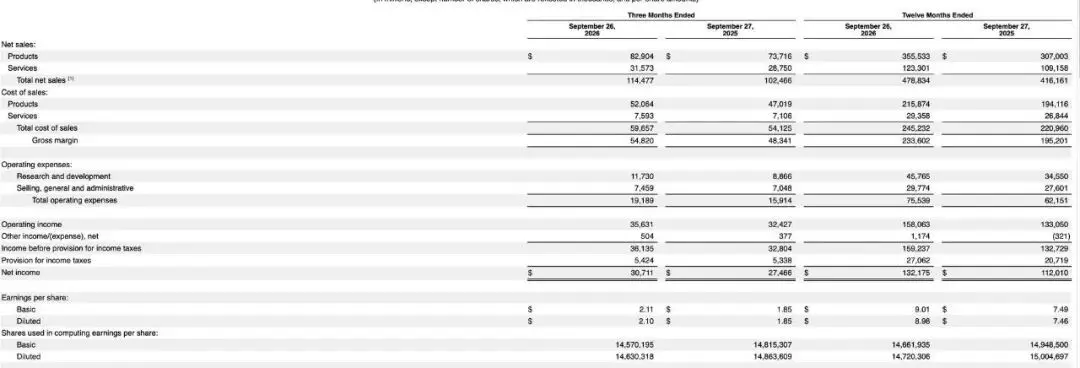
The financial report shows that Apple's revenue for the fourth quarter was $114.477 billion, a year-on-year increase of 11.7%, exceeding Wall Street's expectation of $113.39 billion; net profit was $30.711 billion, a year-on-year increase of 11.8%; diluted earnings per share were $2.10, higher than $1.85 in the same period last year, exceeding Wall Street's expectation of $1.99.
For the entire fiscal year 2026, Apple's revenue was $478.834 billion, a year-on-year increase of 15.1%. Net profit was $132.175 billion, a year-on-year increase of 18%, and diluted earnings per share were $8.98, a year-on-year increase of 20.4%. Both iPhone and service businesses set historical highs, and the company's total annual revenue also set a record.
01 Apple's Cash Flow Remains Abundant
The first financial report after Ternus took over as Apple CEO is a key window for the outside world to observe him.
Apple's gross profit for the fourth quarter was $54.820 billion, with a gross margin of 47.9%; operating profit was $35.631 billion, a year-on-year increase of 9.9%. This quarter's gross margin includes about a 1 percentage point positive impact from tariff refunds, which increased earnings per share by about $0.05.
Research and development expenses for the fourth quarter were $11.730 billion, a year-on-year increase of about 32%; for the entire year, it was $45.765 billion, a 32.5% increase from the previous fiscal year's $34.550 billion.
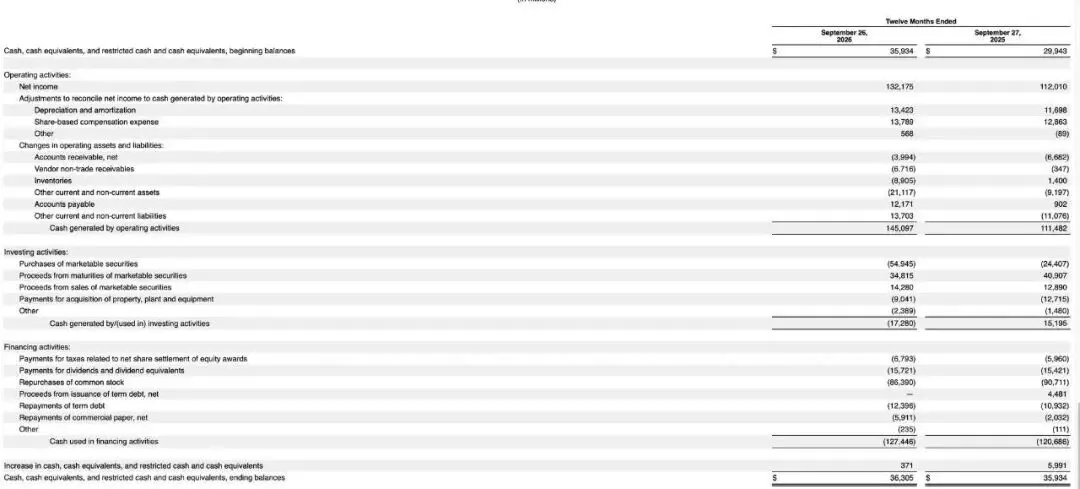
Apple's operating cash flow for fiscal year 2026 was $145.097 billion, a year-on-year increase of about 30% from the previous fiscal year's $111.482 billion. Cash expenditures for fixed asset purchases for the year were $9.041 billion, and calculated by the usual method of operating cash flow minus capital expenditures, free cash flow was about $136.056 billion.
Unlike Apple, Google, Meta, and Amazon's free cash flow is turning negative. The demand for AI computing power continues to grow, and all three companies are significantly increasing their investments in data centers, servers, and chips.
Alphabet's capital expenditures for the third quarter were $51.4 billion, with free cash flow for the quarter being negative $9.1 billion. Amazon's free cash flow over the past 12 months has dropped to negative $42.357 billion; Meta's capital expenditures for the third quarter were $34.91 billion, and free cash flow also turned negative at $2.12 billion.
Apple's capital expenditures for fiscal year 2026 were $9.041 billion, lower than the previous fiscal year's $12.715 billion. Annual R&D expenses were $45.765 billion, a year-on-year increase of 32.5%, and operating cash flow remained above $145 billion.
In fiscal year 2026, Apple's stock buyback expenditure was $86.390 billion, and dividend payments were $15.721 billion, totaling over $102.1 billion. In the fourth quarter, the company's operating cash flow was $28 billion, and the same amount was returned to shareholders.
The difference is that cloud computing giants need to continuously invest hundreds of billions of dollars to build AI data centers, while Apple does not need to bear infrastructure expenditures of the same scale. Its business still relies mainly on hardware sales and service revenue, with a large active device user base providing a continuous cash source for the service business.
02 iPhone Business Remains Bright
The iPhone remains Apple's most important source of revenue and the main driver of growth in the fourth quarter.
In the fourth quarter, iPhone revenue was $57.583 billion, up from $49.025 billion in the same period last year, a year-on-year increase of 17.5%, exceeding analysts' expectations of $56.48 billion. Apple also stated that the active installed base of iPhones has set a new record, with the number of global upgrade users reaching an all-time high.
For the entire fiscal year, iPhone revenue was $254.098 billion, a year-on-year increase of about 21.2%. The iPhone 18 Pro and iPhone 18 Pro Max were launched on September 18, and this fiscal quarter only includes sales revenue for the 9 days after the launch.
Apple's first foldable phone, the iPhone Duo, was released on October 23 and is not included in this quarter's performance. The subsequent sales of the iPhone Duo and the iPhone 18 series will be fully reflected in the next fiscal quarter.
In the fourth quarter, Mac revenue was $10.792 billion, a year-on-year increase of 23.7%, significantly higher than analysts' expectations of $9.69 billion. For the entire fiscal year, Mac revenue was $37.929 billion, a year-on-year increase of 12.5%.
Recently, Apple has successively launched new products such as the MacBook Pro and iMac, and for the first time introduced touch functionality into the Mac product line, which will also bring new growth in the future.
In the fourth quarter, service revenue was $31.573 billion, a year-on-year increase of 9.8%, roughly in line with market expectations. For the entire fiscal year, service revenue was $123.301 billion, a year-on-year increase of 13%, setting a new historical high.
The performance of iPad and wearable devices, on the other hand, was the opposite. In the fourth quarter, iPad revenue was $6.229 billion, a year-on-year decrease of 10.4%, lower than analysts' expectations of about $6.83 billion. Revenue from wearables, home, and accessories was $8.3 billion, a year-on-year decrease of 7.9%, also below market expectations of about $9 billion.
In fiscal year 2026, iPad revenue was $27.929 billion, slightly down from $28.023 billion in the previous fiscal year; revenue from wearables, home, and accessories was $35.577 billion, roughly flat with the previous fiscal year.
The growth this quarter mainly came from iPhone, Mac, and service businesses, while iPad and wearable devices have not yet seen significant growth momentum.
03 Greater China Revenue Below Wall Street Expectations
In the fourth quarter, Apple achieved growth in major markets, with Japan being the exception.
By region, revenue in the Americas was $48.680 billion, a year-on-year increase of 10.2%; revenue in Europe was $32.008 billion, an increase of 11.5%; revenue in other Asia-Pacific regions was $9.710 billion, an increase of 15%. Revenue in Japan was $6.540 billion, a year-on-year decrease of 1.4%. Apple's revenue in Greater China was $17.539 billion, up from $14.493 billion in the same period last year, a year-on-year increase of 21%.
It can be said that Greater China has become an important source of growth for Apple this quarter. However, this figure is still below expectations, as analysts had previously estimated about $18.75 billion, with an actual difference of about $1.2 billion. Therefore, Greater China became the main regional market that did not meet expectations this quarter.
For the entire fiscal year, Apple's revenue in Greater China was $82.378 billion, up from $64.377 billion in the same period last year, a year-on-year increase of about 28%.
For a long time, Apple has faced competition from local smartphone manufacturers in the Chinese market, as well as issues related to the localization of AI features. The performance in the Chinese market not only relates to Apple's revenue but also whether the new generation of AI features can drive users to upgrade their devices. The 21% growth in the fourth quarter is a positive signal, but the lower-than-expected revenue also indicates that Apple still has issues to resolve in this market.
04 How Does Apple Maintain Profit Margins?

In addition to market demand, the rising prices of storage chips are also an unavoidable issue for Apple. The continuous expansion of AI server construction has increased global demand for storage chips, leading to rising prices for memory and storage components, which in turn increases supply chain cost pressures for consumer electronics manufacturers.
Apple's solution is to adjust prices.
The iPhone 18 Pro launched this year starts at $1,199, and the iPhone 18 Pro Max starts at $1,299, both of which are $100 higher than the corresponding models of the previous generation.
Former Apple CEO Cook once said that Apple "reluctantly" raised prices to cope with rising component costs. He described the then-storage chip prices as a "once-in-a-century flood."
Ternus also discussed this matter in an interview after the financial report. He stated that despite global supply chain constraints and unfavorable exchange rate factors, Apple still achieved strong growth, and the previous price adjustments were mainly to offset rising component costs.
The gross margin for the fourth quarter was 47.9%, and for the entire year, it was 48.8%, both maintaining a high level. Among them, tariff refunds contributed about 1 percentage point this quarter. How storage chip costs will trend in the future will still affect Apple's profitability.
In fiscal year 2026, Apple's cash expenditures for fixed asset purchases were $9.041 billion, lower than the previous fiscal year's $12.715 billion. Microsoft and Google are continuously expanding their investments in data centers, making Apple's capital expenditure scale appear limited.
Apple's total R&D investment for the year was $45.765 billion, a year-on-year increase of 32.5%. R&D investment is still increasing, but it has not taken the path of large-scale construction of AI infrastructure.
05 What to Watch Next?
Ternus stated in the financial report that Apple is ending this fiscal year with its most ambitious product lineup to date. This includes the iPhone Duo, as well as the iPhone 18 Pro and iPhone 18 Pro Max; the company has also launched a new generation of home hardware and introduced touch functionality into the Mac for the first time.
He specifically mentioned the brand new Siri AI, emphasizing that this product lineup can help Apple meet the upcoming holiday shopping season— the iPhone Duo launched on October 23, and its sales performance will be fully reflected in the next quarter's financial report; the iPhone 18 series will also complete a full sales cycle.
Numerically, Ternus's first financial report overall shows growth. With annual revenue of $478.8 billion, net profit of $132.2 billion, along with record iPhone and service revenue, Apple continues its growth momentum from recent years.
However, the prices of storage chips, product gross margins, and the localization of AI features in the Chinese market will all affect future performance.
 Risk warning Risk warning