BTC $80,033.62 -1.36%
ETH $2,321.03 -1.45%
BNB $738.89 -2.65%
XRP $1.29 -2.23%
SOL $100.12 -2.19%
TRX $0.3313 -0.10%
DOGE $0.0784 -1.85%
ADA $0.2004 -2.62%
BCH $279.31 -6.25%
LINK $11.59 -0.98%
HYPE $87.43 +7.66%
AAVE $132.58 -1.22%
SUI $0.9211 -1.88%
XLM $0.1695 -0.94%
ZEC $1,269.06 -2.25%
AAPL $348.55 +0.67%
AMZN $249.54 -1.65%
GOOGL $289.02 -11.14%
MSFT $538.85 +1.61%
META $618.33 -0.49%
NVDA $214.28 -2.67%
TSLA $402.82 -2.13%
SNDK $1,363.57 -0.03%
INTC $92.27 -3.39%
SPCX $142.90 -4.30%
MU $955.01 -0.94%
AMD $564.91 -0.88%

a16z

a16z Crypto, as a specialized fund of Andreessen Horowitz (a16z), focuses on investments at various stages of Web3, with assets under management exceeding $7.6 billion to date.
All
Article
Flash

first_img Marc Andreessen: Companies should create habitats for intelligent agents, not confine them in cages

a16z co-founder Marc Andreessen commented on the online programming platform Replit and its CEO Amjad Masad's proposed concept of Agent Habitat, believing that more companies will become autonomous driving companies as a result. He stated that the keyword pointed out by Masad is chaos, and quoted his viewpoint that most agents today operate in chat windows, personal accounts, and one-off scripts, holding credentials and data given to them by others, but no one decides what they can access, nor can anyone see what they have done.Andreessen noted that disruptive technologies like personal computers, spreadsheets, and email entered the workplace in a bottom-up chaotic manner, and only later did they require habitats to moderately constrain that chaos. He cited examples such as early employees bringing personal computers into the office, spreadsheets enabling non-programmers to create business models and forecasts, but also introducing hard-to-audit formula errors; email bypassed the information flow controlled by the mailroom in the past. He believes this kind of chaos indicates that employees are claiming tools that can bring alignment and significant productivity improvements.Andreessen also stated that code is the ultimate product of alignment, and expanding the range of code contributors will bring chaos, thus requiring a free-range style of agent habitat rather than cages, but it cannot be completely laissez-faire. He mentioned that an employee from Sumitomo Mitsui Finance and Leasing completed a development process originally planned to take 6 people 6 months in just one week. He indicated that for companies to become autonomous driving companies, they must achieve alignment, and in the future, the degree of alignment may be measured by the richness of the agent habitat; Replit and its clients have already understood this, while most companies have not yet grasped it.

first_img a16z Weekly Report: Listed GPU rental prices are higher than at the beginning of the year, Netflix's growth rate is about 12%

The venture capital firm a16z released a chart weekly report written by Moses Sternstein on October 23, 2026. The report states that Netflix is still growing, with revenue growth slowing to just below about 12%, the lowest level since 2021 to 2022. The company is producing its own short videos and entering live sports. The report cites BCG data indicating that the upper limit of media consumption in the U.S. is about 26 hours per week, showing a moderate decline since the peak of lockdowns. Moses Sternstein: Competition comes not only from other streaming services but also from short videos, with much of the recent media growth coming from background consumption while driving or working.In terms of computing power, the report cites Ornn Data stating that the rental price of every GPU in the chart series is higher than at the beginning of the year, including the oldest A100, which is about 9% to 143% higher compared to a 6-year straight-line depreciation. Moses Sternstein: Over a longer period, older A100 and H100 GPUs spend more time below that line, but have only shown significant strength since April this year, making comparisons over a longer period not entirely fair. According to OpenRouter, token demand surged sharply in spring, jumped again after a brief plateau at the end of summer, with token consumption for both open-source and closed-source models still following an exponential path, and the share of proprietary models slightly increased last week. The author states that OpenRouter only covers a very small portion, and these indices are not perfect proxies for actual token spending and GPU pricing.In manufacturing, the report states that computer production capacity and utilization rates are rising, with production increases being larger. The increase in communication and semiconductor production mainly comes from expansion, while the price increase for electrical equipment is the largest, but domestic production has slightly declined. The import increase of key categories of AI capital expenditures mentioned above far exceeds the domestic production increase in dollar terms. According to ADP, the increase in average weekly hours for industries related to AI construction is greater than that of other industries, and is generally greater than the net increase in personnel. Job switchers in manufacturing have about a 5 percentage point wage growth premium compared to stayers. Cybersecurity stocks remain strong in IGV this year, but have seen a larger pullback than the market since October. The revenue growth rate of large companies has mostly only increased by a few percentage points, with some experiencing declines, and stock price performance reaching up to about 125%, with Palo Alto Networks' revenue growth largely driven by acquisitions.

first_img Alliance co-founder Imran Khan comments on a16z's transformation: Crypto experience can be transferred to cutting-edge technology

Imran Khan, co-founder of Alliance, expressed his views on a16z crypto's shift towards cutting-edge technology. He stated that he is always grateful to a16z for leading the investment in Coinbase in 2013, which provided external validation for the crypto industry; Marc Andreessen's 2014 article "Why Bitcoin Matters" in The New York Times pushed him to shift his career towards Bitcoin.Imran Khan mentioned that at that time, very few institutions or funds were willing to publicly support crypto, and a16z and USV were two funds that took on brand risk. Since then, a large number of talents have entered and reshaped the crypto industry. He believes that the current infrastructure development in artificial intelligence has a practical connection with Bitcoin mining infrastructure and the talent flowing from crypto to artificial intelligence.He stated that the shift from crypto to cutting-edge technologies such as robotics, biology, artificial intelligence, energy, and computing power means that the talents and capabilities built in crypto over the past decade can be applied to a broader range of fields. He cited the resistance faced by data centers as an example, noting that crypto also faced opposition, but traditional finance has now accepted crypto to a certain extent. He believes that cutting-edge technology is the next generation of technology builders, and the world often recognizes the importance of new technologies many years later.

first_img a16z crypto partner Ali Yahya announced his departure and will establish an AI company

a16z crypto partner Ali Yahya posted on X that he has decided to leave a16z, move to San Francisco, and start a company. He stated that he has been with the company for nearly 10 years, and when he met Chris Dixon, Ben Horowitz, and Marc Andreessen in 2017, he was an engineer at Google Brain working on robotics research, with a strong interest in open source but no knowledge of investing.Ali Yahya mentioned that at that time, Chris Dixon had already laid the groundwork for a16z in the early crypto space by investing in companies like Coinbase, but the company's crypto team consisted of only Chris Dixon, and he hoped to expand the team. Chris Dixon invited him to leave Google to help build the company's crypto business. He expressed that forming the team together and supporting founders' work has been the most meaningful experience of his life, and he thanked Chris, Ben, Marc, and the team.Regarding his entrepreneurial direction, Ali Yahya stated that he is still in the early stages and is most focused on infrastructure that can support an open software ecosystem. He made two observations: current AI is mostly a technology for individual use, but in the future, it will shift towards collaboration among multiple people and multiple intelligent agents, potentially leading to large-scale open networks; the cost of software development has significantly decreased, allowing for on-demand generation and disposal after single use, which will change the software stack and may give rise to new operating systems mediated by AI and an AI-native developer ecosystem. He invited those working in related fields, especially those in the Bay Area, to communicate with him.

a16z crypto has been renamed a16z Frontier, with its investment scope expanded to frontier technology

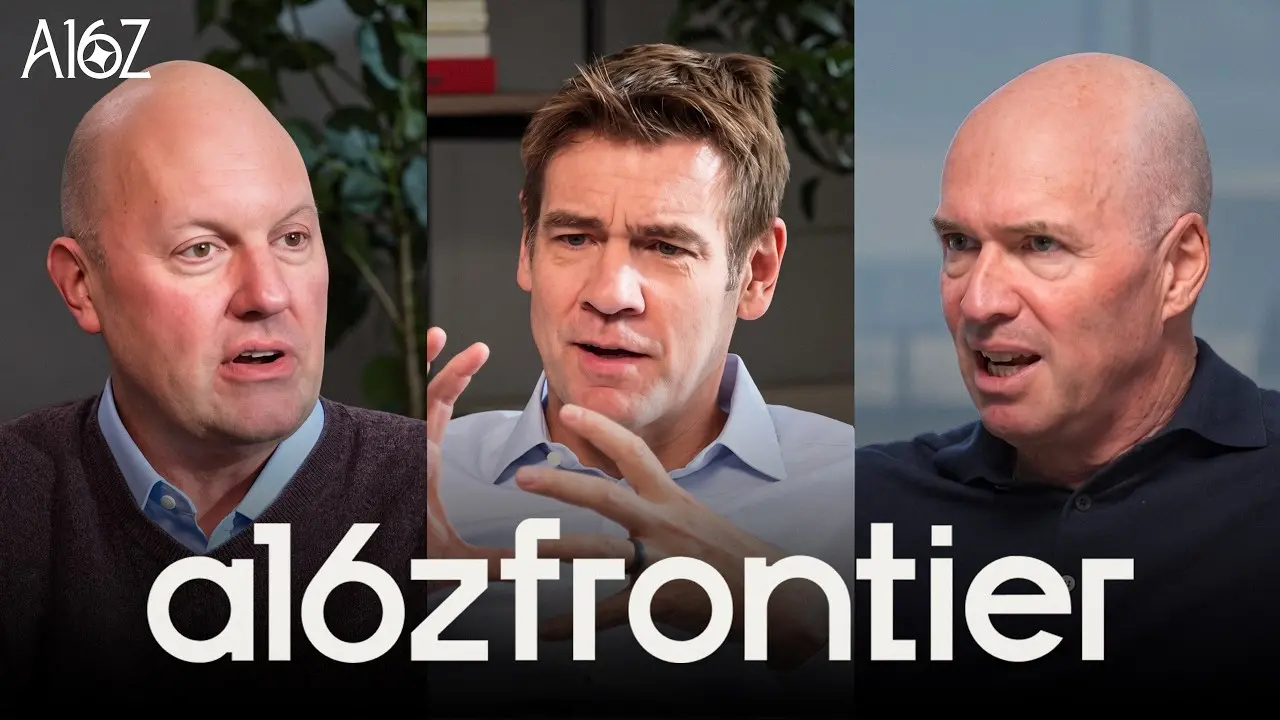
On October 23, a16z General Partner Chris Dixon announced that a16z crypto would be renamed a16z Frontier. The investment scope has expanded from crypto startups to a broader category of frontier technology startups, which are companies that create new technologies, open new markets, and may take years to mature. Dixon emphasized that this adjustment is an expansion of scope rather than a shift in direction, and the team will continue to invest in crypto and related businesses while advocating for reasonable crypto regulation.Dixon stated that as blockchain becomes more widely adopted, Wall Street and fintech companies have normalized the launch of on-chain products, and the importance of the "crypto company" label has diminished; companies should be defined by their business rather than the technology they use. His explanation also pointed to the AI wave, which not only focuses on using AI to perform existing tasks faster and better but also emphasizes the emergence of new native use cases, full-stack entrepreneurship that integrates software and hardware with services, and new networks that connect people with intelligent agents.Dixon believes that blockchain will continue to play an important role, providing the internet with a fast, cheap, global, and programmable funding track. Stablecoins are becoming standard tools for fintech and institutions, and they can also support machine-to-machine transactions and the cold start of new networks. The fund will be co-led by Dixon along with a16z founders Marc Andreessen, Ben Horowitz, and General Partners Eddy Lazzarin and Guy Wuollet, while the operating team will continue to serve existing and future portfolio companies in areas such as regulation, market entry, talent, marketing, and technology development.

first_img a16z General Partner David Haber: Long-cycle intelligent agents can charge based on results

David Haber, a general partner at a16z, stated that long-cycle intelligent agents can now progress towards goals across dozens of steps and various interaction methods over weeks to months. He noted that AI previously handled short tasks with clear boundaries, where customer service was implemented earlier due to verifiable results and edge cases manageable by humans; now, intelligent agents can guide insurance clients from the initial call to payout, mortgage clients from pre-approval to closing, and business leads from demonstration to signing, gaining returns based on revenue growth rather than just cost savings.He used the example of plaintiff lawyers preparing cases, stating that the process resembles a relay race, where value can easily be lost at handoff points. Potential clients often contact multiple law firms simultaneously, and slow responses or evaluations can lead to loss; after signing, evidence collection is limited by manpower, and firms may not follow up with witnesses who did not answer the fifth call, making it difficult to review low-value cases item by item. Missing bills or unexplained treatment gaps can also lower settlement amounts. Long-cycle intelligent agents can assess in real-time around the clock, utilizing sub-agents to advance evidence collection and client updates via phone, email, or text, while maintaining complete records from call logs to medical records.Haber proposed three commercialization paths: selling platforms to existing teams, taking over outsourced services, or vertically integrating as a full-stack service provider, such as purchasing debt portfolios and completing collections. He mentioned that most states in the U.S. prohibit non-lawyers from sharing attorney fees, so the plaintiff legal scenario needs to align pricing with settlement amounts but cannot directly share profits.


app_icon
ChainCatcher Building the Web3 world with innovations.